홈MCP워크벤치Skills
홈워크벤치알림마이페이지
llms.txt · MCP 가이드개인정보처리방침 · 이용약관 · 지원v1.8.0
  1. 홈
  2. /화합물

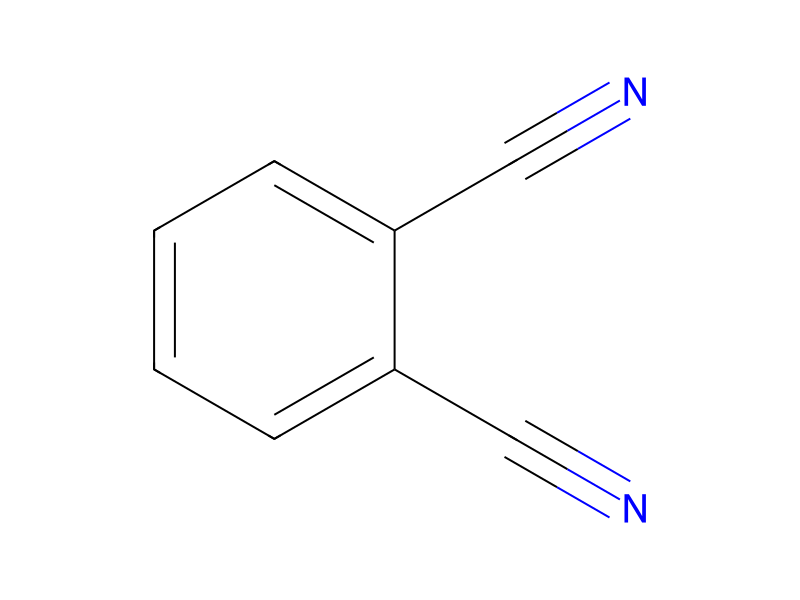
1,2-벤젠다이카보나이트릴

Phthalonitrile

HCID 7042
새 노트새 반응견적 요청하기
인쇄 미리보기

데이터를 보충하는 중입니다. 잠시 후 페이지를 새로 고치면 최신 내용을 볼 수 있습니다
기본 정보개요이름 및 식별자물성안전 및 규제화학 및 산업관련 반응화합물 노트
부분 구조 검색유사 구조 찾기

기본 정보

CAS
91-15-6
표준 SMILES
N#Cc1ccccc1C#N
InChIKey
XQZYPMVTSDWCCE-UHFFFAOYSA-N
분자식
C8H4N2
평균 분자량
128.13 g/mol
단동위원소 질량
128.03744813

개요

Phthalonitrile is a dinitrile that is benzene which is substituted by cyano groups at positions 1 and 2. It is a member of benzenes and a dinitrile.

이름 및 식별자

우선 이름
Phthalonitrile
IUPAC
benzene-1,2-dicarbonitrile
현지명
1,2-벤젠다이카보나이트릴
영어명
Phthalonitrile
분자식
C8H4N2
분자량
128.13

이름 및 동의어

Phthalonitrile1,2-Dicyanobenzene91-15-61,2-BENZENEDICARBONITRILEo-Phthalodinitrilebenzene-1,2-dicarbonitrileo-Dicyanobenzeneo-Cyanobenzonitrileo-Benzenedinitrileo-Pdno-BenzenedicarbonitrilePhthalic acid dinitrile
이름 더 보기
1,2-벤젠다이카보나이트릴o-프탈로디니트릴오쏘-프탈로다이나이트릴1,2-다이사이아노벤젠1,2-벤젠디카르보나이트릴1,2-벤조디나이트릴1,2-비스(사이아노)벤젠오쏘-다이사이아노벤젠오쏘-벤젠디나이트릴오쏘-벤젠디카르보나이트릴오쏘-사이아노벤조나이트릴프탈로니트릴PhthalodinitrilPHTHALODINITRILEO-PHTHALONITRILEC8H4N2o-pdn[qr]usafnd-09
USAF ND-09FtalodinitrilFtalonitril1,2-Benzendikarbonitrilortho-DicyanobenzeneDTXSID8029604978627YAJUNSC-17562

데이터베이스 식별자

CAS
91-15-6
PubChem CID
7042
DTXSID
DTXSID8029604
ChEMBL
CHEMBL3185350
ChEBI
CHEBI:232056
UNII
978627YAJU
EC Number
202-044-8
Nikkaji
J3.921G

물성

구조 계산 물성보충 중

XLogP
1
극성 표면적
47.6 Ų
수소 결합 공여자 수
0
수소 결합 수용자 수
2
회전 가능 결합 수
0
무거운 원자 수
10
형식 전하
0
복잡도
178

실험 및 물리화학적 성질

Chemical ClassesNitrogen Compounds -> Nitriles
SpringerMaterials PropertiesSchoenflies notation
LogP · 3건

log Kow = 0.99

0.58

0.99

OdorSlightly aromatic
Density · 2건

1.238 g/cu cm

1.24 g/cm³

Color/Form · 3건

NEEDLES FROM WATER OR PETROLEUM ETHER

Buff-colored crystals

Faint grayish yellow

Solubility · 4건

Soluble in alcohol and ether

Soluble in acetone and benzene.

In water, 395 mg/l @ 25 °C.

Solubility in water, g/100ml at 25 °C: 0.06

Flash Point · 2건

162 °C

162 °C

Boiling Point304.5 °C
DecompositionWhen heated to decomposition it emits toxic fumes of CN- and NOx /cyanides and nitrogen oxides/.

안전 및 규제

안전 정보는 참고용이며, 공급업체의 물질안전보건자료(SDS), 관련 법규 및 전문가 평가를 대체하지 않습니다.

GHS 분류

GHS Classification · 6건

Danger

H300 (28.4%): Fatal if swallowed [Danger Acute toxicity, oral]

P261, P262, P264, P270, P271, P273, P280, P301+P316, P302+P352, P304+P340, P316, P321, P330, P361+P364, P403+P233, P405, and P501 (click each P-code to see the statement)

Aggregated GHS information provided per 162 reports by companies from 11 notifications to the ECHA C&L Inventory. Each notification may be associated with multiple companies.

Danger

H301: Toxic if swallowed [Danger Acute toxicity, oral]

유해성 정보

Regulatory Information · 2건

Status: Active Update: 31-01-2022 https://echa.europa.eu/registration-dossier/-/registered-dossier/1983

Phthalonitrile: Does not have an individual approval but may be used under an appropriate group standard

Fire HazardsCombustible. Gives off irritating or toxic fumes (or gases) in a fire. Finely dispersed particles form explosive mixtures in air.
Hazards Summary · 1건

Inhalation of high concentrations may cause CNS effects; [ICSC] Emergency treatment: Benzyl cyanide; [HSDB] Lethal doses cause tremor and convulsions in rats; [RTECS] TLV Basis = convulsions and decreased body weight; Unlike the aliphatic nitriles, aromatic nitriles such as m-phthalodinitrile do not liberate cyanide in the body. [ACGIH] An acute neurotoxin; Not irritating to skin or eyes; [Reference #1] See m-Phthalodinitrile. See NITRILES.

UN ClassificationUN Hazard Class: 6.1; UN Pack Group: III
Chemical DangersDecomposes on heating. This produces toxic fumes including cyanide. On combustion, forms nitrogen oxides. Reacts with strong oxidants.
Packaging and LabellingDo not transport with food and feedstuffs.

화학 및 산업

약리 정보

Mechanism of Action... systemic cyanide poisoning is suspected.
Metabolism/Metabolites · 1건

Organic nitriles are converted into cyanide ions through the action of cytochrome P450 enzymes in the liver. Cyanide is rapidly absorbed and distributed throughout the body. Cyanide is mainly metabolized into thiocyanate by either rhodanese or 3-mercaptopyruvate sulfur transferase. Cyanide metabolites are excreted in the urine. (L96)

용도 및 제조

Uses · 6건

Used as an intermediate mainly for the production of phthalocyanine dyes; Also used in sintering metals; [ACGIH]

Metal Extraction and Refining [Category: Industry]

Intermediate in organic synthesis, (esp pigments and dyes), base material for high temp lubricants and coatings

Insecticide, synergist /Former/

Used as a starting material for producing phthalocyanine pigments, fluorescent brighteners and photographic sensitizers.

Phthalonitrile is used as a precursor to phthalocyanine pigments (which are precursors to the blue dye in jeans), fluorescent brighteners, and photographic sensitizers. (L611)

Methods of Manufacturing · 2건

Vapor phase reaction of ammonia and phthalic anhydride over alumina catalyst @ high temp.

Produced commercially from o-xylene by ammoxidation; produced commercially from phthalic acid, phthalic anhydride, phthalamide or phthalimide by reaction with ammonia and elimination of water @ 300-500 °C in gas-phase with catalyst.

General Manufacturing Information · 2건

1,2-Benzenedicarbonitrile: ACTIVE

HIGHLY TOXIC STOMACH POISON FOR CATERPILLARS & DIPTEROUS LARVAE.

응용 분야 · 1건

용도Phthalonitrile is used as an intermediate for chemical synthesis in the production of building blocks for colorants and coatings, life science and agricultural chemicals. It is also used as a precursor to phthalocyanine pigments (which are precursors to the blue dye in jeans), fluorescent brighteners, and photographic sensitizers.

관련 반응

108건
반응 기록 만들기
HRID 128845 반응식
HRID 128845생성물로uspto-grants-1995_11
HRID 128846 반응식
HRID 128846생성물로uspto-grants-1995_11
HRID 128847 반응식
HRID 128847생성물로uspto-grants-1995_11
HRID 128848 반응식
HRID 128848생성물로uspto-grants-1995_11
HRID 128849 반응식
HRID 128849생성물로uspto-grants-1995_11
HRID 128850 반응식
HRID 128850생성물로uspto-grants-1995_11
HRID 128851 반응식
HRID 128851생성물로uspto-grants-1995_11
HRID 240205 반응식
HRID 240205생성물로uspto-grants-2014_02
1 / 14 페이지

화합물 노트

불러오는 중…

이 페이지에서기본 정보개요이름 및 식별자물성안전 및 규제화학 및 산업관련 반응화합물 노트
더보기
새 노트새 반응견적 요청하기
Melting Point · 2건

138 °C

141 °C

Vapor Pressure · 3건

0.00569 [mmHg]

0.05 millibar @ 20 °C (3.75X10⁻² mm Hg)

Vapor pressure, Pa at 20 °C: 4

물리화학적 성질

녹는점
137 · 137-139 °C (lit.)
끓는 점
227.54 °C · 227.54°C (rough estimate)
밀도
1.24 · 1.24
증기압
1 Pa · <1 Pa (25 °C)
굴절률
1.6231 · 1.6231 (estimate)
인화점
162 °C · 162°C
저장 조건
30 °C · Store below +30°C.
용해도
50 mg/mL, · 벤젠: 50mg/mL, 투명
물리적 상태
결정 또는 결정성 분말
색상
흰색에서 베이지색
수소이온지수(pH)
7 · 7 (H2O)
수용성
0.56 g/L · 0.56g/L(25℃)
BRN
775028 · 775028
Henry's Law Constant
2 · 2.0×101 mol/(m3Pa) at 25℃, HSDB (2015)
안정성
안정적인. 강염기, 강산, 강산화제, 강환원제와 호환되지 않습니다.
InChI
1S/C8H4N2/c9-5-7-3-1-2-4-8(7)6-10/h1-4H
InChIKey
XQZYPMVTSDWCCE-UHFFFAOYSA-N
SMILES
N#Cc1ccccc1C#N
NIST
Phthalonitrile(91-15-6)
EPA
1 · 1,2-Benzenedicarbonitrile (91-15-6)
화학적 성질 · 1건

Phthalonitrile is a crystalline powder having a faint grayish yellow color and a slighty aromatic odor, similar to benzonitrile. Phthalonitrile was first described in 1896 when it was isolated during the diazotization of 2-aminobenzonitrile. The compound is sparingly soluble in water (ca. 1 g/L) and soluble in acetone, nitrobenzene, and benzonitrile. It cannot be distilled and polymerizes if heated above the melting point. It is not explosive and is difficult to ignite, but the dust can explode.

Toxic Combustion ProductsWhen heated to decomposition it emits toxic fumes of hydrogen cyanide and NOx /cyanides and nitrogen oxides/.
Hazard Classes and Categories · 3건

Acute Tox. 2 (28.4%)

Acute toxicity (Oral) - Category 3

Acute toxicity (Oral) - Category 3

안전 및 보호

Fire FightingUse dry powder, carbon dioxide, foam.
First Aid Measures · 4건

Fresh air, rest. Refer for medical attention.

Rinse skin with plenty of water or shower.

First rinse with plenty of water for several minutes (remove contact lenses if easily possible), then refer for medical attention.

Rinse mouth. Induce vomiting (ONLY IN CONSCIOUS PERSONS!). Give a slurry of activated charcoal in water to drink. Refer for medical attention .

Safe StorageSeparated from strong oxidants and food and feedstuffs.
Disposal Methods · 1건

SRP: At the time of review, criteria for land treatment or burial (sanitary landfill) disposal practices are subject to significant revision. Prior to implementing land disposal of waste residue (including waste sludge), consult with environmental regulatory agencies for guidance on acceptable disposal practices.

Spillage Disposal · 1건

Personal protection: particulate filter respirator adapted to the airborne concentration of the substance. Do NOT let this chemical enter the environment. Sweep spilled substance into covered containers. Carefully collect remainder. Then store and dispose of according to local regulations.

Eye PreventionWear safety goggles.
Fire PreventionNO open flames. Closed system, dust explosion-proof electrical equipment and lighting. Prevent deposition of dust.
Inhalation RiskA harmful concentration of airborne particles can be reached quickly when dispersed.
Skin PreventionProtective gloves.
Exposure PreventionPREVENT DISPERSION OF DUST!
Ingestion PreventionDo not eat, drink, or smoke during work.
Inhalation PreventionUse local exhaust or breathing protection.

독성 정보

Treatment · 1건

Antidotes to cyanide poisoning include hydroxocobalamin and sodium nitrite, which release the cyanide from the cytochrome system, and rhodanase, which is an enzyme occurring naturally in mammals that combines serum cyanide with thiosulfate, producing comparatively harmless thiocyanate. Oxygen therapy can also be administered. (L97)

Health Effects · 1건

Exposure to high levels of cyanide for a short time harms the brain and heart and can even cause coma, seizures, apnea, cardiac arrest and death. Chronic inhalation of cyanide causes breathing difficulties, chest pain, vomiting, blood changes, headaches, and enlargement of the thyroid gland. Skin contact with cyanide salts can irritate and produce sores. (L96, L97)

Environmental Fate · 3건

TERRESTRIAL FATE: Based on a classification scheme(1), an estimated Koc value of 82(SRC), determined from a log Kow of 0.99(2) and a regression-derived equation(3), indicates that 1,2-benzenedicarbonitrile is expected to have high mobility in soil(SRC). Volatilization of 1,2-benzenedicarbonitrile from moist soil surfaces is not expected to be an important fate process(SRC) given an estimated Henry's Law constant of 5.0X10⁻⁷ atm-cu m/mole(SRC), using a fragment constant estimation method(4). 1,2-Benzenedicarbonitrile is not expected to volatilize from dry soil surfaces(SRC) based upon a vapor pressure of 3.75X10⁻² mm Hg(5).

AQUATIC FATE: Based on a classification scheme(1), an estimated Koc value of 82(SRC), determined from a log Kow of 0.99(2) and a regression-derived equation(3), indicates that 1,2-benzenedicarbonitrile is not expected to adsorb to suspended solids and sediment(SRC). Volatilization from water surfaces is not expected(3) based upon an estimated Henry's Law constant of 5.0X10⁻⁷ atm-cu m/mole(SRC), developed using a fragment constant estimation method(4). According to a classification scheme(5), a range of BCF values of 0.8 to <5.5 for carp(6), suggests the potential for bioconcentration in aquatic organisms is low(SRC).

ATMOSPHERIC FATE: According to a model of gas/particle partitioning of semivolatile organic compounds in the atmosphere(1), 1,2-benzenedicarbonitrile, which has a vapor pressure of 3.75X10⁻² mm Hg at 25 °C(2), is expected to exist solely as a vapor in the ambient atmosphere(SRC). Vapor-phase 1,2-benzenedicarbonitrile is degraded in the atmosphere by reaction with photochemically-produced hydroxyl radicals(SRC); the half-life for this reaction in air is estimated to be 356 days(SRC), calculated from its rate constant of 4.5X10⁻¹⁴ cu cm/molecule-sec at 25 °C(SRC) determined using a structure estimation method(3).

Adverse EffectsNeurotoxin - Other CNS neurotoxin
Exposure Routes · 2건

The substance can be absorbed into the body by inhalation and by ingestion.

Oral (L96) ; inhalation (L96) ; dermal (L96)

Toxicity Summary · 1건

Organic nitriles decompose into cyanide ions both in vivo and in vitro. Consequently the primary mechanism of toxicity for organic nitriles is their production of toxic cyanide ions or hydrogen cyanide. Cyanide is an inhibitor of cytochrome c oxidase in the fourth complex of the electron transport chain (found in the membrane of the mitochondria of eukaryotic cells). It complexes with the ferric iron atom in this enzyme. The binding of cyanide to this cytochrome prevents transport of electrons from cytochrome c oxidase to oxygen. As a result, the electron transport chain is disrupted and the cell can no longer aerobically produce ATP for energy. Tissues that mainly depend on aerobic respiration, such as the central nervous system and the heart, are particularly affected. Cyanide is also known produce some of its toxic effects by binding to catalase, glutathione peroxidase, methemoglobin, hydroxocobalamin, phosphatase, tyrosinase, ascorbic acid oxidase, xanthine oxidase, succinic dehydrogenase, and Cu/Zn superoxide dismutase. Cyanide binds to the ferric ion of methemoglobin to form inactive cyanmethemoglobin. (L97)

Signs and Symptoms · 3건

Dizziness. Headache. Nausea. Vomiting. Convulsions. Unconsciousness.

Dizziness. Headache. Nausea. Vomiting. Convulsions. Unconsciousness.

Cyanide poisoning is identified by rapid, deep breathing and shortness of breath, general weakness, giddiness, headaches, vertigo, confusion, convulsions/seizures and eventually loss of consciousness. (L96, L97)

ICSC Environmental DataThe substance is harmful to aquatic organisms. This substance does enter the environment under normal use. Great care, however, should be taken to avoid any additional release, for example through inappropriate disposal.
Soil Adsorption/Mobility · 1건

The Koc of 1,2-benzenedicarbonitrile is estimated as 82(SRC), using a measured log Kow of 0.99(1) and a regression-derived equation(2). According to a classification scheme(3), this estimated Koc value suggests that 1,2-benzenedicarbonitrile is expected to have high mobility in soil(SRC).

Human Toxicity Excerpts · 3건

COMPARISON OF 20 WORKERS (AGE 32-62) WITH POSSIBLE EXPOSURE FOR 2-24 YR, FROM WHICH 7 SUFFERED ACUTE POISONING IN 1953-66, WITH CORRESPONDING CONTROL GROUP SHOWED NO SIGNIFICANT DIFFERENCES IN CHROMOSOMES.

MORTALITY RATE OF 221 EXPOSED WORKERS WAS INSIGNIFICANTLY GREATER THAN THAT OF INTERNAL OR EXTERNAL CONTROL GROUPS.

NO EVIDENCE FOR CHRONIC TOXICITY OF PHTHALONITRILE WAS FOUND. EXAM OF EXPOSED WORKERS FOR LEUKOSIS OR CARCINOGENIC EFFECTS, CLINICAL & NEUROLOGICAL EXAM OF 81 EXPOSED WORKERS, EEG STUDIES OF WORKERS GAVE RESULTS WITHIN NORMAL LIMITS.

Artificial Pollution Sources · 1건

1,2-Benzenedicarbonitrile's production and use as an intermediate in organic synthesis (esp, pigments and dyes) and as a base material for high temperature lubricants and coatings(1) may result in its release to the environment through various waste streams(SRC).

Carcinogen ClassificationNo indication of carcinogenicity to humans (not listed by IARC).

안전 데이터

wgk
1
tsca
TSCA listed
rtecs
TI8575000
ridadr
UN 3439 6.1/PG 2
독성
LD50 orally in Rabbit: 85 mg/kg
HS 번호
29269095
risk_code
25-23/24/25
hazard_code
T
safety_code
36/37/39-45-28A
포장분류
II
위험 등급
6.1
기존화학 물질
KE-02184
자연 발화 온도
>580 °C
Hazard Classifications
Acute Tox. 3 OralAquatic Chronic 3
스토리지 클래스
6.1A - Combustible acute toxic Cat. 1 and 2very toxic hazardous materials
유해 물질 데이터
91-15-6(Hazardous Substances Data)
제조 방법 · 1건

Phthalonitrile can be produced from phthalic acid, phthalic anhydride, phthalamide, or phthalimide by reaction with ammonia and elimination of water at 300–500°C in the gas phase in the presence of a catalyst. In a single-stage continuous process, o-xylene is converted to phthalonitrile by reaction with ammonia and oxygen in the gas phase in a fluidized-bed reactor. Generally, metal oxide mixtures containing vanadium, antimony, chromium, and molybdenum, with further active components such as iron, tungsten, and alkali-metal oxides, on an alumina or silica support are used as catalysts.

상·하류 제품 정보

상류 원료

프탈이미드o-자일렌포스포러스옥시클로라이드프탈 산

하류 제품

1,3-디(2,4,6-트리옥소헥사히드로-5-피리미딘일리덴)아이소인돌붕소서브프탈로시아닌염화물Benzonitrile, 2,2',2''-(1,3,5-triazine-2,4,6-triyl)tris-2-(1,1-디메틸에틸)벤조니트릴2-에틸벤존니트릴프탈로시아닌백금4-(4-피리딜메틸)-1(2H)-프탈라지논MAGNESIUM PHTHALOCYANINE팔라듐프탈로시아닌프탈아미드바탈라닙베이스