3-Pyridinecarboxaldehyde, 2-amino-
데이터를 보충하는 중입니다. 잠시 후 페이지를 새로 고치면 최신 내용을 볼 수 있습니다
기본 정보
- CAS
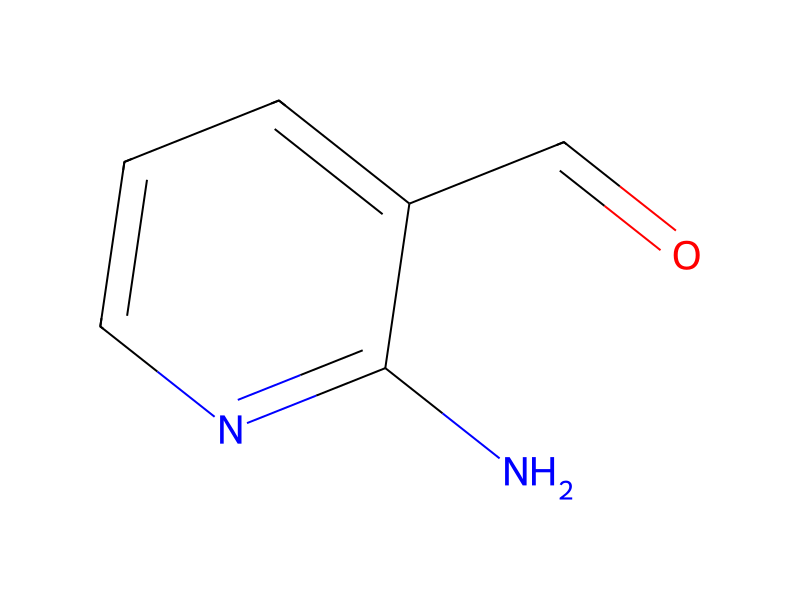
7521-41-7- 표준 SMILES
Nc1ncccc1C=O- InChIKey
NXMFJCRMSDRXLD-UHFFFAOYSA-N- 분자식
- C6H6N2O
- 평균 분자량
- 122.12 g/mol
- 단동위원소 질량
- 122.04801282
이름 및 식별자
- 우선 이름
- 3-Pyridinecarboxaldehyde, 2-amino-
- IUPAC
- 2-aminopyridine-3-carbaldehyde
- 영어명
- 2-Amino-3-pyridinecarboxaldehyde
- 분자식
- C6H6N2O
- 분자량
- 122.12
이름 및 동의어
7521-41-72-Amino-3-pyridinecarboxaldehyde3-Pyridinecarboxaldehyde, 2-amino-DTXSID20226184RefChem:95394DTXCID20148675NXMFJCRMSDRXLD-UHFFFAOYSA-N2-Aminonicotinaldehyde2-aminopyridine-3-carbaldehyde2-Amino-3-formylpyridine2-Aminopyridine-3-carboxaldehyde2-amino-pyridine-3-carbaldehyde
이름 더 보기
3-formylpyridin-2-amine2-aminonicotinaldehyde 12-Aminonicotinaldehyde 99%2-Aminonicotinaldehyde >2-Aminopyridine-3-carboxaL2-AMINO-PYRIDIN-3-CARBALDEHYDE
MFCD018303822-Amino-3-pyridine carboxaldehyde2-amino nicotinaldehyde2-amino-3 formylpyridine2-amino-3-formyl-pyridineSCHEMBL120361orb2940100SCHEMBL5394033
데이터베이스 식별자
- CAS
7521-41-7- PubChem CID
- 737633
- DTXSID
DTXSID20226184- EC Number
- 626-730-5
- Nikkaji
- J886.528K
물성
구조 계산 물성보충 중
- XLogP
- 0.5
- 극성 표면적
- 56 Ų
- 수소 결합 공여자 수
- 1
- 수소 결합 수용자 수
- 3
- 회전 가능 결합 수
- 1
- 무거운 원자 수
- 9
- 형식 전하
- 0
- 복잡도
- 105
물리화학적 성질
- 녹는점
- 98 · 98-102 °C (lit.)
- 끓는 점
- 290.7 · 290.7±25.0 °C(Predicted)
- 밀도
- 1.264 · 1.264±0.06 g/cm3(Predicted)
- 인화점
- 300 ℃ · >300℃
- 저장 조건
- Keep in dark place,Sealed in dry,Room Temperature
- 용해도
- 클로로포름(약간 용해됨), 메탄올(약간 용해됨)
- 산도 계수 (pKa)
- 4.99 · 4.99±0.36(Predicted)
- 물리적 상태
- 분말, 결정 및/또는 덩어리
- 색상
- 노란색에서 밝은 갈색까지
- 수용성
- 불용성
- BRN
- 109598 · 109598
- InChI
- InChI=1S/C6H6N2O/c7-6-5(4-9)2-1-3-8-6/h1-4H,(H2,7,8)
- InChIKey
- NXMFJCRMSDRXLD-UHFFFAOYSA-N
- SMILES
- C1(N)=NC=CC=C1C=O
화학적 성질
yellow crystals
안전 및 규제
안전 정보는 참고용이며, 공급업체의 물질안전보건자료(SDS), 관련 법규 및 전문가 평가를 대체하지 않습니다.
GHS 분류
GHS Classification
Warning
H315 (100%): Causes skin irritation [Warning Skin corrosion/irritation];H319 (100%): Causes serious eye irritation [Warning Serious eye damage/eye irritation];H335 (98%): May cause respiratory irritation [Warning Specific target organ toxicity, single exposure; Respiratory tract irritation]
P261, P264, P264+P265, P271, P280, P302+P352, P304+P340, P305+P351+P338, P319, P321, P332+P317, P337+P317, P362+P364, P403+P233, P405, and P501 (click each P-code to see the statement)
Aggregated GHS information provided per 50 reports by companies from 10 notifications to the ECHA C&L Inventory. Each notification may be associated with multiple companies.;Information may vary between notifications depending on impurities, additives, and other factors. The percentage value in parenthesis indicates the notified classification ratio from companies that provide hazard codes. Only hazard codes with percentage values above 10% are shown. For more detailed information, please visit ECHA C&L website.
유해성 정보
Hazard Classes and CategoriesSkin Irrit. 2 (100%);Eye Irrit. 2 (100%);STOT SE 3 (98%)
안전 데이터
- wgk
- 3
- HS 번호
- 29339900
- risk_code
- 36/37/38-20/21/22
- hazard_code
- Xi,Xn
- safety_code
- 26-36-36/37/39
- 포장분류
- II
- 위험 등급
- IRRITANT
- Hazard Classifications
- Eye Irrit. 2Skin Irrit. 2STOT SE 3
- 스토리지 클래스
- 11 - Combustible Solids
화학 및 산업
제조 방법
Preparative Methods of 2-Amino-3-pyridinecarboxaldehyde: the reagent is best when freshly prepared. A multistep procedure starting from 2-amino-3- picoline has been improved upon by a simple two-step approach. Sulfamation of nicotinamide with ammonium sulfamate (both commercially available) provides 2-(3′-pyridyl)pyrido[2,3-d]pyridimine which may be hydrolyzed in 2 N HCl to provide the reagent (eq 1)[1]. Substituted derivatives of the reagent may be prepared via a similar intermediate.
상·하류 제품 정보
상류 원료
하류 제품
관련 반응
121건


화합물 노트
불러오는 중…