
테레프타로일 크로라이드
Terephthaloyl chloride
데이터를 보충하는 중입니다. 잠시 후 페이지를 새로 고치면 최신 내용을 볼 수 있습니다

기본 정보
- CAS
100-20-9- 표준 SMILES
O=C(Cl)c1ccc(C(=O)Cl)cc1- InChIKey
LXEJRKJRKIFVNY-UHFFFAOYSA-N- 분자식
- C8H4Cl2O2
- 평균 분자량
- 203.02 g/mol
- 단동위원소 질량
- 201.95883473
개요
cross-links albumin
이름 및 식별자
- 우선 이름
- Terephthaloyl chloride
- IUPAC
- benzene-1,4-dicarbonyl chloride
- 현지명
- 테레프타로일 크로라이드
- 영어명
- Terephthaloyl chloride
- 분자식
- C8H4Cl2O2
- 분자량
- 203.02
이름 및 동의어
Terephthaloyl chloride100-20-9Terephthaloyl dichloride1,4-BENZENEDICARBONYL DICHLORIDEp-Phthaloyl chlorideTerephthalic acid dichlorideTerephthalic dichloridep-Phthaloyl dichlorideTerephthalyl dichloridep-Phenylenedicarbonyl dichloride1,4-Benzenedicarbonyl chlorideDTXSID7026653
이름 더 보기
1,4-벤젠다이카보닐다이클로라이드테레프타로일크로라이드테레프탈로일염화물테레프탈로일염화물1,4-벤젠다이카보닐 다이클로라이드이염화 테레프탈로일TCLTerephtaloyl chloridebis(forMaldehyde)TEREPHTHALYL CHLORIDE1,4-dichloroformylbenzenep-PhthaL
NSC-41885G247CO9608DTXCID506653RefChem:4159231,4-phthaloyl dichloride202-829-5Terephthalic acid chloridebenzene-1,4-dicarbonyl chloride
데이터베이스 식별자
- CAS
100-20-9- PubChem CID
- 7488
- DTXSID
DTXSID7026653- ChEMBL
CHEMBL1893301- UNII
- G247CO9608
- EC Number
- 202-829-5
- Nikkaji
- J4.979D
물성
구조 계산 물성보충 중
- XLogP
- 4
- 극성 표면적
- 34.1 Ų
- 수소 결합 공여자 수
- 0
- 수소 결합 수용자 수
- 2
- 회전 가능 결합 수
- 2
- 무거운 원자 수
- 12
- 형식 전하
- 0
- 복잡도
- 173
실험 및 물리화학적 성질
Chemical ClassesToxic Gases & Vapors -> Acid Halides
SpringerMaterials PropertiesBoiling point
LogP0.88 (calculated)
Density1.32 g/cm³
Color/FormCOLORLESS NEEDLES
Solubility
SOLUBLE IN ETHER
Solubility in water: reaction
Flash Point
356 °F
180 °C
Boiling Point
259 °C
264 °C
266 °C @760 [mm Hg]
Melting Point
82-84 °C
79.5-84 °C
Vapor PressureVapor pressure, Pa at 20 °C: 320
Food Contact Substances
FCS -> FDA Cumulative Estimated Daily Intake (CEDI)
FCS -> FDA Inventory of Food Contact Substances Listed in 21 CFR
안전 및 규제
안전 정보는 참고용이며, 공급업체의 물질안전보건자료(SDS), 관련 법규 및 전문가 평가를 대체하지 않습니다.
GHS 분류
GHS Classification
This chemical does not meet GHS hazard criteria for 88.7% (2008 of 2263) of all reports.
Danger
H314 (11.2%): Causes severe skin burns and eye damage [Danger Skin corrosion/irritation]
P260, P261, P264, P271, P280, P301+P330+P331, P302+P361+P354, P304+P340, P305+P354+P338, P316, P321, P363, P403+P233, P405, and P501 (click each P-code to see the statement)
Aggregated GHS information provided per 2263 reports by companies from 9 notifications to the ECHA C&L Inventory. Each notification may be associated with multiple companies.
Danger
유해성 정보
Regulatory Information
Chemical: 1,4-Benzenedicarbonyl dichloride
1,4-Benzenedicarbonyl dichloride is listed on the EPA's Chemical Data Reporting (CDR) system. Manufacturers and importers of 1,4-Benzenedicarbonyl dichloride are required to report information about their production and use of this chemical to the EPA under the Toxic Substances Control Act (TSCA). (40 eCFR Part 711)
Status: Active Update: 29-04-2021 https://echa.europa.eu/registration-dossier/-/registered-dossier/13172
Terephthaloyl dichloride: Does not have an individual approval but may be used under an appropriate group standard
Fire HazardsCombustible. Gives off irritating or toxic fumes (or gases) in a fire. Finely dispersed particles form explosive mixtures in air.
Hazards Summary
A reproductive effector; Causes asphyxiation by upper airway obstruction after lethal-dose inhalation studies of mice; [RTECS] Dust/air mixture may be explosive; Reacts with water producing hydrogen chloride; A corrosive substance that can cause injury to the skin, eyes, and respiratory tract; Inhalation may cause upper airway edema and pulmonary edema; [ICSC] A skin irritant; [HSDB] Reacts with water; A corrosive substance that can cause injury to the skin, eyes, and respiratory tract; A lachrymator; Inhalation may cause chemical pneumonitis; Effects in high-dose animal studies include lacrimation, changes in renal tubules and other changes to the brain; [MSDSonline]
화학 및 산업
용도 및 제조
Uses
Used in dyes, synthetic fibers, resins, films, pharmaceuticals, rubber chemicals, and as a cross-linking agent for polyurethanes and polysulfides; [HSDB]
Textiles (Fiber & Fabric Manufacturing) [Category: Industry]
DYE MANUFACTURE; SYNTHETIC FIBERS, RESINS, FILMS; ULTRAVIOLET ABSORPTION; PHARMACEUTICALS; RUBBER CHEMICALS
CROSS-LINKING AGENT FOR POLYURETHANES AND POLYSULFIDES
U.S. Production2023: 250,000 - <400,000 lb
Consumer UsesNot Known or Reasonably Ascertainable
Industry UsesIntermediate
General Manufacturing Information
Plastics Material and Resin Manufacturing
1,4-Benzenedicarbonyl dichloride: ACTIVE
응용 분야
용도Terephthaloyl chloride acts as a monomer with p-phenylenediamine used in the preparation of polymer viz. poly paraphenylene terephthalamide. It is an active component in performance polymers and aramid fibers, which gives flame resistance, chemical resistance, temperature stability, light weight, and very high strength. It is also used as an effective water scavenger, utilized to stabilize isocyanates and urethane prepolymers. Further, it is used in the preparation of liquid crystalline thermosets by thermal cyclotrimerization of dicyanate compounds of ring substituted bis(4-hydroxyphenyl) terepthalates. In addition to this, it is involved in the condensation reaction with difunctional alfa, μ-diaminopolystyrene to get chain-extended polystyrene containing amide bonds along the polymer backbone.
일반 설명Terephthaloyl chloride undergoes condensation reaction with difunctional α,ω-diaminopolystyrene to yield chain-extended polystyrene containing amide bonds along the polymer backbone. It undergoes interfacial reaction with bovine serum albumin to form thin cross-linked films.
제조 방법
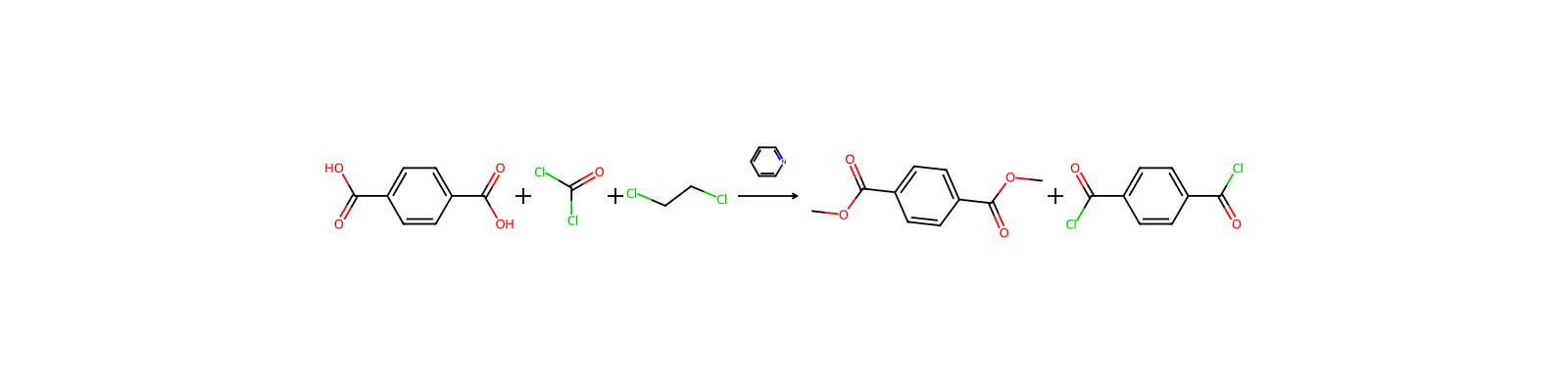
관련 반응
117건




화합물 노트
불러오는 중…