
Glycine
데이터를 보충하는 중입니다. 잠시 후 페이지를 새로 고치면 최신 내용을 볼 수 있습니다
기본 정보
- CAS
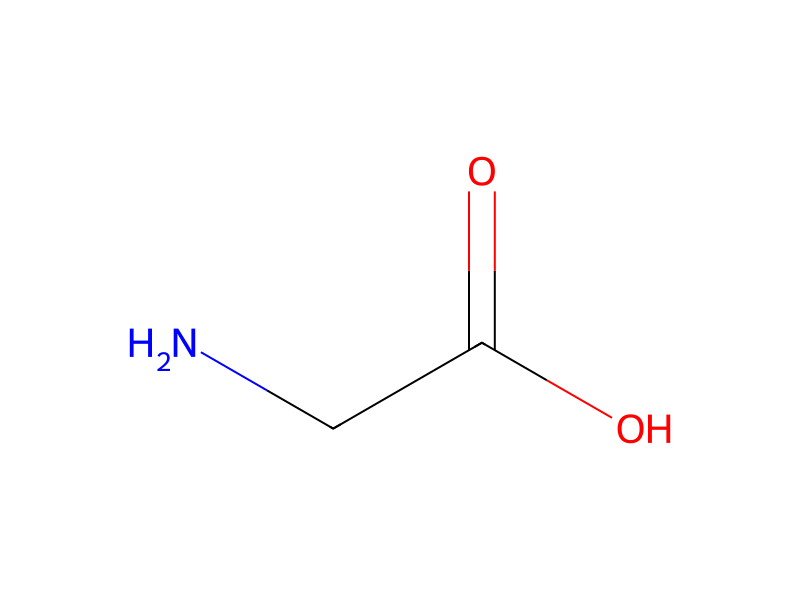
18875-39-3- 표준 SMILES
NCC(=O)O- InChIKey
DHMQDGOQFOQNFH-UHFFFAOYSA-N- 분자식
- C2H5NO2
- 평균 분자량
- 75.07 g/mol
- 단동위원소 질량
- 75.0320284
개요
Glycine appears as white crystals. (NTP, 1992)
이름 및 식별자
- 우선 이름
- Glycine
- IUPAC
- 2-aminoacetic acid
이름 및 동의어
glycine56-40-62-Aminoacetic acidaminoacetic acidAminoethanoic acidGlycocollGlycolixirGlicoaminGlycostheneAciportPadilHampshire glycine
이름 더 보기
AmitoneLeimzuckerAcetic acid, amino-AminoazijnzuurSucre de gelatineGlicinaGLY (IUPAC abbrev)Glycinum
데이터베이스 식별자
- CAS
18875-39-3、25718-94-9、56-40-6- PubChem CID
- 750
- DTXSID
DTXSID9020667- ChEMBL
CHEMBL773- ChEBI
CHEBI:15428- UNII
- TE7660XO1C
- EC Number
- 200-272-2、654-407-9
- Nikkaji
- J1.163K
물성
구조 계산 물성보충 중
- XLogP
- -3.2
- 극성 표면적
- 63.3 Ų
- 수소 결합 공여자 수
- 2
- 수소 결합 수용자 수
- 3
- 회전 가능 결합 수
- 1
- 무거운 원자 수
- 5
- 형식 전하
- 0
- 복잡도
- 42.9
실험 및 물리화학적 성질
Chemical ClassesBiological Agents -> Amino Acids and Derivatives
DrugsPharmaceuticals -> Listed in ZINC15
Cosmetics
Cosmetic ingredients (Glycine) -> CIR (Cosmetic Ingredient Review)
Hair conditioning; Buffering; Skin conditioning; Antistatic
pH0.2 molar soln in water: 4.0
LogP
log Kow = -3.21
-3.21
OdorOdorless
TasteSweet
Food AdditivesFLAVOR ENHANCER, FLAVORING AGENT OR ADJUVANT, NUTRIENT SUPPLEMENT -> FDA Substance added to food
Density
1.1607 (NTP, 1992) - Denser than water; will sink
1.161 g/cu cm @ 20 °C
Flavoring AgentsEU Flavoring substances
Color/Form
White crystals
MONOCLINIC OR TRIGONAL PRISMS FROM DILUTE ALCOHOL
Monoclinic prisms from alc
Solubility
greater than or equal to 100 mg/mL at 64 °F (NTP, 1992)
Insoluble in ethanol, ethyl ether, slightly soluble in acetone; very soluble in water
Solubility in 100 ml water @ 25 °C: 25.0 g; @ 50 °C: 39.1 g; @ 75 °C: 54.4 g; @ 100 °C: 67.2 g
100 g of abs alc dissolve about 0.06 g. Sol in 164 parts pyridine. Almost insol in ether.
water solubility = 2.49X10+5 mg/l @ 25 °C
안전 및 규제
안전 정보는 참고용이며, 공급업체의 물질안전보건자료(SDS), 관련 법규 및 전문가 평가를 대체하지 않습니다.
GHS 분류
GHS Classification
This chemical does not meet GHS hazard criteria for 96.7% (582 of 602) of all reports.
Not Classified
Aggregated GHS information provided per 602 reports by companies from 8 notifications to the ECHA C&L Inventory.
Not Classified
유해성 정보
Regulatory Information
Chemical: Glycine
Regulation (EC) No 1334/2008 (amended)
Glycine is listed on the EPA's Chemical Data Reporting (CDR) system. Manufacturers and importers of Glycine are required to report information about their production and use of this chemical to the EPA under the Toxic Substances Control Act (TSCA). (40 eCFR Part 711)
TP - indicates a substance that is the subject of a proposed TSCA section 4 test rule.
Status: Active Update: 23-03-2023 https://echa.europa.eu/registration-dossier/-/registered-dossier/14889
Glycine: Non hazardous
Other Safety InformationIMAP assessments - Glycine: Environment tier I assessment
Fire HazardsLOW. Ignites at very high temperatures. (NTP, 1992)
Hazards SummaryHuman ingestion of 800 mg/kg causes changes in surface EEG, changes in psychological tests, and nausea or vomiting; [RTECS] Safe when used as a flavoring agent in food; [JECFA] May cause irritation; [Sigma-Aldrich MSDS]
FDA Requirements
Glycine is a food additive permitted for direct addition to food for human consumption, as long as 1) the quantity of the substance added to food does not exceed the amount reasonably required to accomplish its intended physical, nutritive, or other technical effect in food, and 2) any substance intended for use in or on food is of appropriate food grade and is prepared and handled as a food ingredient.
Aminoacetic acid used as a nutrient and/or dietary supplement in animal drugs, feeds, and related products is generally recognized as safe when used in accordance with good manufacturing or feeding practice.
Reactive GroupSalts, Acidic
EPA Safer ChemicalChemical: Glycine
Reactivity ProfileAn amino acid. A 0.2M aqueous solution has a pH of 4.0., so acts as a weak acid. Has characteristics of both acid and base.
Atmospheric Standards
This action promulgates standards of performance for equipment leaks of Volatile Organic Compounds (VOC) in the Synthetic Organic Chemical Manufacturing Industry (SOCMI). The intended effect of these standards is to require all newly constructed, modified, and reconstructed SOCMI process units to use the best demonstrated system of continuous emission reduction for equipment leaks of VOC, considering costs, non air quality health and environmental impact and energy requirements. Glycine is produced, as an intermediate or a final product, by process units covered under this subpart.
Air and Water ReactionsWater soluble.
Hazard Classes and Categories
Not Classified
Not Classified
안전 및 보호
Fire FightingExtinguish fires with a dry chemical, carbon dioxide, foam, or halon extinguisher. A water spray may also be used. (NTP, 1992)
First Aid
EYES: First check the victim for contact lenses and remove if present. Flush victim's eyes with water or normal saline solution for 20 to 30 minutes while simultaneously calling a hospital or poison control center. Do not put any ointments, oils, or medication in the victim's eyes without specific instructions from a physician. IMMEDIATELY transport the victim after flushing eyes to a hospital even if no symptoms (such as redness or irritation) develop.
Storage ConditionsGlycine irrigation should be stored at a temperature of 40 degrees C or less; freezing should be avoided. Glycine irrigation should not be heated to temperatures > 66 degrees C.
Nonfire Spill Response
SMALL SPILLS AND LEAKAGE: If you spill this chemical, you should dampen the solid spill material with water, then transfer the dampened material to a suitable container. Use absorbent paper dampened with water to pick up any remaining material. Seal your contaminated clothing and the absorbent paper in a vapor-tight plastic bag for eventual disposal. Wash all contaminated surfaces with a soap and water solution. Do not reenter the contaminated area until the Safety Officer (or other responsible person) has verified that the area has been properly cleaned.
Disposal Methods
SRP: At the time of review, criteria for land treatment or burial (sanitary landfill) disposal practices are subject to significant revision. Prior to implementing land disposal of waste residue (including waste sludge), consult with environmental regulatory agencies for guidance on acceptable disposal practices.
Personal Protective Equipment (PPE)
RECOMMENDED RESPIRATOR: Where the neat test chemical is weighed and diluted, wear a NIOSH-approved half face respirator equipped with an organic vapor/acid gas cartridge (specific for organic vapors, HCl, acid gas and SO2) with a dust/mist filter. (NTP, 1992)
독성 정보
Health Effects
Chronically high levels of glycine are associated with at least 12 inborn errors of metabolism including: Citrullinemia Type I, Hyperglycinemia, non-ketotic, Hyperprolinemia Type I, Hyperprolinemia Type II, Iminoglycinuria, Isovaleric Aciduria, Malonic Aciduria, Methylmalonic Aciduria, Methylmalonic Aciduria Due to Cobalamin-Related Disorders, Non Ketotic Hyperglycinemeia, Prolinemia Type II, Propionic academia and Short Chain Acyl CoA Dehydrogenase Deficiency (SCAD Deficiency).
Exposure RoutesAbsorbed from the small intestine via an active transport mechanism.
Toxicity Summary
Safe in the present practices of use and concentration. Ingredient, concentration, and use information are available in documents discoverable at https://cir-reports.cir-safety.org
In the CNS, there exist strychnine-sensitive glycine binding sites as well as strychnine-insensitive glycine binding sites. The strychnine-insensitive glycine-binding site is located on the NMDA receptor complex. The strychnine-sensitive glycine receptor complex is comprised of a chloride channel and is a member of the ligand-gated ion channel superfamily. The putative antispastic activity of supplemental glycine could be mediated by glycine's binding to strychnine-sensitive binding sites in the spinal cord. This would result in increased chloride conductance and consequent enhancement of inhibitory neurotransmission. The ability of glycine to potentiate NMDA receptor-mediated neurotransmission raised the possibility of its use in the management of neuroleptic-resistant negative symptoms in schizophrenia. <br/>Animal studies indicate that supplemental glycine protects against endotoxin-induced lethality, hypoxia-reperfusion injury after liver transplantation, and D-galactosamine-mediated liver injury. Neutrophils are thought to participate in these pathologic processes via invasion of tissue and releasing such reactive oxygen species as superoxide. In vitro studies have shown that neutrophils contain a glycine-gated chloride channel that can attenuate increases in intracellular calcium and diminsh neutrophil oxidant production. This research is ealy-stage, but suggests that supplementary glycine may turn out to be useful in processes where neutrophil infiltration contributes to toxicity, such as ARDS.
Natural Pollution SourcesOccurs in many proteins and is especially abundant in silk fibroin, gelatin, and sugarcane.
Human Toxicity ExcerptsA CASE REPORT AND REVIEW OF THE LITERATURE ON A CARDIAC ARREST DURING TRANSURETHRAL PROSTATECTOMY AFTER ABSORPTION OF 1.5% GLYCINE.
Carcinogen ClassificationNo indication of carcinogenicity to humans (not listed by IARC).
Non-Human Toxicity ExcerptsGlycine ... has no evident ocular toxicity, except that when fed in large amt to chicks it has been found to cause a peculiar enlargement of the eyeballs.
Toxicity DataORL-RAT LD<sub>50</sub> 7930 mg/kg, SCU-RAT LD<sub>50</sub> 5200 mg/kg, IVN-RAT LD<sub>50</sub> 2600 mg/kg, ORL-MUS LD<sub>50</sub> 4920 mg/kg
규제 정보
FDA Requirements
Glycine is a food additive permitted for direct addition to food for human consumption, as long as 1) the quantity of the substance added to food does not exceed the amount reasonably required to accomplish its intended physical, nutritive, or other technical effect in food, and 2) any substance intended for use in or on food is of appropriate food grade and is prepared and handled as a food ingredient.
Aminoacetic acid used as a nutrient and/or dietary supplement in animal drugs, feeds, and related products is generally recognized as safe when used in accordance with good manufacturing or feeding practice.
Atmospheric Standards
This action promulgates standards of performance for equipment leaks of Volatile Organic Compounds (VOC) in the Synthetic Organic Chemical Manufacturing Industry (SOCMI). The intended effect of these standards is to require all newly constructed, modified, and reconstructed SOCMI process units to use the best demonstrated system of continuous emission reduction for equipment leaks of VOC, considering costs, non air quality health and environmental impact and energy requirements. Glycine is produced, as an intermediate or a final product, by process units covered under this subpart.
화학 및 산업
약리 정보
ATC Code
B - Blood and blood forming organs
QB - Blood and blood forming organs
PharmacodynamicsHelps trigger the release of oxygen to the energy requiring cell-making process; Important in the manufacturing of hormones responsible for a strong immune system.
Mechanism of Action
In the CNS, there exist strychnine-sensitive glycine binding sites as well as strychnine-insensitive glycine binding sites. The strychnine-insensitive glycine-binding site is located on the NMDA receptor complex. The strychnine-sensitive glycine receptor complex is comprised of a chloride channel and is a member of the ligand-gated ion channel superfamily. The putative antispastic activity of supplemental glycine could be mediated by glycine's binding to strychnine-sensitive binding sites in the spinal cord. This would result in increased chloride conductance and consequent enhancement of inhibitory neurotransmission. The ability of glycine to potentiate NMDA receptor-mediated neurotransmission raised the possibility of its use in the management of neuroleptic-resistant negative symptoms in schizophrenia. Animal studies indicate that supplemental glycine protects against endotoxin-induced lethality, hypoxia-reperfusion injury after liver transplantation, and D-galactosamine-mediated liver injury. Neutrophils are thought to participate in these pathologic processes via invasion of tissue and releasing such reactive oxygen species as superoxide. In vitro studies have shown that neutrophils contain a glycine-gated chloride channel that can attenuate increases in intracellular calcium and diminsh neutrophil oxidant production. This research is ealy-stage, but suggests that supplementary glycine may turn out to be useful in processes where neutrophil infiltration contributes to toxicity, such as ARDS.
HYPERPOLARIZATION OF MOTONEURONS PRODUCED BY IONTOPHORETIC APPLICATION OF GLYCINE IS RELATIVELY TRANSIENT BUT APPROACHES THE EQUILIBRIUM POTENTIAL FOR THE INDIRECTLY ACTIVATED INHIBITORY POSTSYNAPTIC POTENTIAL...TESTS WITH GABA... INDICATE SIMILAR ELECTROPHYSIOLOGICAL EFFECTS & SIMILAR INCR IN CL- CONDUCTANCE.
MAJOR EVIDENCE THAT FAVORS GLYCINE AS MEDIATOR OF INTRASPINAL POSTSYNAPTIC INHIBITION IS THE SELECTIVE ANTAGONISM OF ITS EFFECTS BY STRYCHNINE. ... GLYCINE ALSO APPEARS TO BE MOST LIKELY TRANSMITTER FOR INHIBITORY INTERNEURONS IN RETICULAR FORMATION BUT NOT IN CUNEATE NUCLEUS.
Metabolism/Metabolites
Hepatic
Hepatic
MeSH Pharmacological ClassificationSubstances used for their pharmacological actions on glycinergic systems. Glycinergic agents include agonists, antagonists, degradation or uptake inhibitors, depleters, precursors, and modulators of receptor function.
Absorption, Distribution and ExcretionAbsorbed from the small intestine via an active transport mechanism.
Tissue LocationsBladder
Cellular LocationsExtracellular
Metabolite Pathways2-Hydroxyglutric Aciduria (D And L Form)
용도 및 제조
Uses
CIR ingredient: Glycine
A non-essential amino acid that is an inhibitory neurotransmitter; Used as a buffer and reagent in organic chemistry; [Merck Index] Used in biochemical research, as a chicken feed additive, to retard rancidity in animal and vegetable oils, as a medication, and nutrient; [HSDB] Used as a flavoring agent and nutritional supplement; [FDA]
Farming (Feed Additives) [Category: Industry]
For Glycine (USEPA/OPP Pesticide Code: 103401) there are 0 labels match. /SRP: Not registered for current use in the U.S., but approved pesticide uses may change periodically and so federal, state and local authorities must be consulted for currently approved uses./
AS A BUFFERING AGENT; IN SYNTHESES
MEDICATION: DIETARY SUPPLEMENT FOR BODY BUILDING PROTEINS; NUTRIENT; INTRAVENOUS FEEDING; IRRIGATING FLUID IN TRANSURETHRAL REMOVAL OF PROSTATE; BUFFERING COMPOUND IN ANTACID PREPN
U.S. Imports
(1973) 7.78X10+8 GRAMS
(1975) 3.18X10+8 GRAMS
U.S. Production2023: 10,000,000 - <25,000,000 lb
Consumer UsesNot Known or Reasonably Ascertainable
Industry UsesLubricating agent
Methods of Manufacturing
ISOLATION FROM SILK FIBROIN, GELATIN, AND SUGAR CANE; REACTION OF CHLOROACETIC ACID AND AMMONIA
ISOLATION FROM HYDROLYSIS PRODUCTS OF GELATIN: KINGSTON, SCHRYVER, BIOCHEM J, 18, 1071 (1924); BY HYDROLYSIS OF CATTLE LIGAMENTS: US PATENT 2,098,923 (1938 TO ARMOUR & CO).
ISOLATION FROM SILK FIBROIN: MOORE, STEIN, J BIOL CHEM, 150, 113 (1943).
FROM HYDROBROMIC ACID PLUS METHYLENEAMINOACETONITRILE: CLARKE, TAYLOR, ORG SYNTH, 4, 31 (1925); FROM CHLOROACETIC ACID PLUS AMMONIA: ORTEN, HILL, ORG SYNTH, COLL VOL I, 2ND EDITION, 300 (1941)...
For more Methods of Manufacturing (Complete) data for GLYCINE (10 total), please visit the HSDB record page.
Formulations/Preparations
USEPA/OPP Pesticide Code 103401; Trade Names: Topsin; Cercobin; Cleary's 3336. /Former trade names/
AMINOACETIC ACID NF SOLN, STERILE, 1.1%; 1 L, 2 L, 4 L, & 20 L BOTTLES.
IRRIGATION USP: 1.5%/1500, 2000 & 3000 ML, 15% (CONCENTRATE)/1000 ML.
Grades: Technical; NF; FCC.
Household ProductsInformation on 53 consumer products that contain Glycine in the following categories is provided:
Use Classification
EPA Safer Chemical Functional Use Classes -> Processing Aids and Additives
Safer Chemical Classes -> Green circle - The chemical has been verified to be of low concern
Animal Drugs -> FDA Approved Animal Drug Products (Green Book) -> Active Ingredients
Flavouring Agent -> FLAVOURING_AGENT -> JECFA Functional Classes
Flavoring Agents -> JECFA Flavorings Index
Flavouring Agent -> FLAVOURING_AGENT -> JECFA Functional Classes
General Manufacturing Information
Pesticide, Fertilizer, and Other Agricultural Chemical Manufacturing
Glycine: ACTIVE
ALTHOUGH CONSIDERED NON-ESSENTIAL IN RATS, EVIDENCE CLEARLY INDICATES IT IS REQUIRED ESP BY YOUNG BIRDS & POULTRY (1-2% OF RATION).
PRODUCT OF OXIDATIVE DEAMINATION OR TRANSAMINATION OF GLYCINE IS GLYOXYLIC ACID. PRODUCT OF DECARBOXYLATION IS 5,10-METHYLENE TETRAHYDROFOLATE + AMMONIA + 2 HYDROGENS. /FROM TABLE/
AROMATIC CARBOXYLIC ACIDS ARE DETOXICATED IN ANIMALS BY COMBINATION WITH AMINO ACIDS TO FORM PEPTIDE CONJUGATES. PRINCIPAL AMINO ACID USED IN THIS CONJUGATION IS GLYCINE...
REPORTED USES IN FOODS: NON-ALCOHOLIC BEVERAGES 150.0 PPM; CANDY 150.0 PPM; BAKED GOODS 150.0 PPM; CONDIMENTS, PICKLES 150.0 PPM; MEAT, MEAT SAUCES, SOUPS 150.0 PPM; PRESERVES & SPREADS 150.0 PPM. /FROM TABLE/
관련 반응
1,207건




화합물 노트
불러오는 중…