
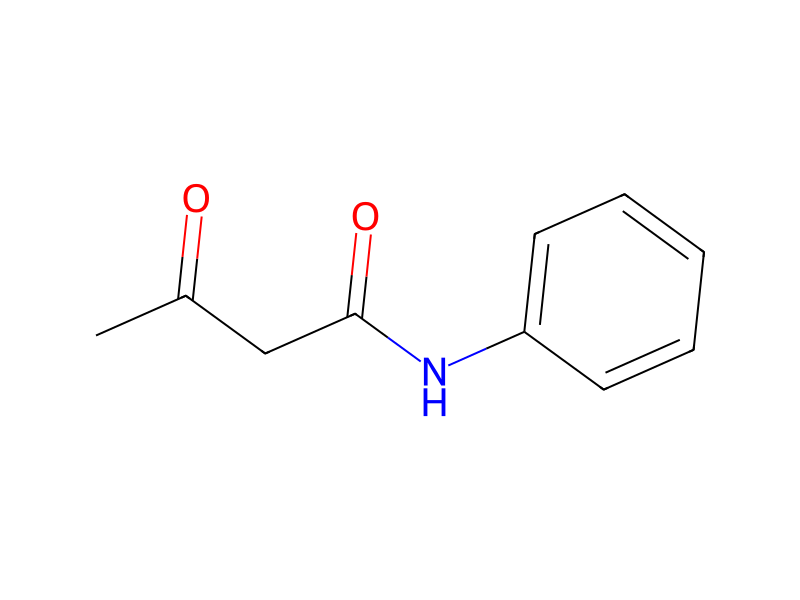
기본 정보
- 표준 SMILES
CC(=O)CC(=O)Nc1ccccc1- InChIKey
DYRDKSSFIWVSNM-UHFFFAOYSA-N- 분자식
- C10H11NO2
- 평균 분자량
- 177.2 g/mol
- 단동위원소 질량
- 177.07897859
개요
Acetoacetanilide is a white crystalline solid. (NTP, 1992)
이름 및 식별자
- 우선 이름
- Acetoacetanilide
- IUPAC
- 3-oxo-N-phenylbutanamide
- 현지명
- 아세토초산아닐리드
- 영어명
- Acetoacetanilide
- 분자식
- C10H11NO2
- 분자량
- 177.2
이름 및 동의어
ACETOACETANILIDE102-01-23-Oxo-N-phenylbutanamideButanamide, 3-oxo-N-phenyl-Acetoacetic anilideAcetylacetanilideAcetoacetamidobenzeneN-PhenylacetoacetamideAcetoacetic acid anilideAcetoacetylanilineAcetoacetanilidN-(Acetylacetyl)aniline
이름 더 보기
아세토아세트아닐리드아세토초산아닐리드AAAAANethyl 3-oxo-3-(phenylamino)propanoateLinazolusafek-1239Coupler 633
Acetanilide, 2-acetyl-USAF EK-1239beta-Ketobutyranilide1-(Phenylcarbamoyl)-2-propanoneAnilid kyseliny acetoctove((Acetoacetyl)amino)benzenealpha-Acetyl-N-phenylacetamideDTXSID0024397
데이터베이스 식별자
- CAS
102-01-2、86349-51-1- PubChem CID
- 7592
- DTXSID
DTXSID0024397- ChEMBL
CHEMBL1604429- UNII
- W35JB9PY3X
- EC Number
- 202-996-4
- Nikkaji
- J4.999I
물성
구조 계산 물성
- XLogP
- 1.5
- 극성 표면적
- 46.2 Ų
- 수소 결합 공여자 수
- 1
- 수소 결합 수용자 수
- 2
- 회전 가능 결합 수
- 3
- 무거운 원자 수
- 13
- 형식 전하
- 0
- 복잡도
- 195
실험 및 물리화학적 성질
Chemical ClassesNitrogen Compounds -> Other Aromatics (Nitrogen)
SpringerMaterials PropertiesCrystal structure
Density
1.26 at 68 °F (NTP, 1992) - Denser than water; will sink
1.26 g/ml at 20 °C
Color/Form
WHITE CRYSTALLINE SOLID
PLATES OR NEEDLES FROM BENZENE OR PETROLEUM ETHER
Solubility
less than 1 mg/mL at 70 °F (NTP, 1992)
SLIGHTLY SOL IN WATER; SOL IN ALC, CHLOROFORM, ETHER, HOT BENZENE, ACID, HOT PETROLEUM ETHER, ALKALI HYDROXIDE SOLN /KETO FORM/
SOL IN ALKALI
Soluble in oxygenated and chlorinated solvents.
Flash Point
325 °F (NTP, 1992)
162.7 °C
365 °F; 185 °C (OPEN CUP)
Boiling Point
Decomposes (NTP, 1992)
BOILING POINT: DECOMPOSES
DecompositionSEE ANILINE. ...WHEN HEATED TO DECOMP, IT EMITS HIGHLY TOXIC FUMES. /ANILINE/
Melting Point
187 °F (NTP, 1992)
86 °C
GIVES VIOLET COLOR WITH FERRIC CHLORIDE; MELTING POINT: 85 °C /KETO FORM/
Vapor Pressure
0.01 mmHg at 68 °F (NTP, 1992)
0.01 [mmHg]
5.2X10⁻⁵ mm Hg at 25 °C
Physical Description
Acetoacetanilide is a white crystalline solid. (NTP, 1992)
CBI; Dry Powder
White solid; [Hawley] White, odorless crystalline powder; [Alfa Aesar MSDS]
Stability/Shelf LifeENOL FORM IS UNSTABLE
물리화학적 성질
- 녹는점
- 83 · 83-88 °C (lit.)
- 끓는 점
- 129 °C · 129°C 24mm
- 밀도
- 1.26 · 1.26
- 증기 밀도
- 6.1 · 6.1 (vs air)
- 증기압
- 0 · 0-0.013Pa at 20-50℃
- 굴절률
- 1.5168 · 1.5168 (estimate)
- 인화점
- 325 °F · 325 °F
- 저장 조건
- Refrigerator
- 용해도
- 클로로포름(약간 용해됨), 메탄올(약간 용해됨)
- 산도 계수 (pKa)
- 12.21 · 12.21±0.46(Predicted)
- 물리적 상태
- 결정성 분말
- 색상
- 하얀색
- 생물학적 소스
- synthetic
- 수용성
- 5 g/L · 5g/L(20℃)
- Merck
- 14 · 14,58
- BRN
- 473419 · 473419
- Henry's Law Constant
- 2.3 · 2.3×106 mol/(m3Pa) at 25℃, HSDB (2015)
- 안정성
- 안정적인. 타기 쉬운. 강한 산화제와 호환되지 않습니다.
- InChI
- 1S/C10H11NO2/c1-8(12)7-10(13)11-9-5-3-2-4-6-9/h2-6H,7H2,1H3,(H,11,13)
- InChIKey
- DYRDKSSFIWVSNM-UHFFFAOYSA-N
- SMILES
- CC(=O)CC(=O)Nc1ccccc1
- LogP
- 0.93 at · 0.93 at 23℃
- NIST
- 3 · Butanamide, 3-oxo-N-phenyl-(102-01-2)
- EPA
- Acetoacetanilide (102-01-2)
화학적 성질
White to off-white powder
안전 및 규제
GHS 분류
GHS Classification
This chemical does not meet GHS hazard criteria for 2.5% (12 of 477) of reports.
Warning
H302 (97.3%): Harmful if swallowed [Warning Acute toxicity, oral]
P260, P261, P264, P270, P271, P280, P301+P317, P302+P352, P304+P340, P317, P319, P321, P330, P362+P364, and P501 (click each P-code to see the statement)
Aggregated GHS information provided per 477 reports by companies from 13 notifications to the ECHA C&L Inventory. Each notification may be associated with multiple companies.
유해성 정보
Regulatory Information
Chemical: Butanamide, 3-oxo-N-phenyl-
Butanamide, 3-oxo-N-phenyl- is listed on the EPA's Chemical Data Reporting (CDR) system. Manufacturers and importers of Butanamide, 3-oxo-N-phenyl- are required to report information about their production and use of this chemical to the EPA under the Toxic Substances Control Act (TSCA). (40 eCFR Part 711)
Status: Active Update: 27-06-2016 https://echa.europa.eu/registration-dossier/-/registered-dossier/14590
Acetoacetanilide: Does not have an individual approval but may be used under an appropriate group standard
Fire HazardsThis chemical is combustible. (NTP, 1992)
Fire PotentialFIRE HAZARD: SLIGHT, WHEN EXPOSED TO HEAT OR FLAME.
Health HazardsACUTE/CHRONIC HAZARDS: This compound is a weak allergen. When heated to decomposition it emits toxic fumes. (NTP, 1992)
Hazards Summary
Reports of reversible eye burns in humans; Not irritating to skin and mildly irritating to eyes of rabbits; No evidence of skin sensitization in guinea pigs; Causes slight methemoglobinemia and significant formation of Heinz bodies in cats following single oral administration of 100 mg/kg; Hemolytic anemia and corresponding injury to liver, spleen, and kidneys observed in 28-day oral study of rats (850 mg/kg/day and, to some extent, at 100 mg/kg/day); Emergency treatment: Phenacetin; Phenacetin was used as a pain-relieving drug, but has not been available in the US since 1983. Can cause methemoglobinemia after ingestion >1 gram/day; Can cause renal papillary necrosis following ingestion of large doses for years; [HSDB] A weak allergen; [CAMEO] A mild skin irritant; Can be absorbed through skin; [Alfa Aesar MSDS]
Reactive GroupAmides and Imides
TSCA Requirements
Section 8(a) of TSCA requires manufacturers of this chemical substance to report preliminary assessment information concerned with production, use, and exposure to EPA as cited in the preamble in 51 FR 41329.
Pursuant to section 8(d) of TSCA, EPA promulgated a model Health and Safety Data Reporting Rule. The section 8(d) model rule requires manufacturers, importers, and processors of listed chemical substances and mixtures to submit to EPA copies and lists of unpublished health and safety studies. Acetoacetanilide is included on this list.
Reactivity Profile
Organic amides react with azo and diazo compounds to generate toxic gases. Flammable gases are formed by the reaction of organic amides with strong reducing agents. Amides are very weak bases (weaker than water). Mixing amides with dehydrating agents such as P2O5 or SOCl2 generates the corresponding nitrile. The combustion of these compounds generates mixed oxides of nitrogen (NOx). Ketones are reactive with many acids and bases liberating heat and flammable gases (e.g., H2). The amount of heat may be sufficient to start a fire in the unreacted portion of the ketone. Ketones react with reducing agents such as hydrides, alkali metals, and nitrides to produce flammable gas (H2) and heat. Ketones are incompatible with isocyanates, aldehydes, cyanides, peroxides, and anhydrides. They react violently with aldehydes, HNO3, HNO3 + H2O2, and HClO4.
Air and Water ReactionsWater insoluble.
NFPA Hazard Classification
2 - Materials that, under emergency conditions, can cause temporary incapacitation or residual injury.
1 - Materials that must be preheated before ignition can occur. Materials require considerable preheating, under all ambient temperature conditions, before ignition and combustion can occur.
0 - Materials that in themselves are normally stable, even under fire conditions.
Hazard Classes and CategoriesAcute Tox. 4 (97.3%)
Hazardous Reactivities and IncompatibilitiesSEE ANILINE. ...CAN REACT VIGOROUSLY WITH OXIDIZING MATERIALS. /ANILINE/
안전 및 보호
Fire FightingFires involving this material can be controlled with a dry chemical, carbon dioxide or Halon extinguisher. (NTP, 1992)
First Aid
EYES: First check the victim for contact lenses and remove if present. Flush victim's eyes with water or normal saline solution for 20 to 30 minutes while simultaneously calling a hospital or poison control center. Do not put any ointments, oils, or medication in the victim's eyes without specific instructions from a physician. IMMEDIATELY transport the victim after flushing eyes to a hospital even if no symptoms (such as redness or irritation) develop.
Fire Fighting Procedures
ALCOHOL FOAM, WATER MIST, CARBON DIOXIDE, DRY CHEMICAL.
"ALCOHOL" FOAM. WATER OR FOAM MAY CAUSE FROTHING.
Nonfire Spill Response
SMALL SPILLS AND LEAKAGE: Should a spill occur while you are handling this chemical, FIRST REMOVE ALL SOURCES OF IGNITION, then you should dampen the solid spill material with 60-70% ethanol and transfer the dampened material to a suitable container. Use absorbent paper dampened with 60-70% ethanol to pick up any remaining material. Seal the absorbent paper, and any of your clothes, which may be contaminated, in a vapor-tight plastic bag for eventual disposal. Solvent wash all contaminated surfaces with 60-70% ethanol followed by washing with a soap and water solution. Do not reenter the contaminated area until the Safety Officer (or other responsible person) has verified that the area has been properly cleaned.
Disposal Methods
SRP: At the time of review, criteria for land treatment or burial (sanitary landfill) disposal practices are subject to significant revision. Prior to implementing land disposal of waste residue (including waste sludge), consult with environmental regulatory agencies for guidance on acceptable disposal practices.
Personal Protective Equipment (PPE)
RECOMMENDED RESPIRATOR: Where the neat test chemical is weighed and diluted, wear a NIOSH-approved half face respirator equipped with an organic vapor/acid gas cartridge (specific for organic vapors, HCl, acid gas and SO2) with a dust/mist filter. (NTP, 1992)
독성 정보
Environmental Fate
TERRESTRIAL FATE: Based on a recommended classification scheme(1), an estimated Koc value of 12(SRC), determined from a structure estimation method(2), indicates that acetoacetanilide will have high mobility in soil(SRC). Volatilization of acetoacetanilide from moist soil surfaces is not expected to occur(SRC) given an estimated Henry's Law constant of 4.2X10⁻¹² atm-cu m/mole(SRC), using a fragment constant estimation method(3). The potential for volatilization of acetoacetanilide from dry soil surfaces may not exist(SRC) based on an extrapolated vapor pressure of 5.2X10⁻⁵ mm Hg(4,SRC).
AQUATIC FATE: Based on a recommended classification scheme(1), an estimated Koc value of 12(SRC), determined from a structure estimation method(2), indicates that acetoacetanilide is not expected to adsorb to suspended solids and sediment in water(SRC). Acetoacetanilide is not expected to volatilize from water surfaces(1,SRC) based on an estimated Henry's Law constant of 4.2X10⁻¹² atm-cu m/mole(SRC), developed using a fragment constant estimation method(3). According to a classification scheme(5), an estimated BCF value of 3.4(1,SRC), from an estimated log Kow(4,SRC), suggests that bioconcentration in aquatic organisms is low(SRC).
ATMOSPHERIC FATE: According to a model of gas/particle partitioning of semivolatile organic compounds in the atmosphere(1), acetoacetanilide, which has an extrapolated vapor pressure of 5.2X10⁻⁵ mm Hg at 25 °C(2,SRC), will exist in both the vapor and particulate phases in the ambient atmosphere. Vapor-phase acetoacetanilide is degraded in the atmosphere by reaction with photochemically-produced hydroxyl radicals(SRC); the half-life for this reaction in air is estimated to be about 1.2 days(3,SRC). Particulate-phase acetoacetanilide may be physically removed from the air by wet and dry deposition(SRC).
Adverse EffectsOccupational hepatotoxin - Secondary hepatotoxins: the potential for toxic effect in the occupational setting is based on cases of poisoning by human ingestion or animal experimentation.
Soil Adsorption/Mobility
Using a structure estimation method based on molecular connectivity indices(1), the Koc for acetoacetanilide can be estimated to be about 12(SRC). According to a recommended classification scheme(2), this estimated Koc value suggests that acetoacetanilide has very high mobility in soil(SRC).
TSCA Test Submissions
Acetoacetanilide (CAS# 102-01-2) was evaluated for acute oral toxicity. The test substance was administered by oral gavage to 10 rats (strain not specified) at a dose-range of 200-3200 mg/kg b.w. Clinical signs at dose levels greater than 800 mg/kg included slight to moderate weakness, vasodilation, tremors and a possible methemoglobin response. At 3200 mg/kg, clinical signs included prostration and rapid heart rates. The LD50 was determined to be 1600 mg/kg for males, and 1130 mg/kg for females. The test substance was determined to be slightly toxic.
Acetoacetanilide (CAS# 102-01-2) was evaluated for acute oral toxicity. The test substance was administered by oral gavage to 10 mice (strain and sex not specified) at a dose-range of 200-3200 mg/kg of body weight. Clinical signs included a dose-related increase in weakness, dark eyes, vasodilation, rough coat, prostration, gasping, and yellow-brown urine. The LD50 was determined to be in a range between 800-1600 mg/kg.
Acetoacetanilide (CAS# 102-01-2) was evaluated for acute intraperitoneal toxicity. The test substance was administered by intraperitoneal injection to 10 mice (strain and sex not specified) at a dose-range of 200-3200 mg/kg of body weight. Clinical signs included a dose-related increase in weakness, dark eyes, vasodilation, rough coat, prostration, gasping, and yellow-brown urine. The LD50 was determined to be in a range between 800-1600 mg/kg.
Acetoacetanilide (CAS# 102-01-2) was evaluated for acute dermal toxicity. The test substance was applied to the cuff of 4 guinea pigs (strain and sex not specified) at a dose-range of 0.25-1.0 g/kg of body weight. Clinical signs included slight edema and erythema and a small blister-like spot. Desquamation and sparse hair was noted at one week, with desquamation persisting to the 2nd week. The LD50 was determined to be in a range between 0.5 and 1.0 g/kg b.w.
For more TSCA Test Submissions (Complete) data for ACETOACETANILIDE (8 total), please visit the HSDB record page.
Human Toxicity Excerpts
IT IS WELL KNOWN TO PRODUCE CYANOSIS IN SOME HUMANS WHEN TAKEN REPEATEDLY, POSSIBLY DUE TO FORMATION OF SULFHEMOGLOBIN. LARGE DOSES IN ACUTE POISONING PRODUCE METHEMOGLOBIN... /ACETANILIDE/
.../"COAL TAR ANALGETICS" INCL ACETANILIDE/ ARE DEPRESSANTS OF CNS. SYMPTOMS OF NAUSEA & VOMITING, VERTIGO & RINGING IN EARS...OCCUR WITH LARGE DOSES OR IN... SENSITIVE INDIVIDUALS WITH THERAPEUTIC DOSES. SWEATING MAY BE PROFUSE. LARGE DOSES LEAD TO MENTAL CONFUSION, MUSCULAR INCOORDINATION & COMA. /ACETANILIDE/
CIRCULATORY COLLAPSE, WITH COLD EXTREMITIES, PALENESS...FEEBLE RAPID PULSE & DYSPNEA, & COMA, WITH FIXED, SEMI-DILATED PUPILS, IS CHARACTERISTIC FINDING IN ACUTE ACETANILIDE POISONING. /ACETANILIDE/
IT MAY...CAUSE CONTACT DERMATITIS & INHALATION OR INGESTION MAY CAUSE AN ECZEMATOUS ERUPTION OF THE SKIN. /ACETANILIDE/
For more Human Toxicity Excerpts (Complete) data for ACETOACETANILIDE (9 total), please visit the HSDB record page.
Artificial Pollution Sources
Acetoacetanilide's production and use as a chemical intermediate in organic syntheses and rubber compounding(1), and in the production of dyes and fungicides(2,3) may result in its release to the environment through various waste streams(SRC).
Environmental Biodegradation
Biodegradation studies of acetoacetanilide based on COD measurements, using an activated sludge seed indicate that acetoacetanilide is biodegradable(1,2). One study used an initial concentration of acetoacetanilide of 248 ppm and reported an 18 percent COD removal over a period of 24 hours(1). A second study used an initial concentration of 100 ppm acetoacetanilide and reported an 87 percent COD removal over a 24 hour period(2).
Environmental Bioconcentration
An estimated BCF value of 3.4 was calculated for acetoacetanilide(SRC), using an estimated log Kow of 1.0(1,SRC) and a recommended regression-derived equation(2). According to a classification scheme(3), this BCF value suggests that bioconcentration in aquatic organisms is low(SRC).
Volatilization from Water/Soil
The Henry's Law constant for acetoacetanilide is estimated as 4.2X10⁻¹² atm-cu m/mole(SRC) using a fragment constant estimation method(1). This value indicates that acetoacetanilide will be essentially nonvolatile from water surfaces(2,SRC). Acetoacetanilide's Henry's Law constant(1,SRC) indicates that volatilization from moist soil surfaces is not expected to occur(SRC). The potential for volatilization of acetoacetanilide from dry soil surfaces may not exist(SRC) based on the extrapolated vapor pressure of 5.2X10⁻⁵ mm Hg(3,SRC).
Non-Human Toxicity Excerpts
... The admin of a single oral dose of 100 mg/kg/body wt to cats resulted in a slight methemoglobin development and marked formation of Heinz bodies. Following oral admin of 850 mg/kg/body wt/day and, to a lesser extent, 100 mg/kg/body wt/day to rats for 28 days, acetoacetanilide has lead primarily to hemolytic anemia with associated damage to the liver, spleen and kidneys.
... In rabbits, acetoacetanilide is not irritating to the skin and slightly irritating to the eyes. There is no indications of skin sensitizing potential in guinea pigs. ...
... Acetoacetanilide is not mutagenic in the Salmonella/microsome test or in the spot test in Escherichia coli. ...
... Fertility and offspring viability were impaired in mice in a combined subchronic feeding and fertility study (10,000, 5,000 and 1,000 ppm in the diet; ca 1230, 650 and 130 mg/kg body wt). ...
Environmental Abiotic Degradation
The rate constant for the vapor-phase reaction of acetoacetanilide with photochemically-produced hydroxyl radicals has been estimated as 1.3X10⁻¹¹ cu cm/molecule-sec at 25 °C(SRC) using a structure estimation method(1,SRC). This corresponds to an atmospheric half-life of about 1.2 days at an atmospheric concentration of 5X10+5 hydroxyl radicals per cu cm(1,SRC). Acetoacetanilide is not expected to undergo hydrolysis in the environment due to the lack of functional groups to hydrolyze. Acetoacetanilide may undergo direct photolysis based on its weak absorption of UV light between 290-320 nm in methanol(2).
Probable Routes of Human Exposure
NIOSH (NOES Survey 1981-1983) has statistically estimated that 1100 workers are potentially exposed to acetoacetanilide in the US(1). Occupational exposure to acetoacetanilide may occur through dermal contact with this compound at workplaces where it is produced or used(SRC).
규제 정보
TSCA Requirements
Section 8(a) of TSCA requires manufacturers of this chemical substance to report preliminary assessment information concerned with production, use, and exposure to EPA as cited in the preamble in 51 FR 41329.
Pursuant to section 8(d) of TSCA, EPA promulgated a model Health and Safety Data Reporting Rule. The section 8(d) model rule requires manufacturers, importers, and processors of listed chemical substances and mixtures to submit to EPA copies and lists of unpublished health and safety studies. Acetoacetanilide is included on this list.
안전 데이터
- wgk
- WGK 3
- tsca
- TSCA listed
- rtecs
- AK4200000
- 독성
- LD50 orl-rat: 5400 mg/kg LONZA# 08FEB79
- HS 번호
- 2921419000
- risk_code
- 21/22
- hazard_code
- Xn
- safety_code
- 36
- 기존화학 물질
- KE-27634
- 자연 발화 온도
- 843 °F
- 스토리지 클래스
- 11 - Combustible Solids
- 유해 물질 데이터
- 102-01-2(Hazardous Substances Data)
화학 및 산업
용도 및 제조
Uses
Used in rubber compounding and in manufacturing other chemicals (hansa yellow dyes, benzidine yellow pigments, the fungicides carboxin and methfuroxam, and pyrazolones and pyrimidines); [HSDB]
MFR OF YELLOW DYES, SUCH AS HANSA & BENZIDINE YELLOWS; IN RUBBER COMPOUNDING; IN ORG SYNTHESES
ACETOACETANILIDE IS USED AS THE INTERNAL STANDARD IN THIS METHOD.
Used as a chemical intermediate for the synthesis of: carboxin; Pigment Orange 15; Pigment Orange 16; Pigment Yellow 1; Pigment Yellow 4; Pigment Yellow 5; Pigment Yellow 12; Solvent Yellow 19.
Used in production of the fungicides carboxin and methfuroxam.
Intermediate for pyrazolones and pyrimidines; Hansa yellows; benzidine yellow pigments.
U.S. Production2023: 850,000 - <1,000,000 lb
Consumer UsesPigment
Industry UsesPigment
Methods of Manufacturing
...BY REACTION OF KETENE DIMER WITH ANILINE: ...WILLIAMS, KRYNITSKY, ORG SYN 21, 4 (1941). BY REACTION OF ANILINE WITH ETHYL ACETOACETATE: ...KNORR, REUTER, BER 27, 1169 (1894).
ENOL FORM (UNSTABLE) PREPARED BY POURING ALKALINE SOLN OF KETO FORM IN COLD, DILUTE SULFURIC ACID.
Formulations/PreparationsGRADES: TECHNICAL.
General Manufacturing Information
Synthetic Dye and Pigment Manufacturing
Butanamide, 3-oxo-N-phenyl-: ACTIVE
응용 분야
용도Acetoacetanilide is used as intermediate for the manufacture of organic pigments and dyestuffs.
일반 설명White crystalline solid.
상·하류 제품 정보
상류 원료
하류 제품
관련 반응
37건


연결된 노트
불러오는 중…