
1,3-디페닐-1,3-프로판디온
Dibenzoylmethane
데이터를 보충하는 중입니다. 잠시 후 페이지를 새로 고치면 최신 내용을 볼 수 있습니다
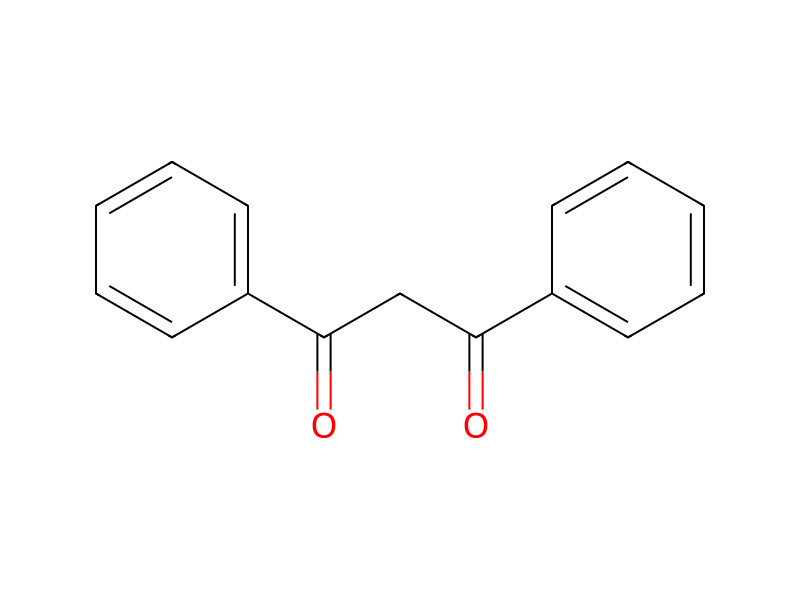
기본 정보
- CAS
120-46-7- 표준 SMILES
O=C(CC(=O)c1ccccc1)c1ccccc1- InChIKey
NZZIMKJIVMHWJC-UHFFFAOYSA-N- 분자식
- C15H12O2
- 평균 분자량
- 224.25 g/mol
- 단동위원소 질량
- 224.08372962
이름 및 식별자
- 우선 이름
- Dibenzoylmethane
- IUPAC
- 1,3-diphenylpropane-1,3-dione
- 현지명
- 1,3-디페닐-1,3-프로판디온
- 영어명
- Dibenzoylmethane
- 분자식
- C15H12O2
- 분자량
- 224.25
이름 및 동의어
Dibenzoylmethane120-46-71,3-Diphenylpropane-1,3-dione1,3-DIPHENYL-1,3-PROPANEDIONE1,3-Propanedione, 1,3-diphenyl-2-BenzoylacetophenonePhenyl phenacyl ketoneomega-BenzoylacetophenoneRhodiastab 83Karenzu DK2DTXSID3041247ANS7ME8OKC
이름 더 보기
1,3-디페닐-1,3-프로판디온DBM1,3-Diphenylpropanedione1,3-diphenyl-3-propanedionekarenzudk2phenylphenacylketoneDBM83
NSC-6266DTXCID1021247CHEBI:75417204-398-9RefChem:132859GAMMA-HYDROXYCHALKONE1,3-Diphenyl-propane-1,3-dioneDibenzoyl-methane
데이터베이스 식별자
- CAS
120-46-7- PubChem CID
- 8433
- DTXSID
DTXSID3041247- ChEMBL
CHEMBL371523- ChEBI
CHEBI:75417- UNII
- ANS7ME8OKC
- EC Number
- 204-398-9
- Nikkaji
- J10.072B
물성
구조 계산 물성보충 중
- XLogP
- 3.1
- 극성 표면적
- 34.1 Ų
- 수소 결합 공여자 수
- 0
- 수소 결합 수용자 수
- 2
- 회전 가능 결합 수
- 4
- 무거운 원자 수
- 17
- 형식 전하
- 0
- 복잡도
- 243
실험 및 물리화학적 성질
Physical Description
Large Crystals; Dry Powder
Solid; [Merck Index] Light yellow crystalline powder; [Alfa Aesar MSDS]
Collision Cross Section165.9 Ų [M+Na]+ [CCS Type: DT; Buffer gas: N2; Ionization: ESI+; Dataset: TOXCAST; Source Identifier: DTXSID3041247];154.4 Ų [M-H]- [CCS Type: DT; Buffer gas: N2; Ionization: ESI-; Dataset: TOXCAST; Source Identifier: DTXSID3041247]
물리화학적 성질
- 녹는점
- 77 · 77-79 °C(lit.)
- 끓는 점
- 219 · 219-221 °C18 mm Hg(lit.)
- 밀도
- 0.8 g/cm3 · 0.800 g/cm3
- 증기압
- 0.01 Pa · 0.01Pa at 20℃
- 굴절률
- 1.66 · 1.6600 (estimate)
- 인화점
- 219 · 219-221°C/18mm
- 저장 조건
- 30 °C · Store below +30°C.
- 용해도
- 클로로포름(약간 용해됨), 메탄올(약간 용해됨, 초음파처리)
- 산도 계수 (pKa)
- 8.95 · 8.95±0.10(Predicted)
- 물리적 상태
- 크리스탈
- 색상
- 밝은 노란색에서 노란색까지
안전 및 규제
안전 정보는 참고용이며, 공급업체의 물질안전보건자료(SDS), 관련 법규 및 전문가 평가를 대체하지 않습니다.
GHS 분류
GHS Classification
This chemical does not meet GHS hazard criteria for 32.7% (84 of 257) of reports.
Warning
H317 (66.1%): May cause an allergic skin reaction [Warning Sensitization, Skin]
P261, P272, P280, P302+P352, P321, P333+P317, P362+P364, and P501 (click each P-code to see the statement)
Aggregated GHS information provided per 257 reports by companies from 6 notifications to the ECHA C&L Inventory.;Reported as not meeting GHS hazard criteria per 84 of 257 reports by companies.;There are 5 notifications provided by 173 of 257 reports by companies with hazard statement code(s).;Information may vary between notifications depending on impurities, additives, and other factors. The percentage value in parenthesis indicates the notified classification ratio from companies that provide hazard codes. Only hazard codes with percentage values above 10% are shown. For more detailed information, please visit ECHA C&L website.
유해성 정보
Regulatory Information
Chemical: 1,3-Propanedione, 1,3-diphenyl-
1,3-Propanedione, 1,3-diphenyl- is listed on the EPA's Chemical Data Reporting (CDR) system. Manufacturers and importers of 1,3-Propanedione, 1,3-diphenyl- are required to report information about their production and use of this chemical to the EPA under the Toxic Substances Control Act (TSCA). (40 eCFR Part 711)
Status: Active Update: 13-06-2022 https://echa.europa.eu/registration-dossier/-/registered-dossier/11371
1,3-Propanedione, 1,3-diphenyl-: Does not have an individual approval but may be used under an appropriate group standard
Hazards SummaryCauses changes in liver and uterine weights in 2-week constant oral studies of mice; [RTECS] May cause irritation; [Alfa Aesar MSDS]
Hazard Classes and CategoriesSkin Sens. 1 (66.1%)
규제 정보
화학 및 산업
용도 및 제조
UsesPermitted for use as an inert ingredient in non-food pesticide products; [EPA]
U.S. Production2023: 700,000 - <850,000 lb;2022: 850,000 - <1,000,000 lb;2021: 550,000 - <700,000 lb;2020: 700,000 - <850,000 lb
Consumer UsesHeat stabilizer;Other
Industry UsesProcessing aids not otherwise specified;Heat stabilizer;Other
Use Classification
Plastics -> Other stabilisers
Plastics -> Polymer Type -> PVC (soft); PVC (rigid); PET
General Manufacturing Information
Plastics Material and Resin Manufacturing;All Other Chemical Product and Preparation Manufacturing;Plastics Product Manufacturing
1,3-Propanedione, 1,3-diphenyl-: ACTIVE
응용 분야
출처Dibenzoylmethane(DBM) is a 1,3-diketone derivative of acetylacetone that has both methyl groups replaced with phenyl groups.Although smaller in size and lacking hydroxyl and methoxy groups,DBM resembles the turmeric spice curcumin (CUR),a diferuloylmethane. Both molecules are metal-chelating agents,contain a B-diketone flanked by two aryl groups,and exhibit anti-proliferative and anticarcinogenic activity. In addition to sharing structural similarity with DBM,CUR,which is also a naturally occurring compound is found in the plant Curcuma longa and has numerous medicinal uses.DBM and its many naturally occurring derivatives are minor constituentsof licorice. DBM has been isolated from licorice root extracts and otherspecies of Glycyrrhiza.
용도Dibenzoylmethane is a new kind of PVC heat stabilizer, it has better transparency, nontoxic and odorless. In case of combined use with Calcium/Zinc, Barium/Zin and other heat stabilizer, it can greatly improve the initial color, transparency, long term stability of PVC, and also can improve the precipitation and “zinc burning” problem during the process. It has very good synergy with zinc soaps, and can protect the PVC color. This material can absorb UV at 290nm, which has the effect as light stabilizer and act as long term stabilizer for PVC products.
관련 반응
70건


화합물 노트
불러오는 중…