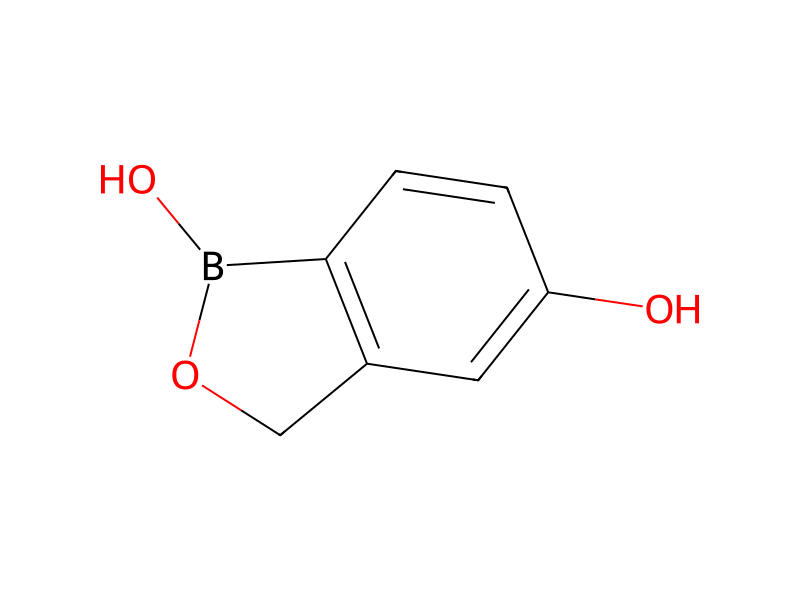
Into a 100-mL 3-necked round-bottom flask purged and maintained with an inert atmosphere of nitrogen was placed a solution of 5-hydroxy-2-(4,4,5,5-tetramethyl-1,3,2-dioxaborolan-2-yl)benzaldehyde (5.5 g, 22 mmol, 1.0 equiv) in methanol (25 mL). This was followed by the addition of NaBH4 (1.24 g, 32.6 mmol, 1.5 equiv) in several batches at 0° C. The resulting solution was stirred for 10 min at 0° C., then it was concentrated under vacuum to get rid of half methanol at low temperature. To the residual solution was added water (6 mL) and HCl (6M, 14.5 mL) dropwise at 0° C. The resulting solution was stirred overnight at room temperature. Then it was concentrated under vacuum at low temperature to remove MeOH. The solid was collected by filtration. This resulted in 2.0 g of benzo[c][1,2]oxaborole-1,5(3H)-diol as a white solid.