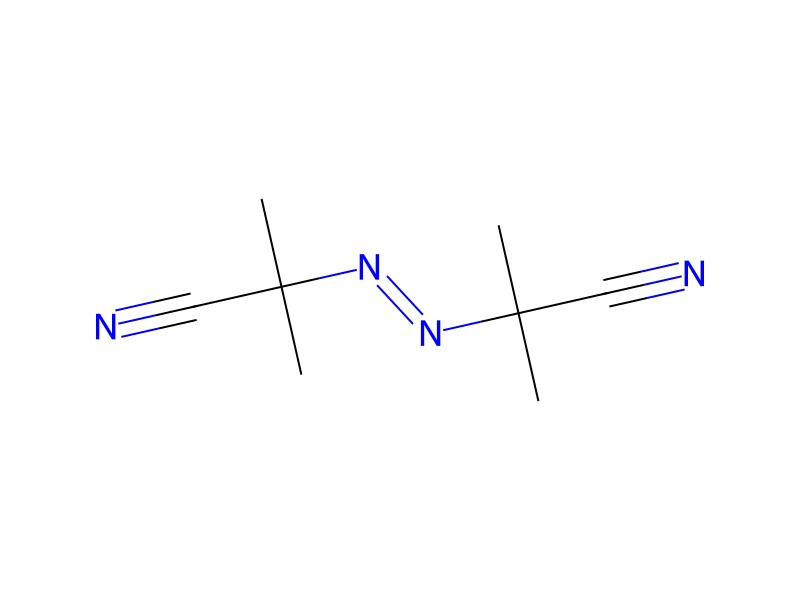
Azobisisobutyronitrile → 3-Bromomethyl-pyrazine-2-carboxylic acid ethyl ester
HRID 1045633
반응식

[CH2:1]([O:3][C:4]([C:6]1[C:11]([CH3:12])=[N:10][CH:9]=[CH:8][N:7]=1)=[O:5])[CH3:2].[Br:13]N1C(=O)CCC1=O.N(C(C)(C)C#N)=NC(C)(C)C#N>C(Cl)(Cl)(Cl)Cl>[CH2:1]([O:3][C:4]([C:6]1[C:11]([CH2:12][Br:13])=[N:10][CH:9]=[CH:8][N:7]=1)=[O:5])[CH3:2]참가 물질
5



실험 절차
A mixture of 3-methyl-pyrazine-2-carboxylic acid ethyl ester (Example 1.1) (0.5 g), N-bromosuccinimide (“NBS”) (0.536 g) and 2,2′-azobis(2-methylpropionitrile) (“AIBN”) (0.487 g) in carbon tetrachloride (2.5 ml) was heated to reflux. After 1 hour thin layer chromatography showed a mixture of starting material and the desired product. Further NBS (0.536 g) and AIBN (0.243 g) were added and the reaction mixture heated for a further 1 hour. The percentage of product increased and impurities began to form. The reaction mixture was cooled to ambient temperature and then to 0° C. The cold mixture was filtered and the filtrate concentrated. The residue was purified by chromatography on silica gel (eluent: 0-10% v/v ethyl acetate in iso-hexane) to give 3-bromomethyl-pyrazine-2-carboxylic acid ethyl ester (640 mg) contaminated with 3-methyl-pyrazine-2-carboxylic acid ethyl ester (due to co-elution, ˜3:2). MH+=245, RT=1.26 min (Method A).