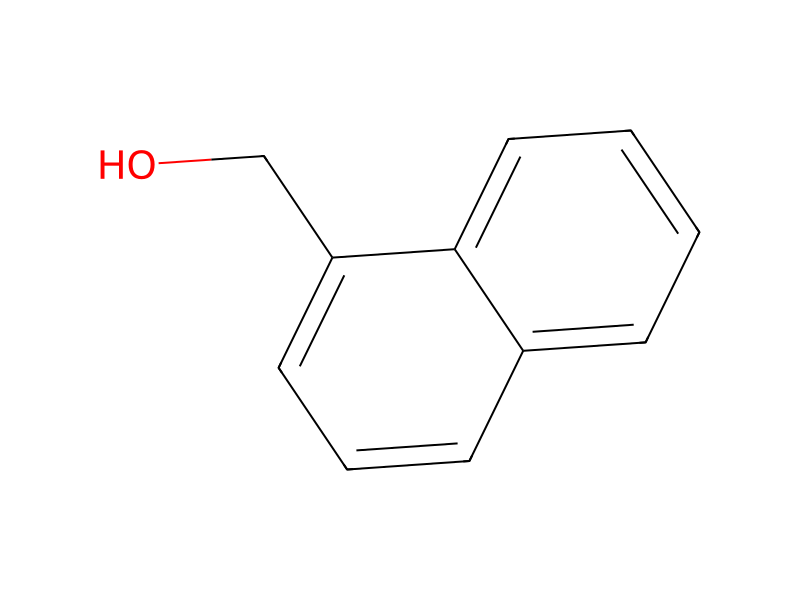
[OH:1][CH2:2][C:3]1[C:12]2[C:7](=[CH:8][CH:9]=[CH:10][CH:11]=2)[CH:6]=[CH:5][CH:4]=1.C1(P(C2C=CC=CC=2)C2C=CC=CC=2)C=CC=CC=1.O[N:33]1[C:37](=[O:38])[C:36]2=[CH:39][CH:40]=[CH:41][CH:42]=[C:35]2[C:34]1=[O:43].CCOC(/N=N/C(OCC)=O)=O>C1COCC1.CCOCC>[C:3]1([CH2:2][O:1][N:33]2[C:34](=[O:43])[C:35]3=[CH:42][CH:41]=[CH:40][CH:39]=[C:36]3[C:37]2=[O:38])[C:12]2[C:7](=[CH:8][CH:9]=[CH:10][CH:11]=2)[CH:6]=[CH:5][CH:4]=11-(hydroxymethyl)naphthalene (1.00 g, 6.33 mmol), triphenyl phosphine (1.73 g, 6.60 mmol, 1.04 equiv) and N-hydroxyphthalimide (1.08 g, 6.63 mmol, 1.05 equiv) were dissolved in 25 mL of dry THF. Diethylazodicarboxylate (1.09 mL, 6.93 mmol, 1.09 equiv) was then added dropwise and the reaction was stirred overnight. The reaction mixture was diluted with 25 mL of Et2O and placed in a freezer for 2 hours. The reaction mixture was then filtered to give a white solid. Recrystallization from EtOH gave the desired product (1.21 g) as a white solid. MS(CI) m/e 321 (M+NH4)+.