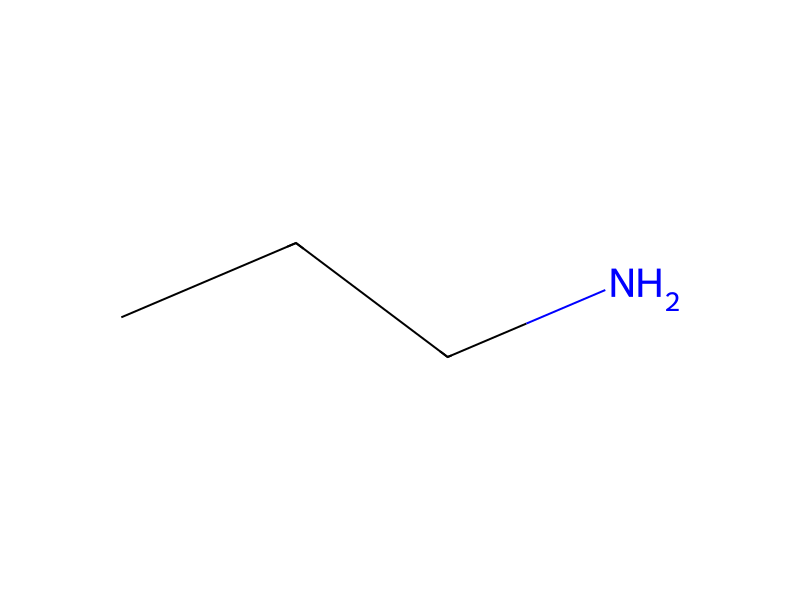
Propylamine → 5-Phenyl-6-(propylamino)pyrazine-2,3-dicarbonitrile
반응식

[C:1]([C:3]1[C:8]([C:9]#[N:10])=[N:7][C:6](Cl)=[C:5]([C:12]2[CH:17]=[CH:16][CH:15]=[CH:14][CH:13]=2)[N:4]=1)#[N:2].[CH2:18]([NH2:21])[CH2:19][CH3:20].[OH-].[Na+]>C1(C)C=CC=CC=1>[C:1]([C:3]1[C:8]([C:9]#[N:10])=[N:7][C:6]([NH:21][CH2:18][CH2:19][CH3:20])=[C:5]([C:12]2[CH:17]=[CH:16][CH:15]=[CH:14][CH:13]=2)[N:4]=1)#[N:2]참가 물질
5




실험 절차
2,3-Dicyano-5-chloro-6-phenylpyrazine (12.03 g; 0.05 mole) was dissolved in 1,400 ml of toluene. The solution was cooled to 5° to 10° C., and with stirring, 3.25 g (0.055 mole) of n-propylamine was added dropwise over the period of 10 minutes. Subsequently, 55 ml of a 1 N aqueous solution of sodium hydroxide was added dropwise over the period of 10 minutes. The mixture was then stirred at 5° to 10° C. for 30 minutes. After the reaction, the reaction mixture was separated into two layers. The toluene layer was concentrated under reduced pressure to obtain a solid. The solid was washed twice with 200 ml of water, dried under reduced pressure, and recrystallized successively from toluene and ethanol to afford 12.1 g (yield 92%) of 2,3-dicyano-5-n-propylamino-6-phenylpyrazine.