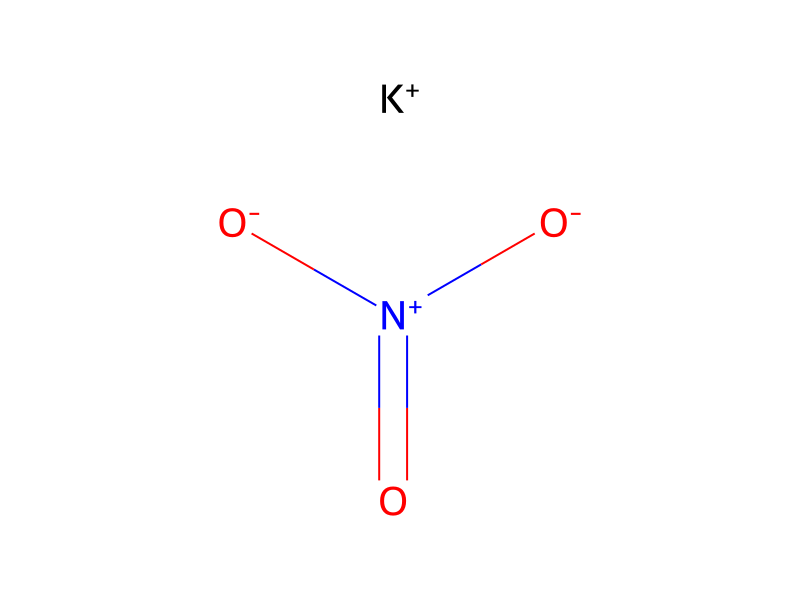
Phosphoric Acid → Nitrate
HRID 128900
반응식

[O-:1][Mo:2]([O-:5])(=[O:4])=[O:3].OP(O)(O)=O.[N+:11]([O-:14])([O-:13])=[O:12].[K+]>O.[OH-].[NH4+]>[O-:4][Mo:2]([O-:5])(=[O:3])=[O:1].[N+:11]([O-:14])([O-:13])=[O:12][O-:1][Mo:2]([O-:5])(=[O:4])=[O:3].OP(O)(O)=O.[N+:11]([O-:14])([O-:13])=[O:12].[K+]>O.[OH-].[NH4+]>[O-:4][Mo:2]([O-:5])(=[O:3])=[O:1].[N+:11]([O-:14])([O-:13])=[O:12]A molybdate solution was prepared from 9.21 g of (NH4)6Mo7O24 4H2O dissolved in 50 mL of deionized water and 33 mL of concentrated ammonium hydroxide. This solution was stirred until all components were soluble. Then 12.5 g of 7G type silica gel was added to the molybdate solution and stirred to ensure homogeneity. This mixture was placed in the Microfluidizer reservoir and recirculation through the machine was started while the internal pressure was adjusted to 9,000 psi. Through Port B shown in FIG. 2 was added over 30 minutes a solution composed of 3.79 g Ni(NO3)2. 6H2O, 6.32 g, Co(NO3)2. 6H2O, 5.27 g Fe(NO3)2.b 9H2O, 2.11 g Bi(NO3)3.5H2O, 0.43 g H3PO4 (80%), and 0.04g KNO3 which had been built to a total volume of 50 mL with distilled water. The pH of the solution dropped until the final addition of the solution through Port A reached a final pH of 5. The temperature of the effluent which was recirculated through the instrument was maintained between 40°-46° C. by passing the effluent pipe through an ice water heat exchanger. The product mixture was filtered using Whatman type 1001070 filter paper affording 35.94 g. of solid product. The solid was calcined by slowly heating from 100° to 540° C. over 6 hours and held at 540° C. for 1 hour. The calcining procedure resulted in a 32% weight loss due to the decomposition of nitrate salts and the product was light brown. The X-Ray diffraction pattern of this material is illustrated in FIG. 7B. This material demonstrated 9 major reflections between 20 to 35 degree two theta at 23.3, 25.5, 26.7, 27.2, 27.5, 28.4, 28.7, 32.0, and 33.7. It was noted that reflections between 20 to 35 degree two theta at 23.3, 25.5, 26.7, 27.2, 27.5, 28.4, 28.7, 32.0, and 33.7. It was noted that this diffraction pattern appeared to contain better defined reflections and fewer separate phase metal oxides as compared to the classically prepared sample shown in FIG. 7A and described below.