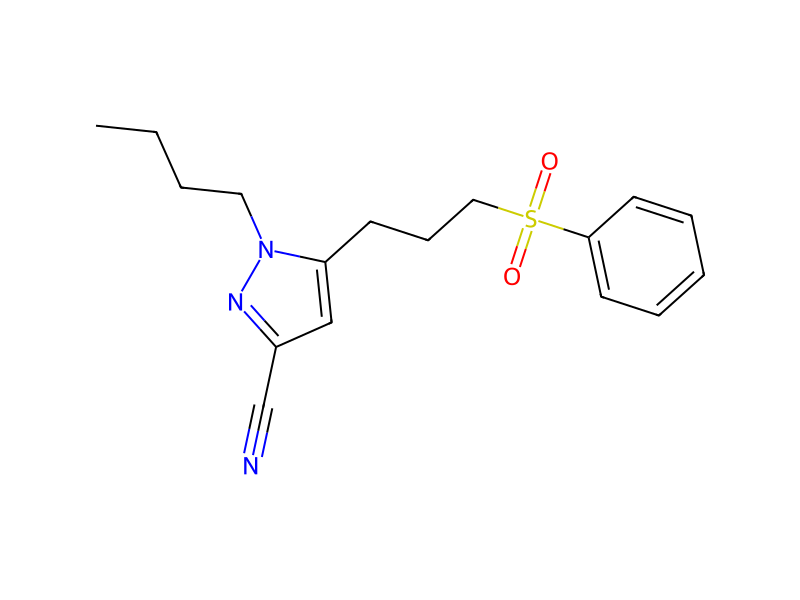
Potassium acetate (3.82 g, 38.9 mmol) was added to a solution of 5-(3-benzenesulfonylpropyl)-1-butyl-1H-pyrazole-3-carbonitrile (8.60 g, 25.9 mmol) in 50 mL of acetic acid. The reaction mixture was stirred until all solids had dissolved, followed by dropwise addition of bromine (1.33 mL, 25.9 mmol) over 5 minutes. The resultant red solution was stirred for 5 hours and aqueous sodium thiosulfate was added to quench excess bromine. The reaction mixture was concentrated under reduced pressure and the residue was diluted with 200 mL of water. The pH of the mixture was adjusted to 8-9 by slow addition of solid sodium carbonate followed by extraction with several portions of ethyl acetate. The combined organic layers were washed with brine, dried over magnesium sulfate, filtered, and concentrated under reduced pressure to afford an orange oil. Purification via flash column chromatography on silica gel (eluting with hexane:ethyl acetate in a gradient from 3:1 to 1:1) afforded 4.80 g of 5-(3-benzenesulfonylpropyl)-4-bromo-1-butyl-1H-pyrazole-3-carbonitrile as a colorless oil that crystallized upon standing.