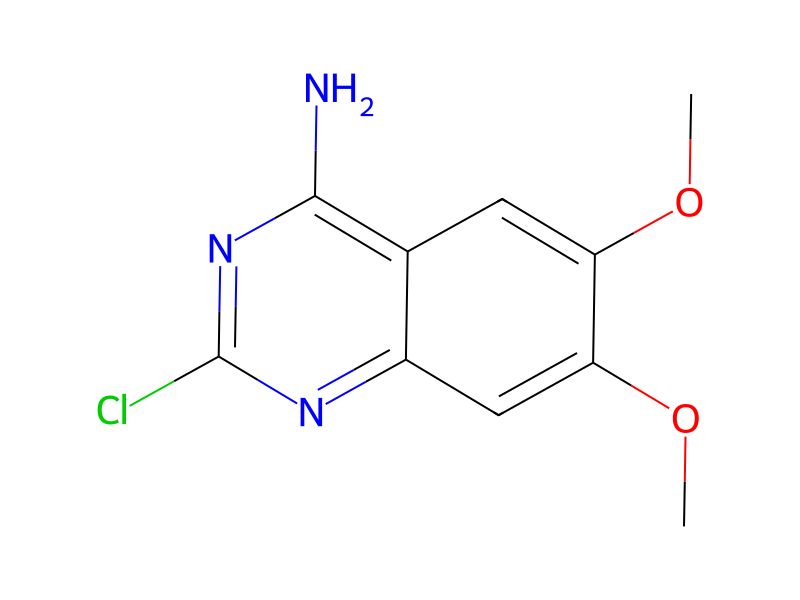
2-Chloro-6,7-dimethoxy-4-quinazolinamine → Terazosin Hydrochloride Anhydrous
HRID 1653671
반응식

[Cl:1][C:2]1[N:11]=[C:10]([NH2:12])[C:9]2[C:4](=[CH:5][C:6]([O:15][CH3:16])=[C:7]([O:13][CH3:14])[CH:8]=2)[N:3]=1.[O:17]1[CH2:21][CH2:20][CH2:19][CH:18]1[C:22]([N:24]1[CH2:29][CH2:28][NH:27][CH2:26][CH2:25]1)=[O:23]>COC(O)C>[ClH:1].[O:17]1[CH2:21][CH2:20][CH2:19][CH:18]1[C:22]([N:24]1[CH2:25][CH2:26][N:27]([C:2]2[N:11]=[C:10]([NH2:12])[C:9]3[C:4](=[CH:5][C:6]([O:15][CH3:16])=[C:7]([O:13][CH3:14])[CH:8]=3)[N:3]=2)[CH2:28][CH2:29]1)=[O:23]참가 물질
4


실험 절차
To 7.00 g 2-chloro-4-amino-6,7-dimethoxyquinazoline (Lancaster Synthesis) in 50 ml methoxyethanol was added 10.8 g, tetrahydrofuroylpiperazine, and the mixture refluxed 3 hours. The clear solution was concentrated and an aqueous solution of potassium bicarbonate was added. The resultant solid that formed was filtered and washed with water. It was then added to methanol and the resulting suspension was acidified with a solution of hydrogen chloride in isopropyl alcohol. The resulting solution was concentrated and the residue crystallized from isopropyl alcohol giving 8.12 g. of product, m.p. 278°-279° C.