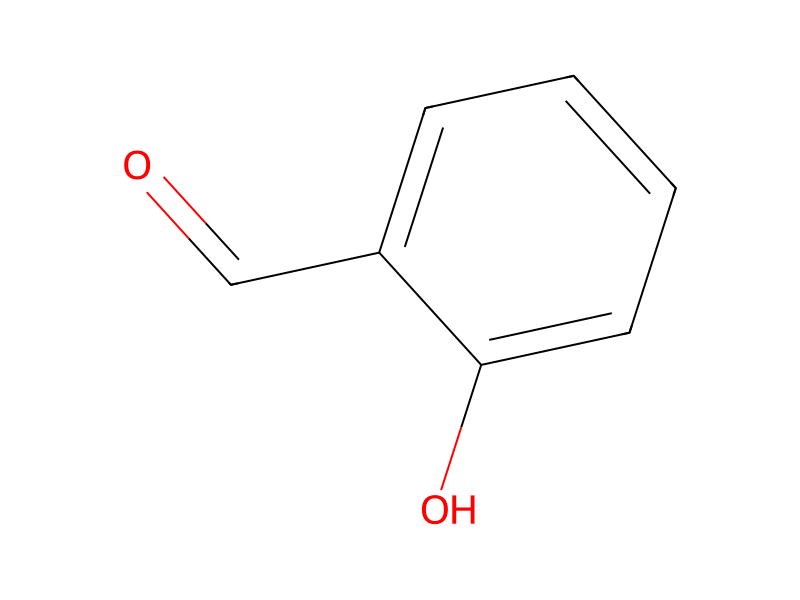
[OH:1][C:2]1[CH:9]=[CH:8][CH:7]=[CH:6][C:3]=1[CH:4]=O.[CH3:10][C:11]1[N:12]([C:17]2[N:22]=[CH:21][C:20]([C:23](=[O:25])[CH3:24])=[CH:19][CH:18]=2)[C:13]([CH3:16])=[CH:14][CH:15]=1.Cl>[OH-].[Na+].CCO>[CH3:10][C:11]1[N:12]([C:17]2[N:22]=[CH:21][C:20]([C:23](=[O:25])/[CH:24]=[CH:4]/[C:3]3[CH:6]=[CH:7][CH:8]=[CH:9][C:2]=3[OH:1])=[CH:19][CH:18]=2)[C:13]([CH3:16])=[CH:14][CH:15]=1To a vigorously stirred solution of 2-hydroxybenzaldehyde in 2.5N NaOH (2.2 mL) at 0° C. was added 1-[6-(2,5-dimethyl-1H-pyrrol-1-yl)pyridin-3-yl]ethanone (prepared by a method analogous to that described by Scott et al., Org. Proc. Res. And Dev., 8:587 (2004)) (0.58 g, 2.7 mmol) in EtOH (2 mL). The reaction mixture was allowed to stir and warm to rt whereupon an additional 1 mL of EtOH was added. The mixture turned a dark red color and was allowed to stir for 25 h. The reaction was neutralized by the addition of 1M HCl and the mixture was extracted with EtOAc. The organic solutions were combined, dried over MgSO4, filtered, and concentrated. The residue was purified by column chromatography to give (2E)-1-[6-(2,5-dimethyl-1H-pyrrol-1-yl)pyridin-3-yl]-3-(2-hydroxyphenyl)prop-2-en-1-one as a yellow solid (0.31 g, 36%). LCMS: (FA) ES+ 319.2 (M+1).