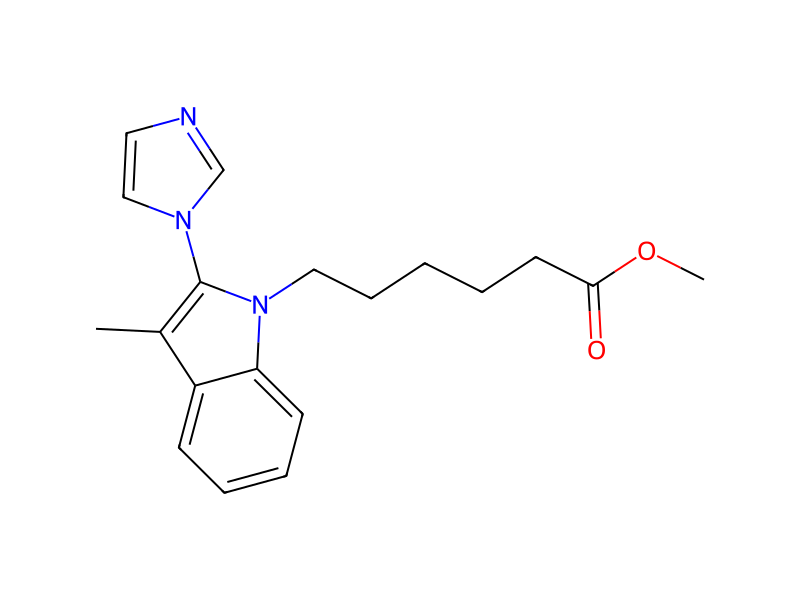
C[O:2][C:3]([CH2:5][CH2:6][CH2:7][CH2:8][CH2:9][N:10]1[C:18]2[C:13](=[CH:14][CH:15]=[CH:16][CH:17]=2)[C:12]([CH3:19])=[C:11]1[N:20]1[CH:24]=[CH:23][N:22]=[CH:21]1)=[O:4].[OH-].[Na+].[ClH:27]>C(O)C.C(OCC)C>[ClH:27].[C:3]([CH2:5][CH2:6][CH2:7][CH2:8][CH2:9][N:10]1[C:18]2[C:13](=[CH:14][CH:15]=[CH:16][CH:17]=2)[C:12]([CH3:19])=[C:11]1[N:20]1[CH:24]=[CH:23][N:22]=[CH:21]1)([OH:4])=[O:2]A mixture of 1-(5-methoxycarbonylpentyl)-2-(1-imidazolyl)-3-methylindole (1.80 g) and 30 ml of 3N NaOH is stirred at room temperature for 1.3 hours. The resulting clear, yellow solution is neutralized to pH 6 with 2N HCl. The resulting suspension is extracted with ethyl acetate (2×50 ml). The organic extract is washed with a saturated NaCl solution (1×25 ml), dried (MgSO4), filtered, and concentrated in vacuo to give a cream-colored solid. The solid is dissolved in ethanol and the solution treated with 0.6 ml of 6.5N HCl in ethanol. The solution is diluted with diethyl ether and after standing for several hours the precipitate which forms is collected by filtration to give 1-(5-carboxypentyl)-2-(1-imidazolyl)-3-methylindole hydrochloride, m.p. 177.5°-180.5° decomposition.