1-Butanol → 1,3-Dibutoxy-1,1,3,3-tetrabutyldistannoxane
반응식

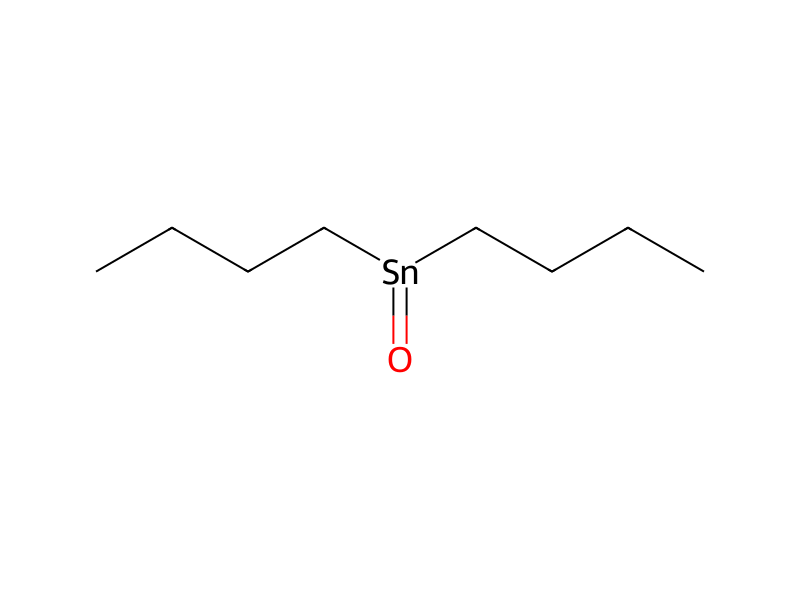
[CH2:1]([Sn:5](=[O:10])[CH2:6][CH2:7][CH2:8][CH3:9])[CH2:2][CH2:3][CH3:4].[CH2:11]([OH:15])[CH2:12][CH2:13][CH3:14]>>[CH2:1]([Sn:5]([CH2:6][CH2:7][CH2:8][CH3:9])([O:15][CH2:11][CH2:12][CH2:13][CH3:14])[O:10][Sn:5]([CH2:6][CH2:7][CH2:8][CH3:9])([CH2:1][CH2:2][CH2:3][CH3:4])[O:15][CH2:11][CH2:12][CH2:13][CH3:14])[CH2:2][CH2:3][CH3:4]참가 물질
3


실험 절차
692 g (2.78 mol) of di-n-butyl tin oxide and 2000 g (27 mol) of 1-butanol (Wako Pure Chemical Industries, Ltd., Japan) were placed in a 3000 mL volumetric pear-shaped flask. The flask containing the white, slurry-like mixture was attached to an evaporator to which was connected an oil bath equipped with a temperature controller, a vacuum pump and a vacuum controller. The purge valve outlet of this evaporator was connected to a line containing nitrogen gas flowing at normal pressure. After closing the purge valve of the evaporator and reducing pressure inside the system, the purge valve was opened gradually to allow nitrogen to flow into the system and return to normal pressure. The oil bath temperature was set to about 126° C., the flask was immersed in the oil bath and rotation of the evaporator was started. After rotating, stirring and heating for about 30 minutes at normal pressure with the purge valve of the evaporator left open, the mixture boiled and distillation of the low boiling point component began. After maintaining in this state for 8 hours, the purge valve was closed, pressure inside the system was gradually reduced, and residual low boiling point component was distilled off with the pressure inside the system at 76 to 54 kPa. After the low boiling point component no longer appeared, the flask was taken out of the oil bath. The reaction liquid was in the form of a clear liquid. The flask was subsequently taken out of the oil bath, the purge valve was opened gradually and the pressure inside the system was returned to normal pressure. 952 g of Reaction liquid were obtained in the flask. Based on the results of 119Sn, 1H and 13C-NMR analyses, a product in the form of 1,1,3,3-tetra-n-butyl-1,3-di(n-butyloxy)distannoxane was obtained at a yield of 99% based on di-n-butyl tin oxide. The same procedure was then repeated 12 times to obtain a total of 11480 g of 1,1,3,3-tetra-n-butyl-1,3-di(n-butyloxy)distannoxane.