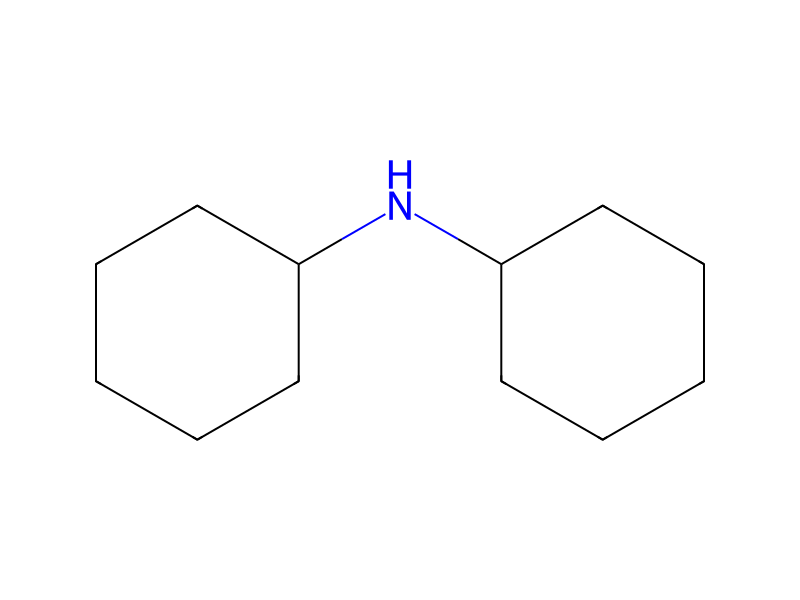
A solution of methyl 3-oxotetradecanoate (19 g, 0.074 mol) in MeOH (100 mL) was degassed by sparging with argon (15 min). [(R)-Ru(Binap)Cl]2.NEt3 catalyst (0.187 g, 0.111 mmol) and 2 N aqueous HCl (0.5 mL) were added and the resulting mixture was hydrogenated at 60 psig and 40–50° C. for 18 h. The reaction was diluted with hexanes (250 mL), filtered through a short column of silica gel, and concentrated. The crude product was dissolved in tetrahydrofuran (THF; 200 mL), treated 2.4 N aqueous LiOH (83 mL, 0.2 mol) and stirred vigorously at room temperature for 4 h. The resulting slurry was partitioned between ether (200 mL) and 1 N aqueous HCl (200 mL) and the layers separated. The aqueous layer was extracted with ether (100 mL) and the combined ethereal extracts were dried (Na2SO4) and concentrated. The crude hydroxy acid was dissolved in hot acetonitrile (250 mL), treated with dicyclohexylamine (DCHA; 17 mL, 0.085 mol) and stirred at 60° C. for 1 h. The product that crystallized upon cooling was collected and recrystallized from acetonitrile (650 mL) to yield 28.6 g (91%) of dicyclohexylammonium (R)-3-hydroxytetradecanoate as a colorless solid: mp 94–95° C.; 1H NMR (CDCl3) δ 0.88 (˜t, 3 H, J˜6.5 Hz), 1.05–1.58 (m, 24 H), 1.65 (m, 2 H), 1.80 (m, 4 H), 2.01 (br d, 4 H) 2.18 (dd, 1 H, J=15.7, 9.4 Hz), 2.36 (dd, 1 H, J=15.7, 2.6 Hz), 2.94 (m, 2 H), 3.84 (m, 1 H)