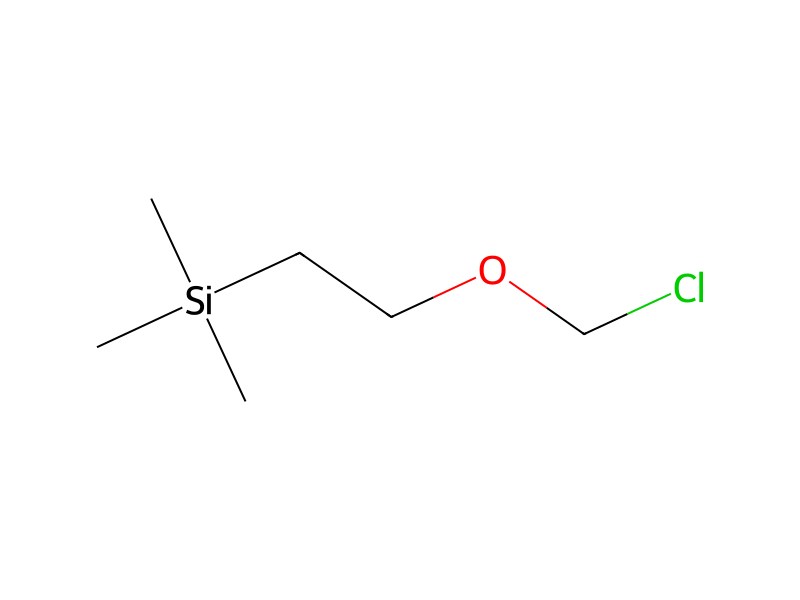
[H-].[Na+].[Cl:3][C:4]1[N:9]=[C:8]2[NH:10][CH:11]=[CH:12][C:7]2=[C:6]([N+:13]([O-:15])=[O:14])[CH:5]=1.[CH3:16][Si:17]([CH3:24])([CH3:23])[CH2:18][CH2:19][O:20][CH2:21]Cl>CN(C)C=O>[Cl:3][C:4]1[N:9]=[C:8]2[N:10]([CH2:21][O:20][CH2:19][CH2:18][Si:17]([CH3:24])([CH3:23])[CH3:16])[CH:11]=[CH:12][C:7]2=[C:6]([N+:13]([O-:15])=[O:14])[CH:5]=1At 0° C. and under an atmosphere of argon, 1.34 g (28.3 mmol) of sodium hydride (60% in mineral oil) are added in small portions to a solution of 5.6 g (28.3 mmol) of 6-chloro-4-nitro-1H-pyrrolo[2,3-b]pyridine in dimethylformamide (50 ml), and the suspension is stirred at RT for 30 minutes. The mixture is once more cooled to 0° C., 5.3 ml (29.8 mmol of 2-(trimethylsilyl)ethoxymethyl chloride are added dropwise and the mixture is allowed to stir at room temperature for 2 h. The suspension is poured into ice-water (250 ml) and stirred until the mixture has reached RT. The mixture is then extracted with ethyl acetate (three times 50 ml) and the organic phase is washed with saturated sodium chloride solution. The solution is dried over magnesium sulfate and concentrated. The residue is purified by column chromatography on silica gel (mobile phase: cyclohexane/ethyl acetate 6:1).

불러오는 중…