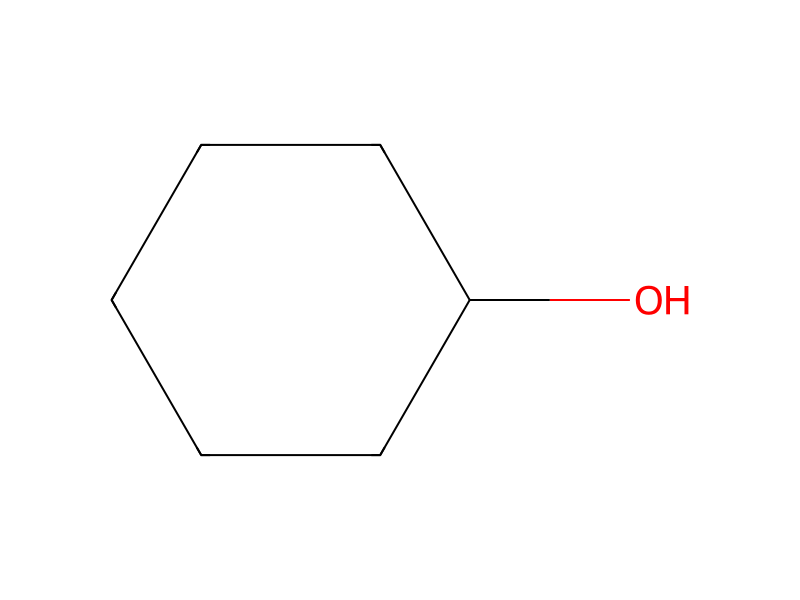
Guaiacol → Methoxycyclohexanol
HRID 2421585
반응식

[C:1]1([OH:8])([OH:7])[CH2:6][CH2:5][CH2:4][CH2:3][CH2:2]1.[CH:9]1(O)CCCCC1.COC1CCCCC1O.C1(O)C=CC=CC=1.C1(OC)C(=CC=CC=1)O>CO>[CH3:9][O:7][C:1]1([OH:8])[CH2:6][CH2:5][CH2:4][CH2:3][CH2:2]1[C:1]1([OH:8])([OH:7])[CH2:6][CH2:5][CH2:4][CH2:3][CH2:2]1.[CH:9]1(O)CCCCC1.COC1CCCCC1O.C1(O)C=CC=CC=1.C1(OC)C(=CC=CC=1)O>CO>[CH3:9][O:7][C:1]1([OH:8])[CH2:6][CH2:5][CH2:4][CH2:3][CH2:2]1
Ruthenium Catalyzed Hydrogenations. For guaiacol hydrogenation in the presence of ruthenium catalyst the products were similar to those identified earlier in our laboratory. At 150° C., 54% of the guaiacol had already been converted by the time the reactor reached temperature, time zero in FIG. 1. The primary product was that resulting from saturation of the phenolic ring, 2-methoxycyclohexanol (40% yield @ 1 h). Cyclohexanediol was the secondary product (8%), although cyclohexanol was also significant (4%). The methanol byproduct was found (1%). There was little phenol formed at this temperature. At 200° C. the initial conversion of guaiacol during heatup was 62%. As shown in FIG. 2 the methoxycyclohexanols were still the main product (38% yield @ 4 h), but cyclohexanediol became less important (3%) while more cyclohexanol was formed (8%). More methanol was present (2%), as was more phenol. At 250° C., 60% of the guaiacol was converted by the time the reactor reached temperature. As shown in FIG. 3 cyclohexanol almost surpassed methoxycyclohexanols as the main product. Methoxycyclohexanol yield peaked at 17% in the 1 to 2 h range before reacting on to secondary products. The maximum cyclohexanol yield was 13%. Cyclohexanediol was only a minor product (1%). More phenol was evident and cyclohexane became a significant product (2%); however, the hexane recovery is likely limited by its low solubility in the water. More cyclohexane may have been actually produced and remained in the reactor as a separate light phase, which could not be sampled by our method. Over the period of the test, the amount of aqueous phase products is reduced. A large methane gas product was produced in this test, as has been reported for processing at these conditions of temperature and catalyst wherein phenol was extensively gasified at as low as 250° C.xi. At 300° C., phenol is the primary product that was recoverable. Cyclohexanol and methoxycyclohexanol are early products which are reduced to low levels within the first hour at temperature. All three isomers of methyl-phenol (cresols) are significant byproducts, as is benzene. Cyclohexane is present in the water product only at low concentration, but is likely present as a significant product in a separate phase. Because of the large amount of methane gas formation, this test was hydrogen limited with the reactor pressure surpassing the pressure set point after 1 h of operation and this factor is expected to have skewed the mechanism away from the high-use hydrogenation pathways, such as saturation of the aromatic ring. xi Elliott, D. C.; Hart, T. R.; Neuenschwander, G. G. “Chemical Processing in High-Pressure Aqueous Environments. 8. Improved Catalysts for Hydrothermal Gasification.” Ind. Eng. Chem. Res. 45(11) 3776-81, 2006.