Carbon tetrabromide → 4-(Bromomethyl)-1-(4-fluorophenyl)pyrrolidin-2-one
HRID 271237
반응식
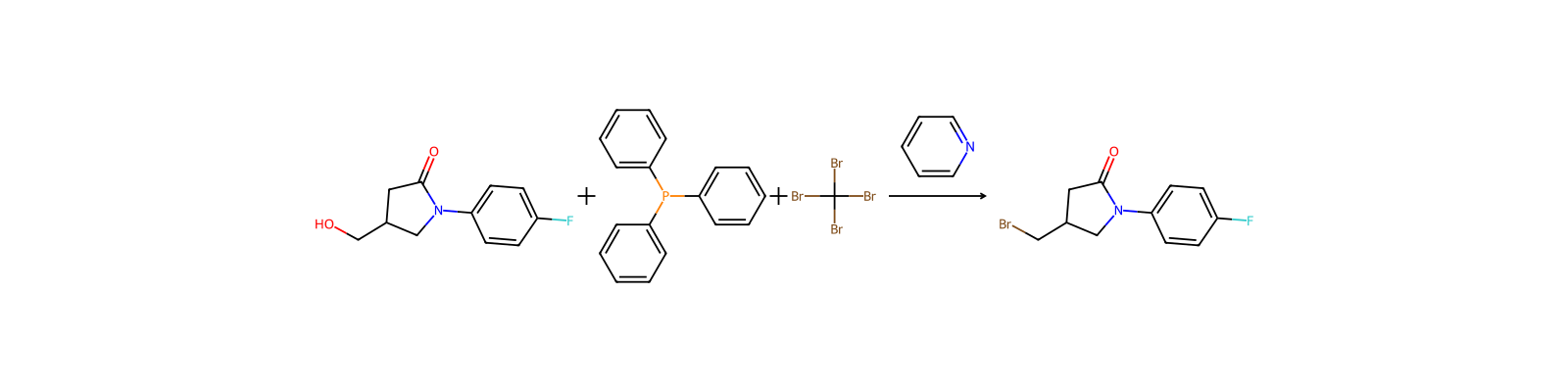
[F:1][C:2]1[CH:7]=[CH:6][C:5]([N:8]2[CH2:12][CH:11]([CH2:13]O)[CH2:10][C:9]2=[O:15])=[CH:4][CH:3]=1.C1(P(C2C=CC=CC=2)C2C=CC=CC=2)C=CC=CC=1.C(Br)(Br)(Br)[Br:36]>N1C=CC=CC=1>[Br:36][CH2:13][CH:11]1[CH2:12][N:8]([C:5]2[CH:6]=[CH:7][C:2]([F:1])=[CH:3][CH:4]=2)[C:9](=[O:15])[CH2:10]1참가 물질
5





실험 절차
To a cooled solution of 1-(4-fluorophenyl)-4-(hydroxymethyl)pyrrolidin-2-one (0.05 g, 0.25 mmol) in pyridine (3 ml) was added triphenylphosphine (0.130 g, 0.5 mmol). The solution was stirred and carbon tetrabromide (0.08 g, 0.25 mmol) was added in 3 separate portions. The reaction mixture was then allowed to warm to room temperature and stirred for three hours. The reaction was quenched with methanol and the solvent removed. The residue was dissolved in EtOAc (75 ml) and sequentially washed with ammonium chloride (sat, 2×25 ml) and water (25 ml). The organic layer was concentrated and purified using preparative tlc (1:1 EtOac:Hexanes) to yield 4-(bromomethyl)-1-(4-fluorophenyl)pyrrolidin-2-one (HNMR).