Diisopropylethylamine → 5-Bromo-2-(2-{[2-(trimethylsilyl)ethoxy]methoxy}propan-2-yl)pyridine
반응식

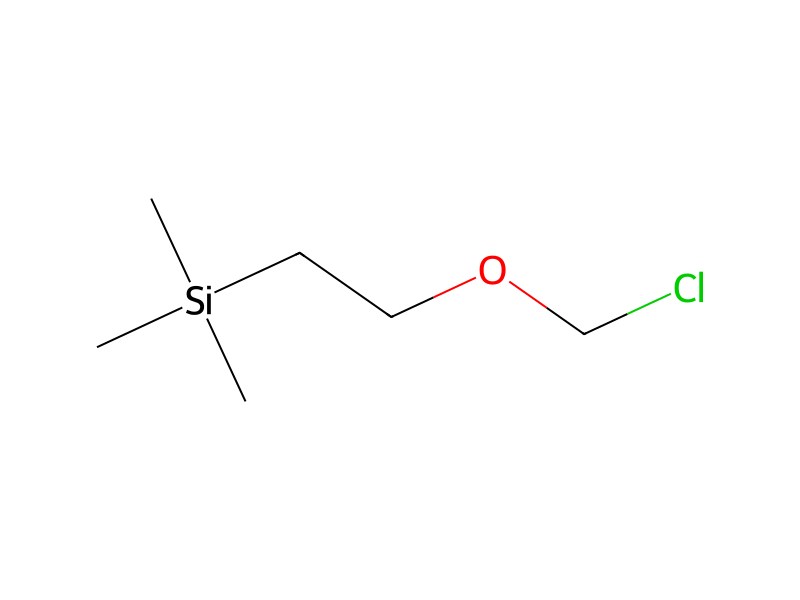
[Br:1][C:2]1[CH:3]=[CH:4][C:5]([C:8]([OH:11])([CH3:10])[CH3:9])=[N:6][CH:7]=1.C(N(CC)C(C)C)(C)C.[CH3:21][Si:22]([CH3:29])([CH3:28])[CH2:23][CH2:24][O:25][CH2:26]Cl>C(Cl)Cl>[Br:1][C:2]1[CH:3]=[CH:4][C:5]([C:8]([CH3:9])([O:11][CH2:26][O:25][CH2:24][CH2:23][Si:22]([CH3:29])([CH3:28])[CH3:21])[CH3:10])=[N:6][CH:7]=1참가 물질
5




실험 절차
To a solution of 5-bromo-2-(1-hydroxy-1-methylethyl)pyridine from Step 1 (14 mmol) in methylene chloride (50 mL) at 0° C. was added N,N-diisopropylethylamine (37.3 mmol) and 2-(trimethylsilyl)ethoxymethyl chloride (15.3 mmol). The resulting mixture was stirred at room temperature for 18 hours, then refluxed for 24 hours. After cooling to room temperature the mixture was quenched with saturated aqueous ammonium chloride solution and partitioned between methylene chloride and water. The crude product from the organic phase was chromatographed on silica gel eluting with 6% ethyl acetate in hexane to afford the 5-bromo-2-(1-methyl-1-{[2-(trimethylsilyl)ethoxy]methoxy}ethyl)pyridine compound.