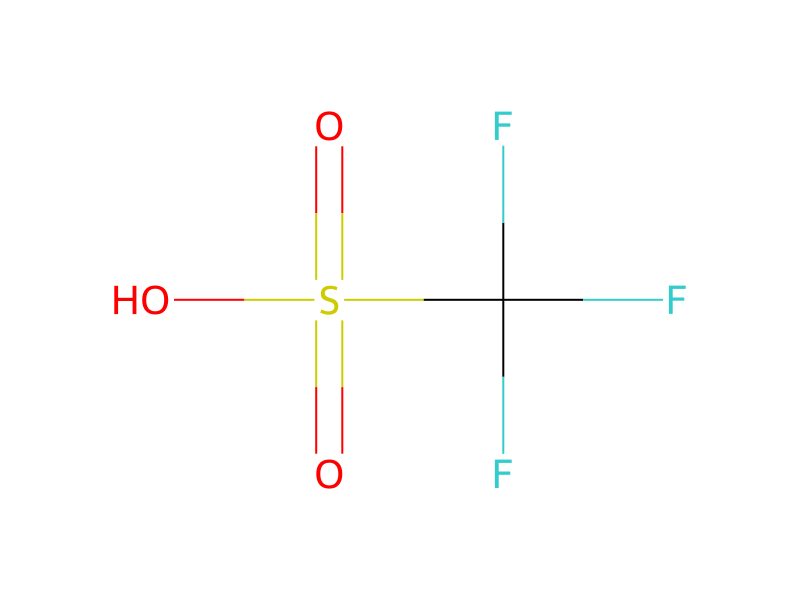
Trifluoromethanesulfonic acid → 5-[4-Fluoro-5-iodo-2-(1-methylethyl)phenoxy]-2,4-pyrimidinediamine
반응식

[F:1][C:2]1[CH:16]=[CH:15][C:5]([O:6][C:7]2[C:8]([NH2:14])=[N:9][C:10]([NH2:13])=[N:11][CH:12]=2)=[C:4]([CH:17]([CH3:19])[CH3:18])[CH:3]=1.FC(S(O)(=O)=O)(F)F.[I:28]N1C(=O)CCC1=O>C1COCC1>[F:1][C:2]1[C:16]([I:28])=[CH:15][C:5]([O:6][C:7]2[C:8]([NH2:14])=[N:9][C:10]([NH2:13])=[N:11][CH:12]=2)=[C:4]([CH:17]([CH3:19])[CH3:18])[CH:3]=1참가 물질
5



실험 절차
5-(4-Fluoro-2-isopropyl-phenoxy)-pyrimidine-2,4-diamine (400 mg, 1.53 mmol, prepared using the procedure of example 1) was dissolved in dry THF at ice bath temperature, and trifluoromethylsulfonic acid (0.67 mL, 7.63 mmol) was added. After stirring for 10 minutes, N-iodosuccinimide (378 g, 1.68 mmol) was added in portions. The ice bath was removed and the reaction mixture was stirred for three hours. The reaction mixture was then poured over ice and extracted with dichloromethane. The combined organic layers were washed with 10% aqueous sodium bisulfite solution and water, dried over Na2SO4, filtered and concentrated under reduced pressure. The residue was chromatographed on silica (95%:5%:1% CH2Cl2:MeOH:NH4OH) to give 338 mg of 5-(4-fluoro-5-iodo-2-isopropyl-phenoxy)-pyrimidine -2,4-diamine, MS (M+H)=389.