홈MCP워크벤치Skills
홈워크벤치알림마이페이지
llms.txt · MCP 가이드개인정보처리방침 · 이용약관 · 지원v1.8.3
  1. 홈
  2. /반응

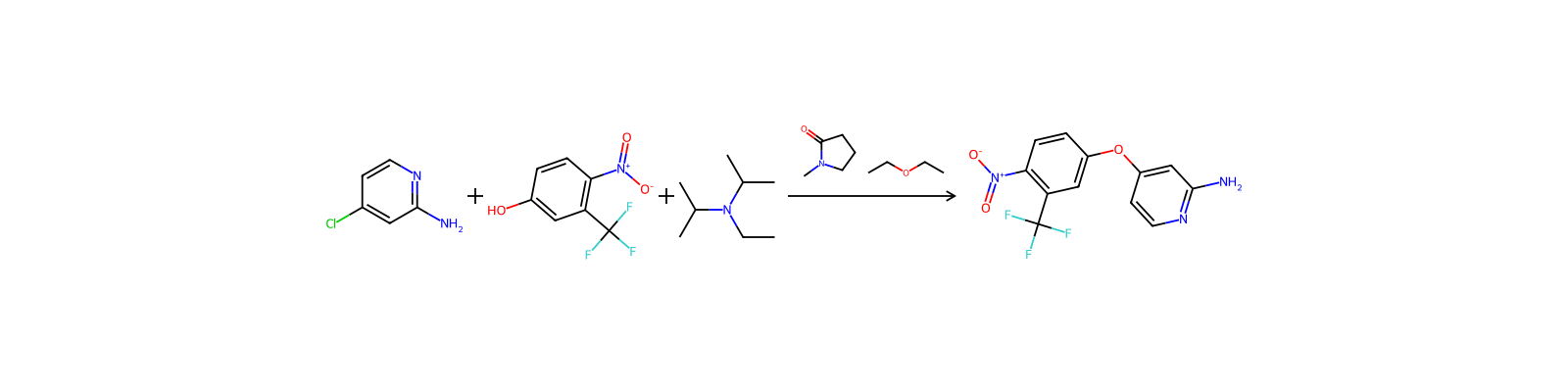
4-Nitro-3-trifluoromethylphenol → 4-(4-Nitro-3-trifluoromethylphenoxy)pyridin-2-ylamine

HRID 492709
인쇄

반응식

HRID 492709 반응식
[NH2:1][C:2]1[CH:7]=[C:6](Cl)[CH:5]=[CH:4][N:3]=1.[OH:9][C:10]1[CH:11]=[CH:12][C:13]([N+:20]([O-:22])=[O:21])=[C:14]([C:16]([F:19])([F:18])[F:17])[CH:15]=1.C(N(C(C)C)CC)(C)C>CN1CCCC1=O.C(OCC)C>[N+:20]([C:13]1[CH:12]=[CH:11][C:10]([O:9][C:6]2[CH:5]=[CH:4][N:3]=[C:2]([NH2:1])[CH:7]=2)=[CH:15][C:14]=1[C:16]([F:17])([F:18])[F:19])([O-:22])=[O:21]
참가 물질반응 조건실험 절차후처리출처 및 근거반응 노트

참가 물질

6

반응물 3

HCID 69314-Nitro-3-trifluoromethylphenolHCID 81531DiisopropylethylamineHCID 5818662-Amino-4-chloropyridine

생성물 1

HCID 231531074-(4-Nitro-3-trifluoromethylphenoxy)pyridin-2-ylamine수율 16.3%

시약·촉매·용매 2

HCID 3283Diethyl Ether용매
HCID 13387
N-methyl-2-pyrrolidone
용매

반응 조건

온도
150 °C

실험 절차

To a solution of 2-amino-4-chloropyridine (2.0 g, 15.6 mmol) in N-methylpyrrolidone (16 ml) were added 5-hydroxy-2-nitrobenzotrifluoride (4.85 g, 23.4 mmol) and diisopropylethylamine (8.15 ml, 46.8 mmol), followed by stirring under a nitrogen atmosphere to heat at 150° C. for 62 hrs. The reaction mixture was cooled down to room temperature and the diisopropylethylamine was evaporated under a reduced pressure. The resultant residue was partitioned between ethyl acetate:tetrahydrofuran=1:1 (300 ml) and a 1 N aqueous solution of sodium hydroxide (100 ml). The organic layer was washed with a 1 N aqueous solution of sodium hydroxide and brine in this order, and dried over anhydrous sodium sulfate. The solvent was evaporated to give a residue, which was then purified by silica gel column chromatography (eluent; heptane/ethyl acetate=1/2, ethyl acetate, then ethyl acetate/methanol=20/1). The crude product was subjected to silica gel filtration (Fuji Silysia NH) The filtrate was concentrated to give a solid, which was then suspended in diethyl ether:hexane=1:1, filtered, and dried under aeration to provide the titled compound (760 mg, 16.3%) as a brown solid.
후처리

  1. temperatureThe reaction mixture was cooled down to room temperature
  2. customthe diisopropylethylamine was evaporated under a reduced pressure
  3. customThe resultant residue was partitioned between ethyl acetate
  4. washThe organic layer was washed with a 1 N aqueous solution of sodium hydroxide and brine in this order
  5. dry with materialdried over anhydrous sodium sulfate
  6. customThe solvent was evaporated
  7. customto give a residue, which
  8. customwas then purified by silica gel column chromatography (eluent
  9. filtrationThe crude product was subjected to silica gel filtration (Fuji Silysia NH) The filtrate
  10. concentrationwas concentrated
  11. customto give a solid, which
  12. filtrationhexane=1:1, filtered
  13. customdried under aeration

출처 및 근거

ORD 기록
ord-32be1cd7737d4c6a8825a97da61989bd
출처 데이터셋
uspto-grants-2009_05
DOI
10.6084/m9.figshare.5104873.v1
특허 번호
US07531532B2

반응 노트

이 페이지에서참가 물질반응 조건실험 절차후처리출처 및 근거반응 노트


