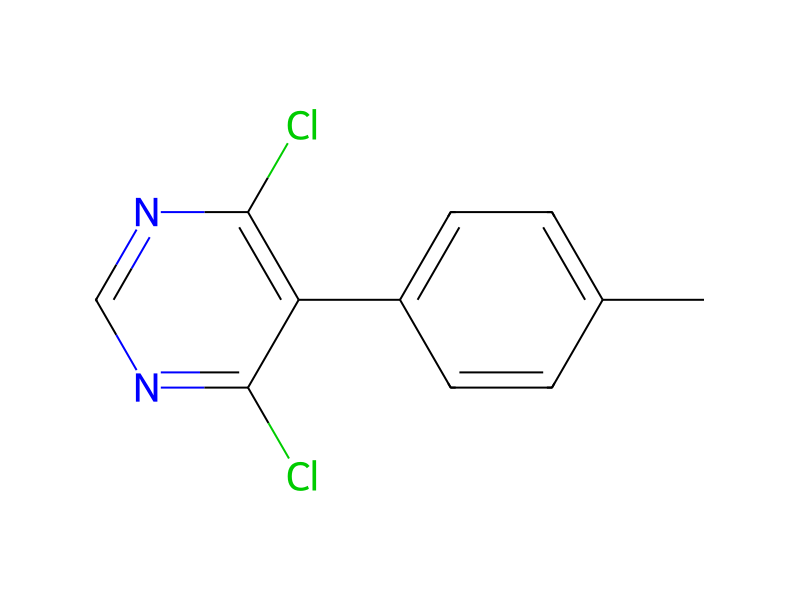
Cl[C:2]1[C:7]([C:8]2[CH:13]=[CH:12][C:11]([CH3:14])=[CH:10][CH:9]=2)=[C:6]([Cl:15])[N:5]=[CH:4][N:3]=1.C(N(C(C)C)CC)(C)C.[K+].[C:26]1([CH:32]=[CH:33][S:34]([NH-:37])(=[O:36])=[O:35])[CH:31]=[CH:30][CH:29]=[CH:28][CH:27]=1.C(OCC)C>CS(C)=O>[Cl:15][C:6]1[N:5]=[CH:4][N:3]=[C:2]([NH:37][S:34]([CH:33]=[CH:32][C:26]2[CH:31]=[CH:30][CH:29]=[CH:28][CH:27]=2)(=[O:35])=[O:36])[C:7]=1[C:8]1[CH:13]=[CH:12][C:11]([CH3:14])=[CH:10][CH:9]=1To 4,6-dichloro-5-p-tolyl-pyrimidine (2.0 g) disolved in DMSO (35 ml) was added di-isopropyl-ethyl-amine (1.46 ml) followed by 2-phenyl-ethenesulfonamide potassium salt (2.78 g). The mixture was stirred for 48 h at rt then poured onto water (500 ml) and diethylether (250 ml) was added and the solution was stirred for 30 minutes. The layers were separated and the water layer was acidified with acetic acid (2.0 ml) and cooled to 0° C. for 1 h. The precipitated product was filtered off and washed with water and diethylether and dried to give 2-phenyl-ethenesulfonic acid(6-chloro-5-p-tolyl-pyrimidin-4-yl)-amide (2.02 g). tR=5.32 (LC); M+=386.23 (ES+); M−=384.22 (ES−).