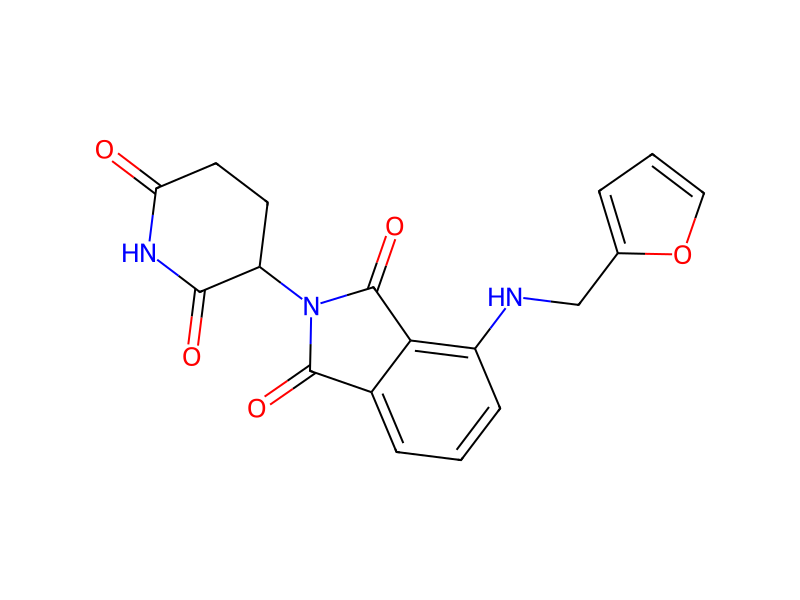
Furfural → 2-(2,6-Dioxo(3-piperidyl))-4-[(2-furylmethyl)amino]isoindoline-1,3-dione
반응식
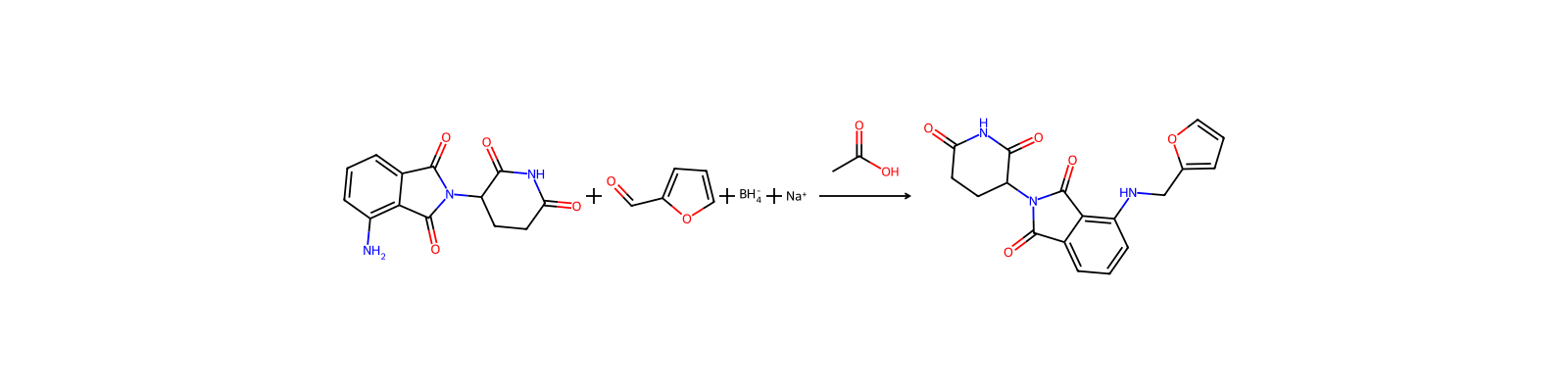
[NH2:1][C:2]1[CH:10]=[CH:9][CH:8]=[C:7]2[C:3]=1[C:4](=[O:20])[N:5]([CH:12]1[CH2:17][CH2:16][C:15](=[O:18])[NH:14][C:13]1=[O:19])[C:6]2=[O:11].[O:21]1[CH:25]=[CH:24][CH:23]=[C:22]1[CH:26]=O.[BH4-].[Na+]>C(O)(=O)C>[O:19]=[C:13]1[CH:12]([N:5]2[C:4](=[O:20])[C:3]3[C:7](=[CH:8][CH:9]=[CH:10][C:2]=3[NH:1][CH2:26][C:22]3[O:21][CH:25]=[CH:24][CH:23]=3)[C:6]2=[O:11])[CH2:17][CH2:16][C:15](=[O:18])[NH:14]1참가 물질
5




실험 절차
To a suspension of 4-amino-2-(2,6-dioxo(3-piperidyl))isoindoline-1,3-dione (0.55 g, 2 mmol) in acetic acid (20 ml) was added furan-2-carbaldehyde (0.20 g, 2.05 mmol). The mixture was heated to reflux for 5 hours and allowed to cool at room temperature. Sodium borohydride (80 mg, 2 mmol) was added to the reaction mixture. The reaction mixture was stirred for 24 hours. The solvent was evaporated in vacuo and the residue was dissolved in ethyl acetate (100 ml), washed with H2O (3×100 ml), saturated aqueous NaHCO3 (2×100 ml), brine (1×100 ml), and dried. The solvent was evaporated and the residue was purified by chromatography (ethyl acetate/hexane, 1:1) to give 0.25 g (35%) of product as a yellow solid: mp 171–173° C.; 1H NMR (DMSO-d6) δ 11.10 (s, 1H), 7.58 (t, J=7.1 Hz, 2H), 7.18 (d, J=8.6 Hz, 1H), 7.08–6.97 (m, 2H), 6.39–6.36 (m, 2H), 5.06 (dd, J=5.2 and 12.4 Hz, 1H), 4.57 (d, J=6.0 Hz, 2H), 2.96–2.82 (m, 1H), 2.63–2.46 (m, 2H), 2.06–2.02 (m, 1H; 13C NMR (DMSO-d6) δ 172.76, 170.01, 168.75, 167.21, 151.97, 145.81, 142.42, 136.05, 132.09, 117.60, 111.04, 110.42, 109.73, 107.38, 48.57,30.95,22.10; Anal. Calcd. For C18H15N3O5: C, 61.19; H, 4.28; N, 11.89. Found: C, 61.02; H, 4.24; N, 11.81.