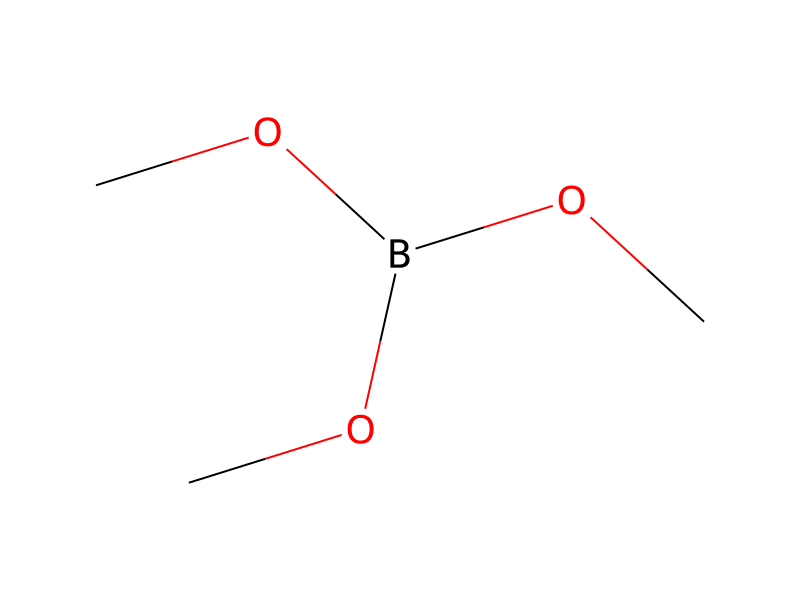
Trimethyl borate → HCID 18795258, compound
Reaction equation

C([Li])CCC.[CH2:6]([C:13]1[CH:14]=[CH:15][C:16]([C:19]2[CH:24]=[CH:23][C:22](Br)=[CH:21][CH:20]=2)=[N:17][CH:18]=1)[CH2:7][CH2:8][CH2:9][CH2:10][CH2:11][CH3:12].[B:26](OC)([O:29]C)[O:27]C>C1COCC1>[CH2:6]([C:13]1[CH:14]=[CH:15][C:16]([C:19]2[CH:24]=[CH:23][C:22]([B:26]([OH:29])[OH:27])=[CH:21][CH:20]=2)=[N:17][CH:18]=1)[CH2:7][CH2:8][CH2:9][CH2:10][CH2:11][CH3:12]Participants
5
Reactant 3


Product 1

Reagents, catalysts & solvents 1

Conditions
- Temperature
- -60 °C
Procedure
9 ml of n-butyl lithium (1.68M hexane solution) was added dropwise to a solution of 5 g of 5-heptyl-2-(4-bromophenyl) pyridine prepared by the method described in Toku-Kai-Sho 60-163864 in 100 ml of THF with maintaining at -60° C. After stirring for 30 minutes with maintaining at -60° C., 3 g of trimethyl borate was added and stirred for further 1 hour. After the inner temperature was recovered gradually to the room temperature, 40 ml of 6N hydrochloric acid was added and then THF was distilled off. The formed solid was filtered and recrystallized, to obtain 3 g of 4-(5-heptylpyridin-2-yl)phenyl boronic acid. Melting point; 206-214° C.
Workup
- customprepared by the method
- temperaturewith maintaining at -60° C.
- stirringstirred for further 1 hour
- customAfter the inner temperature was recovered gradually to the room temperature, 40 ml of 6N hydrochloric acid
- additionwas added
- distillationTHF was distilled off
- filtrationThe formed solid was filtered
- customrecrystallized
Sources & evidence
- ORD record
- ord-eed2201243ee45c08b6d7f059aa3e6d0
- Source dataset
- uspto-grants-2000_04
- Patent number
- US06045720
Reaction notes
Loading…