2-Chloro-N,N-dimethylethylamine → N,N-Dimethyl-2-(6-nitro-1H-indazol-1-yl)ethan-1-amine
Reaction equation

CC([O-])(C)C.[K+].[N+:7]([C:10]1[CH:18]=[C:17]2[C:13]([CH:14]=[N:15][NH:16]2)=[CH:12][CH:11]=1)([O-:9])=[O:8].Cl[CH2:20][CH2:21][N:22]([CH3:24])[CH3:23].C(=O)([O-])[O-].[Na+].[Na+]>O1CCCC1.C1(C)C=CC=CC=1.C(OCC)(=O)C>[CH3:23][N:22]([CH3:24])[CH2:21][CH2:20][N:16]1[C:17]2[C:13](=[CH:12][CH:11]=[C:10]([N+:7]([O-:9])=[O:8])[CH:18]=2)[CH:14]=[N:15]1Participants
8
Reactant 4


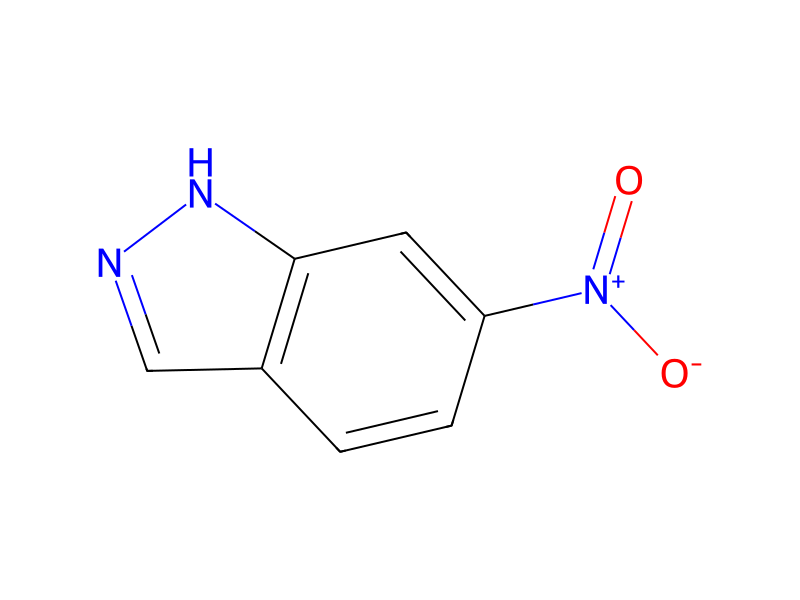

Product 1

Reagents, catalysts & solvents 3



Procedure
0.11 mol of potassium tert-butylate is added to a solution of 0.11 mol (20 g) of 6-nitroindazole in 400 ml of tetrahydrofuran. After total dissolution, a solution of 0.24 mol (27 g) of 2-chloroethyl-N,N-dimethylamine in 300 ml of toluene is added. The reaction medium is heated at reflux for 3 hours. After cooling, 300 ml of a 10% sodium carbonate solution are added. The mixture is diluted with ethyl acetate and decanted, and the aqueous phase is extracted with dichloromethane. After concentration of the organic phases, the residue is purified by chromatography on silica gel using a dichloromethane/methanol mixture (98/2) as eluant to yield the expected compound.
Workup
- dissolutionAfter total dissolution
- temperatureThe reaction medium is heated
- temperatureat reflux for 3 hours
- temperatureAfter cooling
- customdecanted
- extractionthe aqueous phase is extracted with dichloromethane
- customAfter concentration of the organic phases, the residue is purified by chromatography on silica gel using a dichloromethane/methanol mixture (98/2) as eluant
Sources & evidence
- ORD record
- ord-239fd13bfe06424f935cfc98e9f6c626
- Source dataset
- uspto-grants-2000_04
- Patent number
- US06046205
Reaction notes
Loading…