1-(Trimethylsilyl)pyrrolidin-2-one → 3-(2-Chloropyrid 5-yl-methyl)-pyrrolid-2-one
Reaction equation

C([N-]C(C)C)(C)C.[Li+].C[Si](C)(C)[N:11]1[CH2:15][CH2:14][CH2:13][C:12]1=[O:16].[Cl:19][C:20]1[CH:25]=[CH:24][C:23]([CH2:26]Cl)=[CH:22][N:21]=1>C1CCCCC1.O1CCCC1>[Cl:19][C:20]1[CH:25]=[CH:24][C:23]([CH2:26][CH:13]2[CH2:14][CH2:15][NH:11][C:12]2=[O:16])=[CH:22][N:21]=1Participants

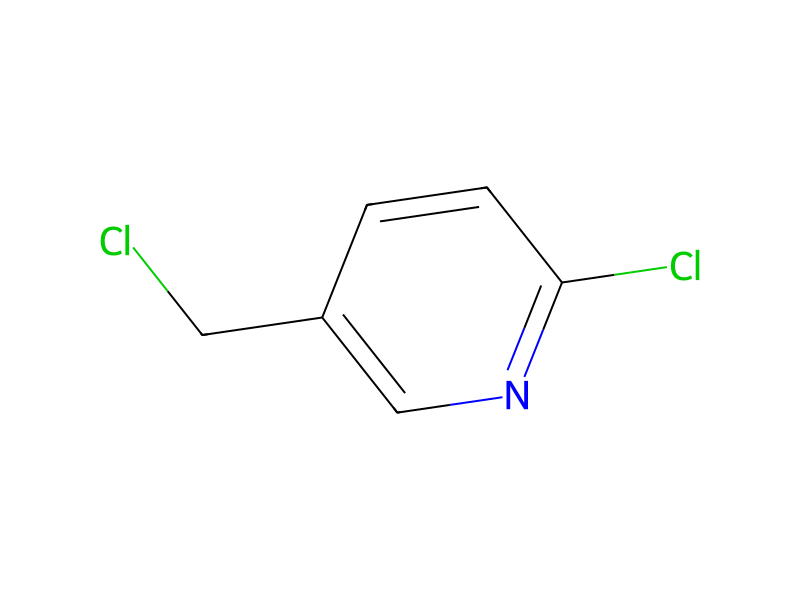




Procedure
Under a nitrogen atmosphere at a temperature of from -78° C. to -60° C., 180 ml of a 1.5 molar solution of lithium diisopropylamide (LDA) in cyclohexane are added dropwise to 31.4 g of N-trimethylsilylpyrrolid-2-one in 150 ml of tetrahydrofuran (THF) and the reaction mixture is stirred at the same temperature for a further one hour. Then, at from -78° C. to -60° C., 25.5 g of 2-chloro-5-chloromethylpyridine in 40 ml of THF are added, and the mixture is stirred for a further 16 hours at that temperature and then for a further three hours at room temperature. The reaction mixture is poured onto a mixture of ice/water and extracted with ethyl acetate, and the organic phase is separated off. The ethyl acetate phase is dried over sodium sulfate and concentrated to dryness by evaporation in vacuo. The residue is purified on silica gel using ethyl acetate/hexane (7:1) as eluant. The title compound having a melting point of 117-118° C. (compound 1.3) is obtained.
Workup
- stirringthe mixture is stirred for a further 16 hours at that temperature
- waitfor a further three hours at room temperature
- extractionextracted with ethyl acetate
- customthe organic phase is separated off
- dry with materialThe ethyl acetate phase is dried over sodium sulfate
- concentrationconcentrated to dryness by evaporation in vacuo
- customThe residue is purified on silica gel
- customis obtained
Sources & evidence
- ORD record
- ord-abc11c9087ec4bbda0b44656b3fcde10
- Source dataset
- uspto-grants-2000_04
- Patent number
- US06048824
Reaction notes
Loading…