Diisopropylamine → 3-Bromopyridine-4-carboxaldehyde
Reaction equation

C(NC(C)C)(C)C.C([Li])CCC.[Br:13][C:14]1[CH:15]=[N:16][CH:17]=[CH:18][CH:19]=1.C1C[O:23][CH2:22]C1>>[Br:13][C:14]1[CH:15]=[N:16][CH:17]=[CH:18][C:19]=1[CH:22]=[O:23]Participants


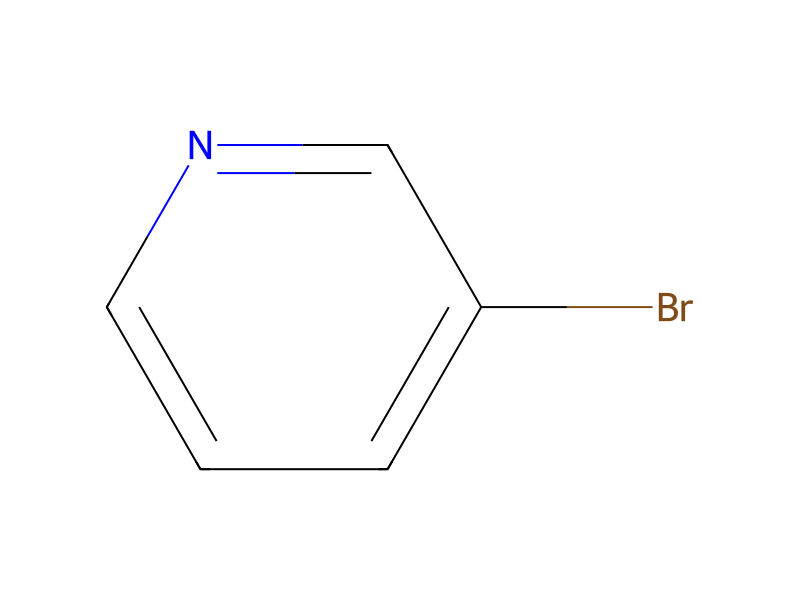


Conditions
- Temperature
- -60 °C
Procedure
A solution of di-isopropylamine (3.44 g, 34.1 mmol) was cooled to −78° C. and treated with n-butyl lithium 1.6 M, 34.1 mmol). A solution of 3-bromopyridine (4.71 g, 30 mmol) in THF (5 ml) was added dropwise trying to keep the temperature below −70° C. The reaction was very exothermic, a solid precipitated and THF (2 ml) was added to improve stirring. The temperature rose to −45° C., after cooling to −60° C. and added remaining pyridine. DMF (2.49 g) in THF (15 ml) was added and the reaction stirred at −65° C. for 30 minutes. Water was added to quench the reaction and the reaction allowed to warm to ambient temperature. The reaction was partitioned between ethyl acetate/water and the aqueous layer extracted with ethyl acetate. The organic layers were combined, dried (MgSO4) and evaporated and the residue was subjected to chromatography (eluting with diethyl ether/hexane) to give 3-bromo-4-pyridinecarbaldehyde (1.4 g, 76%).
Workup
- customthe temperature below −70° C
- customa solid precipitated
- additionTHF (2 ml) was added
- customrose to −45° C.
- additionadded
- additionDMF (2.49 g) in THF (15 ml) was added
- stirringthe reaction stirred at −65° C. for 30 minutes
- additionWater was added
- customto quench
- customthe reaction
- temperatureto warm to ambient temperature
- customThe reaction was partitioned between ethyl acetate/water
- extractionthe aqueous layer extracted with ethyl acetate
- dry with materialdried (MgSO4)
- customevaporated
- washthe residue was subjected to chromatography (eluting with diethyl ether/hexane)
Sources & evidence
- ORD record
- ord-f12d24cbf464481bad14da35478d3828
- Source dataset
- uspto-grants-2004_09
- Patent number
- US06787562B2
Reaction notes
Loading…