Water → HCID 60110695, compound
Reaction equation
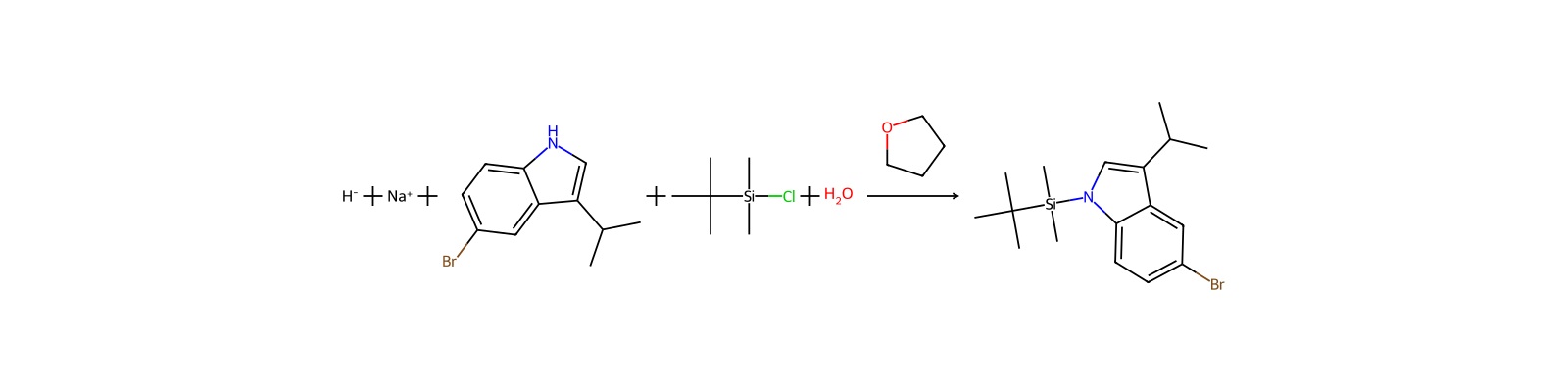
[H-].[Na+].[Br:3][C:4]1[CH:5]=[C:6]2[C:10](=[CH:11][CH:12]=1)[NH:9][CH:8]=[C:7]2[CH:13]([CH3:15])[CH3:14].[C:16]([Si:20](Cl)([CH3:22])[CH3:21])([CH3:19])([CH3:18])[CH3:17].O>C1COCC1>[Br:3][C:4]1[CH:5]=[C:6]2[C:10](=[CH:11][CH:12]=1)[N:9]([Si:20]([C:16]([CH3:19])([CH3:18])[CH3:17])([CH3:22])[CH3:21])[CH:8]=[C:7]2[CH:13]([CH3:15])[CH3:14]Participants
Reactant 4




Product 1

Reagents, catalysts & solvents 1

Procedure
0.50 g (12.6 mmol) of 60% strength sodium hydride in paraffin oil is introduced under argon into 20 ml of THF at room temperature. A solution of 2.0 g (8.40 mmol) of 5-bromo-3-isopropyl-1H-indole (Example X) in 20 ml of THF is added dropwise and the mixture is stirred until evolution of gas can no longer be detected. 2.03 g (13.44 mmol) of tert-butyl(chloro)dimethylsilane are subsequently added dropwise. After a short reaction time a precipitate deposits. The batch is stirred for 3 h at room temperature. It is treated with 200 ml of water. The aqueous phase is extracted twice with ethyl acetate, and the combined org. phases are dried and concentrated in a rotary evaporator. The residue is chromatographed on silica gel (eluent: cyclohexane). 2.63 g (89%) of 5-bromo-1-[tert-butyl(dimethyl)silyl]-3-isopropyl-1H-indole are obtained.
Workup
- stirringThe batch is stirred for 3 h at room temperature
- extractionThe aqueous phase is extracted twice with ethyl acetate
- customphases are dried
- concentrationconcentrated in a rotary evaporator
- customThe residue is chromatographed on silica gel (eluent: cyclohexane)
Sources & evidence
- ORD record
- ord-ad22692dd0244d419999decda45f115d
- Source dataset
- uspto-grants-2004_09
- Patent number
- US06794406B2
Reaction notes
Loading…