Water → 2-Propen-1-yl 4-bromo-3,5-bis(2-propen-1-yloxy)benzoate
Reaction equation

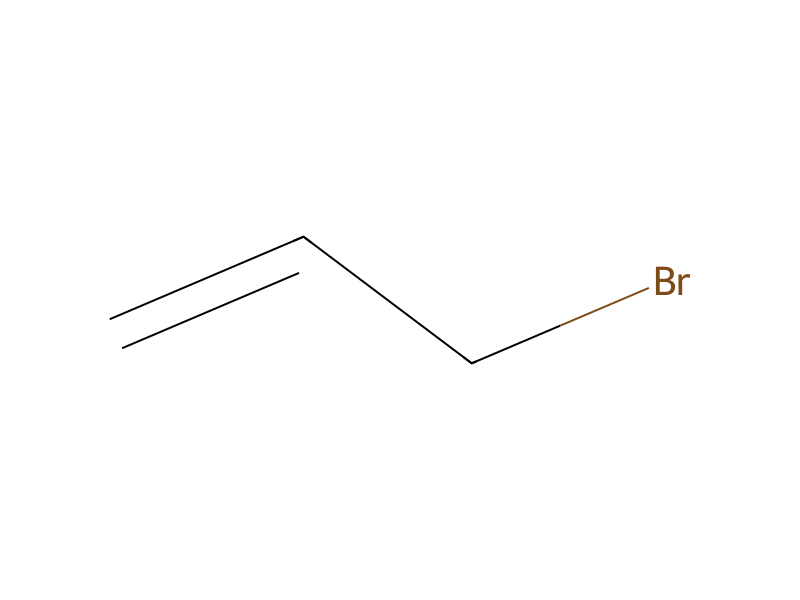
[Br:1][C:2]1[C:10]([OH:11])=[CH:9][C:5]([C:6]([OH:8])=[O:7])=[CH:4][C:3]=1[OH:12].C([O-])([O-])=O.[K+].[K+].[CH2:19](Br)[CH:20]=[CH2:21].O>CN(C=O)C>[CH2:19]([O:7][C:6](=[O:8])[C:5]1[CH:9]=[C:10]([O:11][CH2:10][CH:2]=[CH2:3])[C:2]([Br:1])=[C:3]([O:12][CH2:6][CH:5]=[CH2:4])[CH:4]=1)[CH:20]=[CH2:21]Participants





Procedure
To a solution of 4-Bromo-3,5-dihydroxybenzoic acid (20.43 g, 87.5 mmol, 1.0 equiv) in DMF (120 mL) at room temperature was added solid K2CO3 (60.5 g, 438 mmol, 5 equiv). To the suspension was added allylbromide (31 ml, 358 mmol, 4.1 equiv) dropwise over 25 minutes. After 15 hours, water (150 mL) was added and the slurry was poured into water (300 mL). The precipitate was separated by filtration, washed with water, and dissolved in ether. The solution was washed with brine, dried over MgSO4, filtered, and concentrated to afford 16 as a white powder (30.1 g, 97%). Rf=0.52 (15% EtOAc/hexane); FTIR (neat, cm−1) 3088, 2900, 1717, 1649, 1582, 1424, 986; 1H NMR (400 MHz, CDCl3) δ, 7.24 (s, 2H), 6.12-5.98 (m, 3H), 5.51 (dd, J=17.6, 1.6 Hz, 2H), 5.40 (dd, J=17.2, 1.2 Hz, 1H), 5.32 (dd, J=10.2, 1.2 Hz, 2H), 5.30 (dd, J=8.4, 1.6 Hz, 1H), 4.81 (d, J=6.0 Hz, 2H), 4.66 (d, J=3.4 Hz, 4H); 13C NMR (100 MHz, CDCl3) δ132.2, 132.0, 129.9, 118.4, 117.9, 107.9, 106.9, 69.9, 65.7; MS EI+ calculated for C16H17BrO4 (M−H+): 351, found: 351.
Workup
- customThe precipitate was separated by filtration
- washwashed with water
- dissolutiondissolved in ether
- washThe solution was washed with brine
- dry with materialdried over MgSO4
- filtrationfiltered
- concentrationconcentrated
Sources & evidence
- ORD record
- ord-e8e645eb4c224756ad3de5950758017f
- Source dataset
- uspto-grants-2004_09
- Patent number
- US06797819B1
Reaction notes
Loading…