Hydrazine hydrate (1:1) → HCID 178527336, compound
Reaction equation

[CH:1]1([C@H:4]2[C:8](=O)[CH2:7][CH:6]([CH:10]3[CH2:12][CH2:11]3)[N:5]2[S:13]([C:16]2[CH:21]=[CH:20][C:19]([C:22]([F:25])([F:24])[F:23])=[CH:18][CH:17]=2)(=[O:15])=[O:14])[CH2:3][CH2:2]1.C[N:27]([CH:29](OC)OC)C.O.[NH2:35]N>>[CH:1]1([CH:4]2[C:8]3[C:7](=[N:35][NH:27][CH:29]=3)[C@H:6]([CH:10]3[CH2:12][CH2:11]3)[N:5]2[S:13]([C:16]2[CH:21]=[CH:20][C:19]([C:22]([F:25])([F:24])[F:23])=[CH:18][CH:17]=2)(=[O:15])=[O:14])[CH2:3][CH2:2]1Participants



Procedure
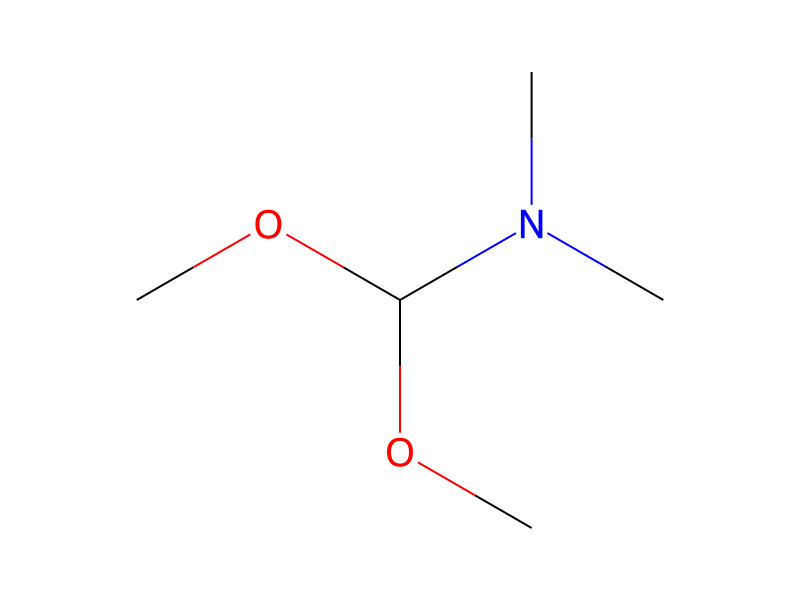
(2S)-2,5-Dicyclopropyl-1-(4-(trifluoromethyl)phenylsulfonyl)pyrrolidin-3-one (21) (149 mg, 0.399 mmol) and DMF-DMA (0.059 mL, 0.439 mmol) where heated at 60° C. for 1.5 hr under nitrogen. The reaction was concentrated in vacuo and used directly in next step. This material was dissolved in ethanol (1.5 mL) and acetic acid (0.075 mL). Hydrazine hydrate (0.1 mL, 20.0 mmol) was added dropwise and the reaction stirred for 16 hr at rt. The reaction was concentrated in vacuo and the resulting crude product was purified by column chromatography using EtOAc/hexane gradients to yield (6S)-4,6-dicyclopropyl-5-(4-(trifluoromethyl)phenylsulfonyl)-2,4,5,6-tetrahydropyrrolo[3,4-c]pyrazole (22) (30.7 mg, 19.4% over two steps) as a white solid. 1H-NMR (CDCl3) δ 8.01 (d, 2H, J=8.2 Hz), 7.71 (d, 2H, J=8.2 Hz), 7.19 (s, 1H), 4.59 (d, 1H, J=10.3 Hz), 4.57 (d, 1H, J=10.3 Hz), 1.35 (m, 2H), 0.81 (m, 1H), 0.68-0.44 (m, 5H), (m, 1H), 0.31 (m, 1H), 0.19 (m, 1H); MS (m/z) 398.1 (M+H)+; retention time=7.168, method [7].
Workup
- concentrationThe reaction was concentrated in vacuo
- dissolutionThis material was dissolved in ethanol (1.5 mL)
- concentrationThe reaction was concentrated in vacuo
- customthe resulting crude product was purified by column chromatography
Sources & evidence
- ORD record
- ord-c208672e23914f82932c30dcf6853c2c
- Source dataset
- uspto-grants-2011_07
- Patent number
- US07977368B2
Reaction notes
Loading…