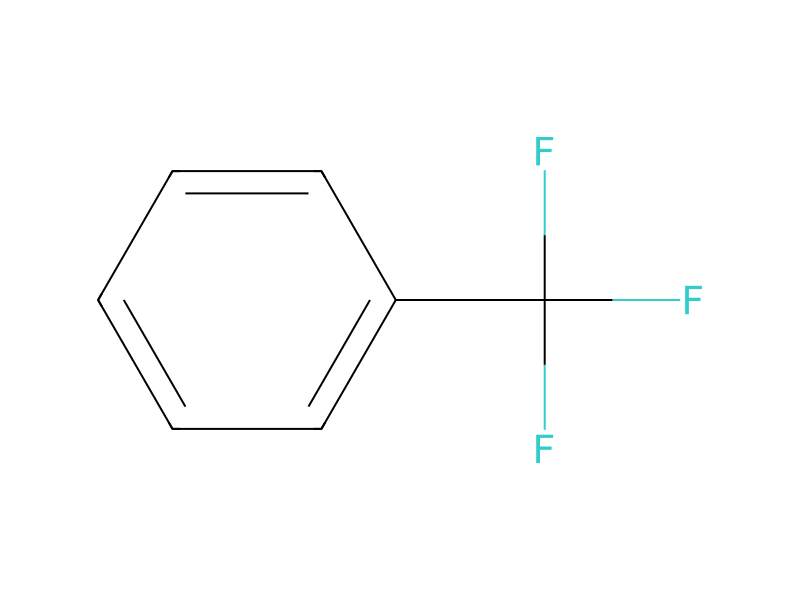
Benzene → (Trifluoromethyl)benzene
Reaction equation

[CH:1]1[CH:6]=[CH:5][CH:4]=[CH:3][CH:2]=1.S(=O)(=O)(O)O.[F:12][C:13](I)([F:15])[F:14].OO>S([O-])([O-])(=O)=O.[Fe+2].CS(C)=O>[F:12][C:13]([C:1]1[CH:6]=[CH:5][CH:4]=[CH:3][CH:2]=1)([F:15])[F:14]Participants
Reactant 4




Product 1
Reagents, catalysts & solvents 2


Procedure
100 μl of benzene, 2.0 ml of dimethyl sulfoxide, 2.0 ml of a 1 N dimethyl sulfoxide solution of sulfuric acid, 1.0 ml of a 3.0 mol/l dimethyl sulfoxide solution of trifluoromethyl iodide, 0.2 ml of a 30% hydrogen peroxide aqueous solution and 0.3 ml of a 1.0 mol/l aqueous solution of iron(II) sulfate were charged in a two-neck flask in which the atmosphere was replaced with argon, and the mixture was stirred for 20 minutes. During the stirring, the temperature of the reaction system rose up in the range of from 40° C. to 50° C. Thereafter the resulting solution was cooled to room temperature. Formation of trifluoromethylbenzene (19F-NMR yield: 20%) was confirmed by 19F-NMR with 2,2,2-trifluoroethanol as an internal standard. The subsequent procedure was conducted in the same manner as in Example 1 and trifluoromethylbenzene was obtained as a colorless oil (0.02 g, yield: 13%).
Workup
- customrose up in the range of from 40° C. to 50° C
Sources & evidence
- ORD record
- ord-61201aea356b4c8980a60f4e2b747649
- Source dataset
- uspto-grants-2011_07
- Patent number
- US07981318B2
Reaction notes
Loading…