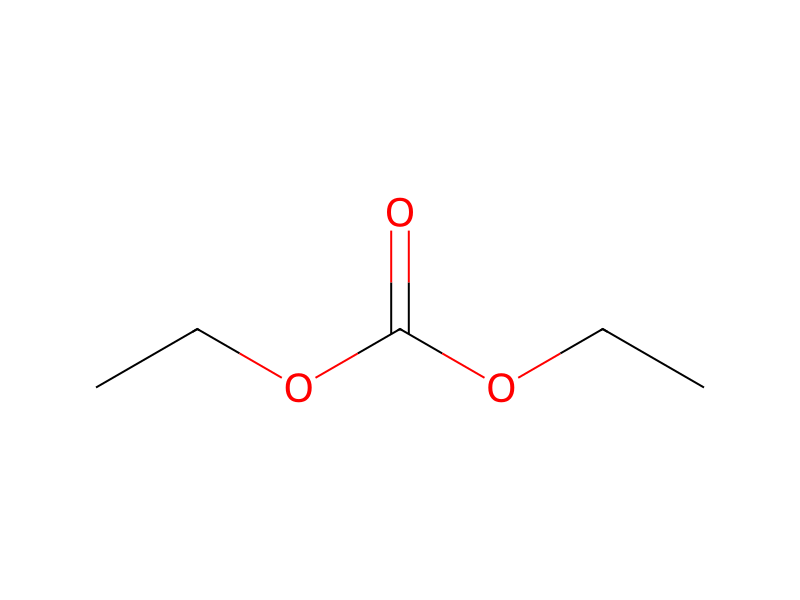
Diethyl Carbonate → HCID 11358513, compound
Reaction equation

[C:1](=[O:8])([O:5][CH2:6][CH3:7])OCC.[Br:9][C:10]1[C:18]([CH3:19])=[CH:17][C:13]([C:14]([OH:16])=[O:15])=[C:12]([CH3:20])[CH:11]=1.C(NC(C)C)(C)C.C([Li])CCC.[NH4+].[Cl-]>O1CCCC1.CCCCCC.C(O)(=O)C>[Br:9][C:10]1[C:18]([CH3:19])=[CH:17][C:13]([C:14]([OH:16])=[O:15])=[C:12]([CH2:20][C:1]([O:5][CH2:6][CH3:7])=[O:8])[CH:11]=1Participants
9
Reactant 5




Product 1

Reagents, catalysts & solvents 3



Conditions
- Temperature
- -78 °C
Procedure
A solution of 1.7 ml (14 mmol) of diethyl carbonate and 2.3 g (10 mmol) of 4-bromo-2,5-dimethylbenzoic acid in 15 ml tetrahydrofuran is added dropwise, over 2.5 hours, to a solution cooled to −78° C., prepared from 4.2 ml (30 mmol) of diisopropylamine and 19 ml of a 1.6 molar n-butyl lithium solution in hexane, in 35 ml tetrahydrofuran. Then it is heated to 0° C., poured into 200 ml of 3% NH4Cl solution, adjusted to pH 6 with acetic acid and extracted with ethyl acetate. The ethyl acetate phase is washed with 14% NaCl solution and dried with Na2SO4. The solvent is distilled off and the residue remaining is triturated several times in a little diisopropylether/petroleum ether and then dried.
Workup
- temperatureThen it is heated to 0° C.
- extractionextracted with ethyl acetate
- washThe ethyl acetate phase is washed with 14% NaCl solution
- dry with materialdried with Na2SO4
- distillationThe solvent is distilled off
- customthe residue remaining is triturated several times in a little diisopropylether/petroleum ether
- customdried
Sources & evidence
- ORD record
- ord-7027051d7f814e3b8b7551d56bfe1a6a
- Source dataset
- uspto-grants-2002_11
- Patent number
- US06479524B1
Reaction notes
Loading…