Phthalonitrile → Phthalocyanine
Reaction equation

[CH:1]1[CH:6]=[C:5]([C:7]#[N:8])[C:4]([C:9]#[N:10])=[CH:3][CH:2]=1>ClC1C2C(=CC=CC=2)C=CC=1.[Ti](Cl)(Cl)(Cl)Cl>[CH:1]1[CH:2]=[CH:3][C:4]2[C:5](=[C:7]3[N:8]=[C:7]4[N:10]=[C:9]([C:4]5[CH:3]=[CH:2][CH:1]=[CH:6][C:5]=54)[N:10]=[C:9]4[NH:8][C:7]([C:5]5[CH:6]=[CH:1][CH:2]=[CH:3][C:4]=54)=[N:10][C:9]4=[N:8][C:7]([C:5]5[CH:6]=[CH:1][CH:2]=[CH:3][C:4]=54)=[N:10][C:9]=2[NH:8]3)[CH:6]=1Participants
Reactant 1
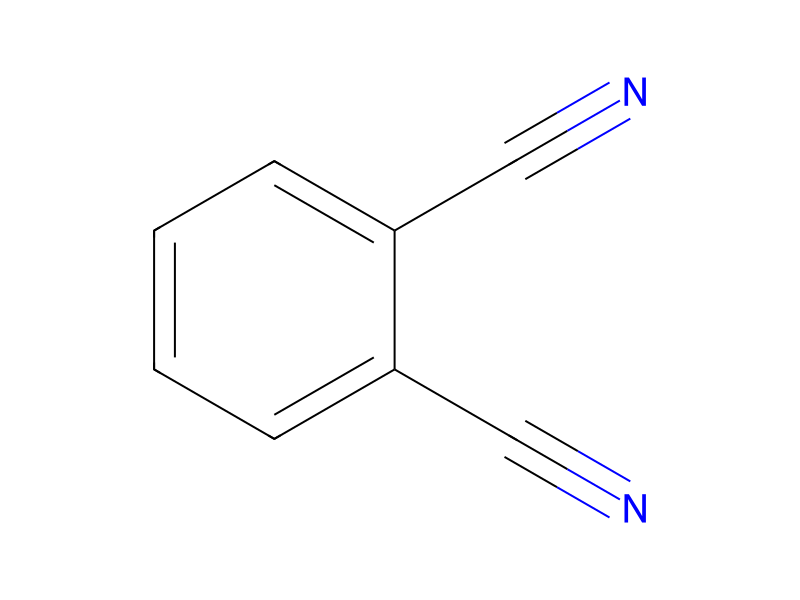
Product 1

Reagents, catalysts & solvents 2


Procedure
20.0 g of phthalodinitrile was dissolved in 200 ml of α-chloronaphthalene, and to the resultant solution was added dropwise 9.0 g of titanium tetrachloride in an atmosphere of nitrogen gas. After completion of the addition, the resultant mixture was heated at 240° C. for 3 hours while stirring, and then, the reaction was terminated. The resultant precipitated crystal was collected by filtration and washed well with α-chloronaphthalene and methanol, to thereby obtain dichlorotitanyl phthalocyanine. The obtained dichlorotitanyl phthalocyanine was heated under reflux while stirring, together with 150 ml of concentrated aqueous ammonia. After 1 hour, the reaction was terminated, and the resultant crystal was collected by filtration, to thereby obtain 17.4 g of a TiOPc. A crystal structure of the obtained TiOPc was confirmed by measuring an X-ray diffraction spectrum with an X-ray of Cu Kα, using an X-ray diffractometer, Model RAD-C System (trade name, manufactured by Rigaku Denki K. K.). The measurement result is shown in FIG. 1.
Workup
- additionAfter completion of the addition
- customthe reaction was terminated
- customThe resultant precipitated crystal
- filtrationwas collected by filtration
- washwashed well with α-chloronaphthalene and methanol
Sources & evidence
- ORD record
- ord-7a48a6cd8ea74ba6b3a3fde8abc95dd2
- Source dataset
- uspto-grants-2002_11
- Patent number
- US06485658B1
Reaction notes
Loading…