Chloroacetic Acid → 2-(Chloromethyl)-6-nitro-1H-benzimidazole
Reaction equation

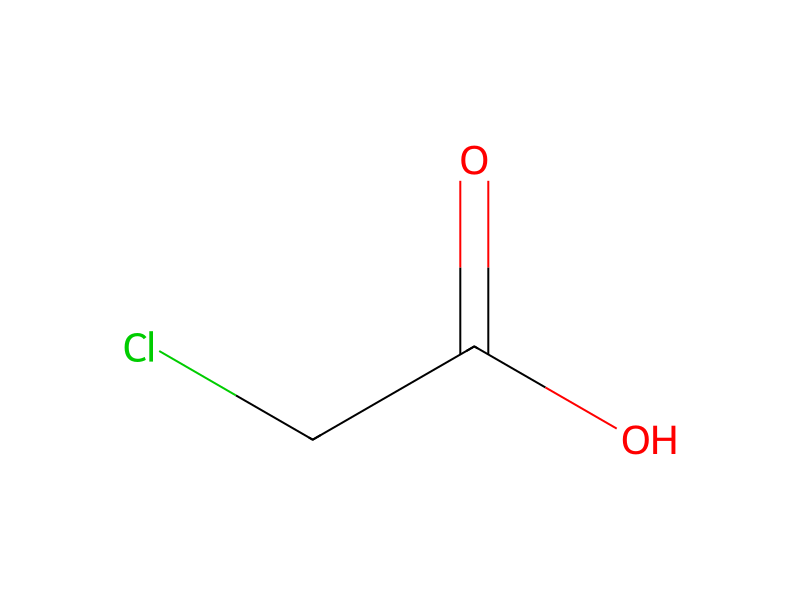
[NH2:1][C:2]1[CH:3]=[C:4]([N+:9]([O-:11])=[O:10])[CH:5]=[CH:6][C:7]=1[NH2:8].[Cl:12][CH2:13][C:14](O)=O>Cl>[Cl:12][CH2:13][C:14]1[NH:1][C:2]2[CH:3]=[C:4]([N+:9]([O-:11])=[O:10])[CH:5]=[CH:6][C:7]=2[N:8]=1Participants
Reactant 2

Product 1

Reagents, catalysts & solvents 1

Procedure
A mixture of 3,4-diamino-nitrobenzene (15.3 g, 0.10 mole) and chloroacetic acid (14.18 μm, 1.5 eq) in 5.0 N aqueous HCl (80 mL) was heated at reflux for 1 hr. After cooling to RT, the reaction was filtered through celite and the filtrate was stored at 0° C. for 2 days. The crystals that formed, were collected and recrystallized from a mixture of EtOH and water to give 7.2 μm of the hydrogen chloride salt of 2-chloromethyl-5-nitro-benzimidazole. A portion of this salt (528 mg, 2.13 mmole) and morpholine (1.31 mL, 7 eq) in toluene (15 mL) were heated at reflux for 4 hr. After cooling to RT, the reaction was filtered and the filter cake was washed with toluene. The solvent was removed from the filtrate to leave the crude 2-[N-morpholinylmethyl]-5-nitro-benzimidazole as an oil. A portion of this material (657 mg) and 10% palladium on charcoal (650 mg) in EtOH (10 mL) was stirred overnight under a hydrogen atmosphere (balloon). Removal of the catalyst by filtration and the solvent left the crude 5-amino-2-[N-morpholinylmethyl]-benzimidazole as an oil. A portion of this material was coupled with 556 as described for 570 to afford 573 (HPLC retention time (YMC ODS S7 3×50 mm): 0.92 min).
Workup
- temperaturewas heated
- temperatureat reflux for 1 hr
- filtrationthe reaction was filtered through celite
- customThe crystals that formed
- customwere collected
- customrecrystallized from a mixture of EtOH and water
Sources & evidence
- ORD record
- ord-b9028c8e70564ee09c711374efdcbaa3
- Source dataset
- uspto-grants-2014_05
- Patent number
- US08716323B2
Reaction notes
Loading…