Water → HCID 68661314, compound
Reaction equation

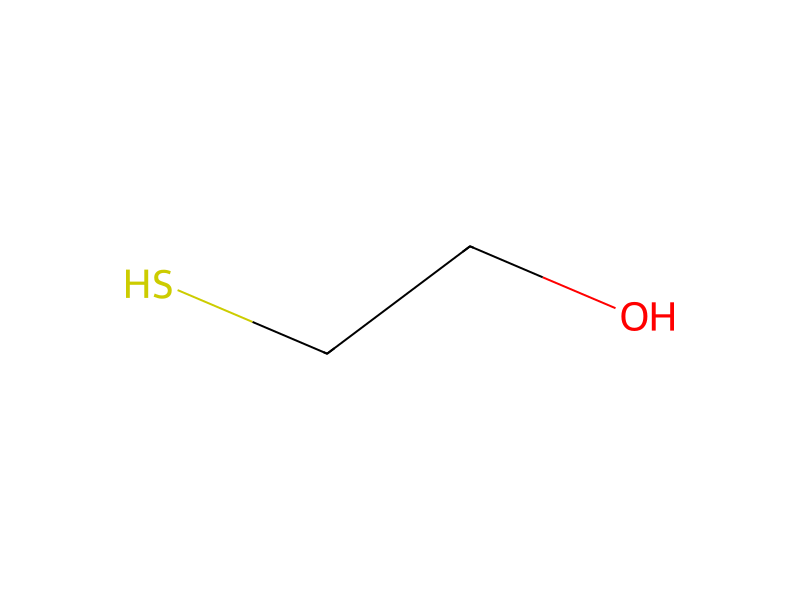
[SH:1][CH2:2][CH2:3][OH:4].[H-].[Na+].Cl[C:8]1[N:17]=[C:16]([C:18]2[CH:23]=[CH:22][CH:21]=[CH:20][CH:19]=2)[C:15]2[C:10](=[CH:11][CH:12]=[C:13]([Cl:24])[CH:14]=2)[N:9]=1.O>CN(C=O)C>[Cl:24][C:13]1[CH:14]=[C:15]2[C:10](=[CH:11][CH:12]=1)[N:9]=[C:8]([S:1][CH2:2][CH2:3][OH:4])[N:17]=[C:16]2[C:18]1[CH:23]=[CH:22][CH:21]=[CH:20][CH:19]=1Participants
Reactant 4



Product 1

Reagents, catalysts & solvents 1

Procedure
To a solution of 86 mg of 2-mercaptoethanol in DMF (7.5 ml) was added 44 mg of sodium hydride (60%), followed by stirring at room temperature for 30 minutes. To the reaction mixture was added 275 mg of 2,6-dichloro-4-phenylquinazoline (compound No. Ia1-3), followed by stirring at room temperature for 2 hours. The reaction solution was poured into 100 ml of water and extracted with ethyl acetate. The resultant extract was concentrated. The resulting residue was purified by silica gel column chromatography (ethyl acetate:hexane=1:5) to obtain 266 mg of the titled compound. Mp.124.4° C. 1H NMR (CDCl3): 3.50 (2H, t, J=5.5 Hz), 3.64 (1H, br. t), 4.07 (2H, q-like, J=5.5 Hz), 7.57-7.61 (3H, m), 7.71-7.74 (2H, m), 7.77 (1H, dd, J=8.9, 2.3 Hz), 7.85 (1H, d, J=8.9 Hz), 7.97 (1H, d, J=2.3 Hz).
Workup
- stirringby stirring at room temperature for 2 hours
- extractionextracted with ethyl acetate
- extractionThe resultant extract
- concentrationwas concentrated
- customThe resulting residue was purified by silica gel column chromatography (ethyl acetate:hexane=1:5)
Sources & evidence
- ORD record
- ord-fc8db45f6e8040259ba780bed449892f
- Source dataset
- uspto-grants-2014_05
- Patent number
- US08722580B2
Reaction notes
Loading…