Imidazole → ((R)-3-bromo-2-methylpropoxy)-tert-butyldiphenylsilane
Reaction equation

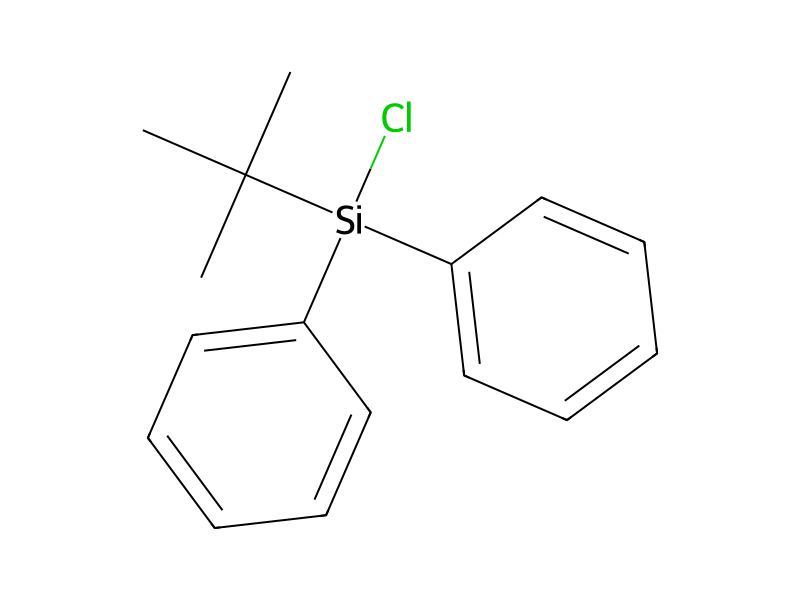
[Br:1][CH2:2][C@H:3]([CH3:6])[CH2:4][OH:5].N1C=CN=C1.[C:12]([Si:16](Cl)([C:23]1[CH:28]=[CH:27][CH:26]=[CH:25][CH:24]=1)[C:17]1[CH:22]=[CH:21][CH:20]=[CH:19][CH:18]=1)([CH3:15])([CH3:14])[CH3:13].[Cl-].[NH4+]>CN(C)C=O>[Br:1][CH2:2][C@H:3]([CH3:6])[CH2:4][O:5][Si:16]([C:12]([CH3:15])([CH3:14])[CH3:13])([C:23]1[CH:24]=[CH:25][CH:26]=[CH:27][CH:28]=1)[C:17]1[CH:22]=[CH:21][CH:20]=[CH:19][CH:18]=1Participants
6





Procedure
To an N,N-dimethylformamide solution (50.0 ml) of (2R)-3-bromo-2-methyl-1-propanol (7.63 g) were added under ice cooling imidazole (7.13 g) and tert-butylchlorodiphenylsilane (14.8 ml), followed by stirring at room temperature for 5 hours. The reaction solution was poured into a saturated aqueous ammonium chloride solution, and extracted with ethyl acetate. The organic layer was washed with brine, dried over anhydrous sodium sulfate, and concentrated under reduced pressure. The resulting residue was purified by silica gel chromatography to afford {[(2R)-3-bromo-2-methylpropyl]oxy}(tert-butyl)diphenylsilane (19.2 g).
Workup
- extractionextracted with ethyl acetate
- washThe organic layer was washed with brine
- dry with materialdried over anhydrous sodium sulfate
- concentrationconcentrated under reduced pressure
- customThe resulting residue was purified by silica gel chromatography
Sources & evidence
- ORD record
- ord-613205832af54b7590d809b4f5e51f6e
- Source dataset
- uspto-grants-2014_05
- Patent number
- US08729095B2
Reaction notes
Loading…