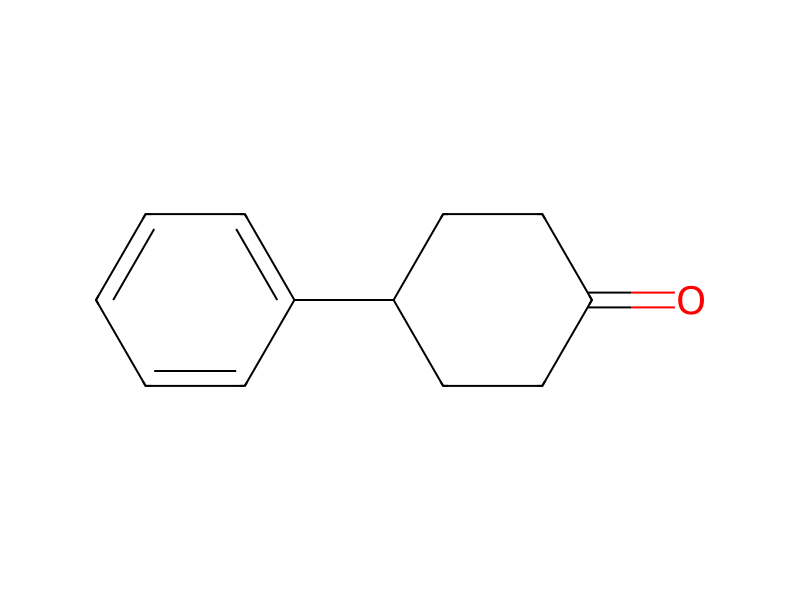
4-Phenylcyclohexanone → HCID 22167780, compound
Reaction equation

[Cl-].[CH3:2][O:3][CH2:4][P+](C1C=CC=CC=1)(C1C=CC=CC=1)C1C=CC=CC=1.CC(C)([O-])C.[K+].[C:30]1([CH:36]2[CH2:41][CH2:40][C:39](=O)[CH2:38][CH2:37]2)[CH:35]=[CH:34][CH:33]=[CH:32][CH:31]=1>O1CCCC1>[C:30]1([CH:36]2[CH2:41][CH2:40][C:39](=[CH:2][O:3][CH3:4])[CH2:38][CH2:37]2)[CH:35]=[CH:34][CH:33]=[CH:32][CH:31]=1Participants
Reactant 3


Product 1

Reagents, catalysts & solvents 1

Conditions
- Temperature
- 0 °C
Procedure
(Methoxymethyl)triphenylphosphonium chloride (5.14g) was suspended in anhydrous tetrahydrofuran (THF) (15ml) and stirred under argon at 0° C. A solution of potassium t-butoxide (1.68g) in THF (15ml) was added dropwise and stirring continued at the same temperature for 0.5h. To the resulting dark red near- solution was added a solution of 4-phenylcyclohexanone (2.61g) in THF (4ml), then the mixture was allowed to regain ambient temperature and stirring continued for 16h. Workup and chromatography as described in Example 5(a) gave 4-phenyl-1-(methoxymethylene)cyclohexane (1.59g) contaminated with a little triphenylphosphine; δ(CDCl3,60MHz), inter alia, 3.55 (3H,s), 5.90 (1H,br s), and 7.35 (6H,m). This material in THF (8ml) and water (2ml) was stirred at 20° C. with toluene sulphonic acid hydrate (2.50g) for 8h. Workup as described in Example 5(b) followed by chromatography on silica gel, eluting with ethyl acetate in hexane mixtures, gave the aldehyde (1.29g) as an approximately 2:3 cis:trans mixture; υMax (CHCl3) 1725, 1605, 1495, and 1450cm-1 ; δ(CDCl3,250MHz), 1.3-2.60 (10H,m), 7.15-7.35 (5H,m), 9.68, and 9.79 (1H,d,J=1.5Hz and s). [M. Carissimi et al., Farmaco (Pavia) Ed.Sci., 1965, 20. 106 (Chem.Abs., 1965, 62, 14560)].
Workup
- stirringstirring
- customto regain ambient temperature
- stirringstirring
- waitcontinued for 16h
Sources & evidence
- ORD record
- ord-9caea9ad0a0a42d2a64339d804deda3c
- Source dataset
- uspto-grants-1990_09
- Patent number
- US04954489
Reaction notes
Loading…