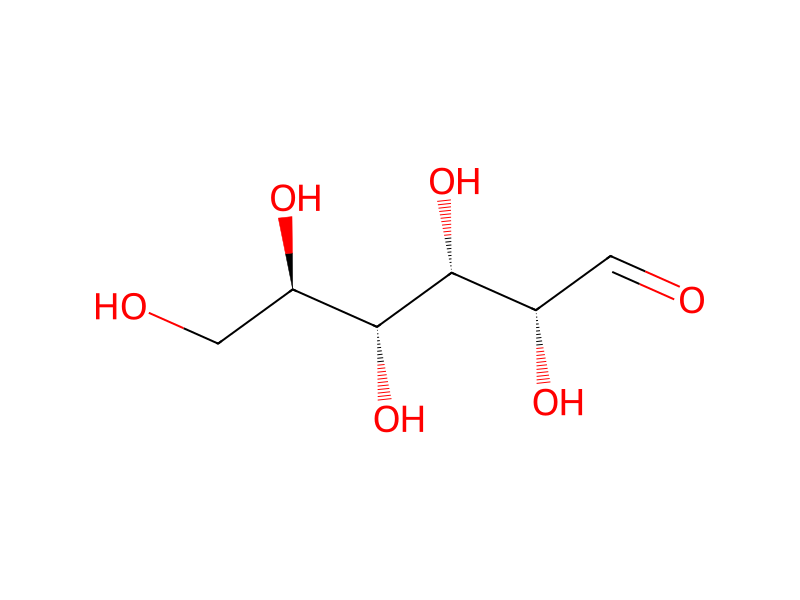
Hydrochloric Acid → (2R,3S,4R,5R)-2,3,4,5,6-pentahydroxyhexanal
Reaction equation

[OH-].[Na+:2].[ClH:3].[O:4]=[CH:5][C@@H:6]([C@H:8]([C@@H:10]([C@@H:12]([CH2:14][OH:15])[OH:13])[OH:11])[OH:9])[OH:7]>O>[O:4]=[CH:5][C@@H:6]([C@H:8]([C@@H:10]([C@@H:12]([CH2:14][OH:15])[OH:13])[OH:11])[OH:9])[OH:7].[Cl-:3].[Na+:2]Participants




Procedure
In another formulation, 8 g of HPC (63.7 mmol of hydroxyl groups) dissolved in 100 g of water was heated with 2.23 g (55.8 mmol) of sodium hydroxide and 1 g (3.27 mmol) of TSTMP. Heating was carried out in a sealed glass reactor at 110° C. for 2 h. After cooling, the unreacted sodium hydroxide was neutralized using about 20 mL of 4 M hydrochloric acid, to yield a dispersion of crosslinked HPC microspheres with a weight-average particle diameter of about 4.3 μm. The viscosity of the dispersion was about 31.2 cP. A 20% (w/v) dextrose solution (120 mL) was then added to obtain a formulation with 10% (w/v) dextrose, 3.3% (w/v) HPC, about 2.5% (w/v) sodium chloride. The dispersion was heated at 60° C. for 10 min after sugar addition. The weight-average particle diameter in the final dispersion was about 4.5 μm, and the dispersion viscosity was about 31 cP. The dispersion viscosity was sensitive to the order in which the solutions were mixed. If the dextrose solution was added after the second heating step (60° C. for 10 min), the viscosity of the resulting dispersion was higher (about 55 cP).
Workup
- temperatureHeating
- temperatureAfter cooling
- customto yield a dispersion of crosslinked HPC microspheres with a weight-average particle diameter of about 4.3 μm
Sources & evidence
- ORD record
- ord-feae9a97ec624610bc5707fefb5a634c
- Source dataset
- uspto-grants-2013_10
- Patent number
- US08563066B2
Reaction notes
Loading…