3,4-dihydro-2H-pyran → 2-chloro-7-(tetrahydro-2H-pyran-2-yl)-7H-purine
Reaction equation
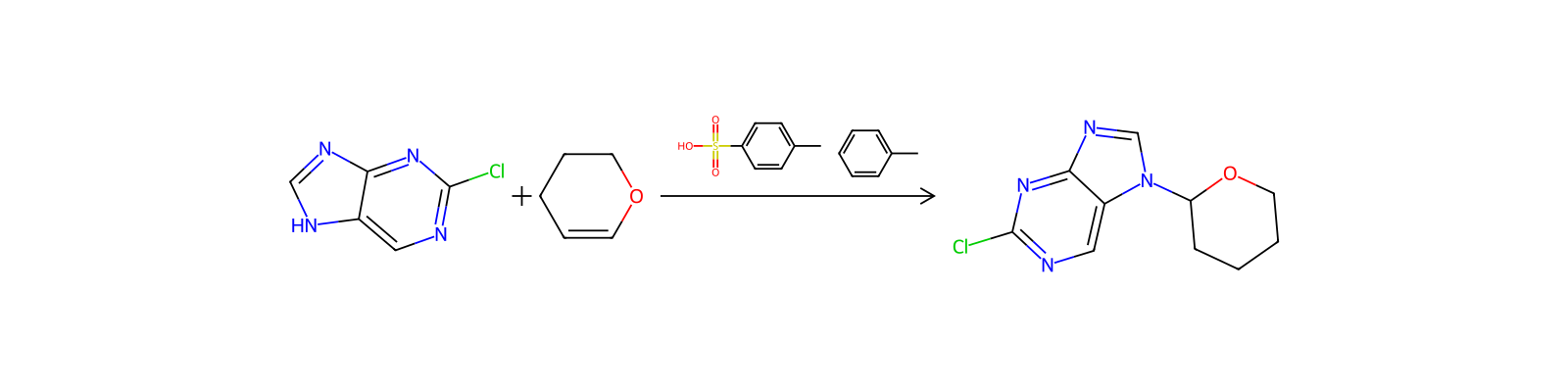
[Cl:1][C:2]1[N:10]=[C:9]2[C:5]([NH:6][CH:7]=[N:8]2)=[CH:4][N:3]=1.[O:11]1[CH:16]=[CH:15][CH2:14][CH2:13][CH2:12]1>C1(C)C=CC(S(O)(=O)=O)=CC=1.C1(C)C=CC=CC=1>[Cl:1][C:2]1[N:10]=[C:9]2[C:5]([N:6]([CH:12]3[CH2:13][CH2:14][CH2:15][CH2:16][O:11]3)[CH:7]=[N:8]2)=[CH:4][N:3]=1Participants
5
Reactant 2


Product 1

Reagents, catalysts & solvents 2


Conditions
- Temperature
- 80 °C
Procedure
A 100-mL, round-bottom flask was charged with 2-chloro-7H-purine (0.200 g, 1.29 mmol), toluene (20 mL), p-toluene sulfonic acid (0.011 g, 0.06 mmol), 3,4-dihydro-2H-pyran (0.328 g, 3.90 mmol), and the resulting solution stirred for 2 h at 80° C. After cooling to room temperature, the reaction mixture was concentrated under vacuum. The residue was purified by column chromatography on silica gel (eluting 1:5, with ethyl acetate/petroleum ether) to afford 2-chloro-7-(tetrahydro-2H-pyran-2-yl)-7H-purine (0.245 g, 79%) as brown oil. MS (ESI, pos. ion) m/z 239 [M+H]+.
Workup
- temperatureAfter cooling to room temperature
- concentrationthe reaction mixture was concentrated under vacuum
- customThe residue was purified by column chromatography on silica gel (eluting 1:5, with ethyl acetate/petroleum ether)
Sources & evidence
- ORD record
- ord-e69be9bbaffd4aa5af0639500ef0b29d
- Source dataset
- uspto-grants-2016_07
- Patent number
- US09388161B2
Reaction notes
Loading…