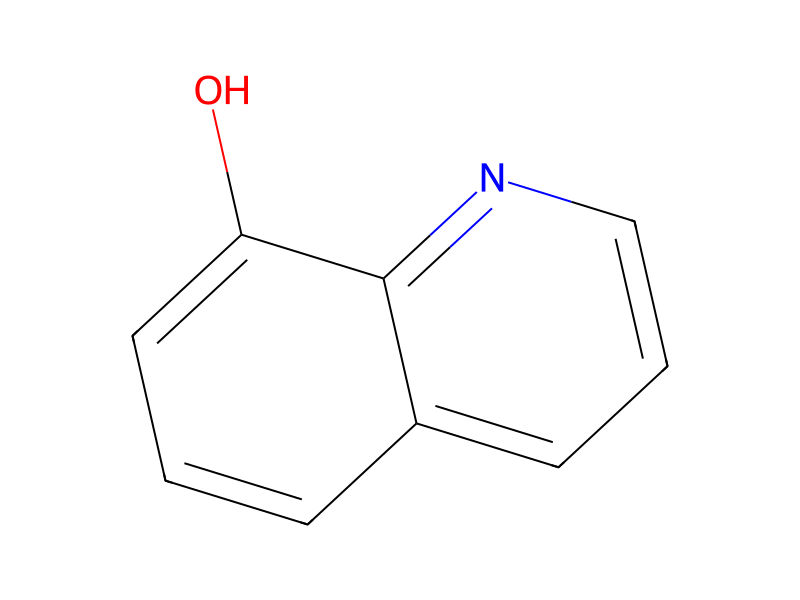
8-Hydroxyquinoline → HCID 89699972, compound
Reaction equation

Br[C:2]1[CH:3]=[C:4]([CH:8]=[C:9]([S:11]([F:16])([F:15])([F:14])([F:13])[F:12])[CH:10]=1)[C:5]([OH:7])=[O:6].[CH3:17][C:18]1[NH:19][CH:20]=[CH:21][N:22]=1.OC1C=CC=C2C=1N=CC=C2>CN(C=O)C.C(=O)(O)[O-].C([N+](CC)(CC)CC)C.[Cu]I>[CH3:17][C:18]1[N:19]([C:2]2[CH:3]=[C:4]([CH:8]=[C:9]([S:11]([F:16])([F:15])([F:14])([F:13])[F:12])[CH:10]=2)[C:5]([OH:7])=[O:6])[CH:20]=[CH:21][N:22]=1Participants
Reactant 3


Product 1

Reagents, catalysts & solvents 3



Conditions
- Temperature
- 160 °C
Procedure
1.0 g (3.06 mmol) of the compound of Example 15A and 276 mg (3.36 mmol) of 2-methylimidazole were dissolved in 20 ml of DMF and 2 ml of water, and the mixture was degassed with argon. 2.06 g (6.42 mmol) of tetraethylammonium bicarbonate were added carefully, followed by 232 mg (1.22 mmol) of copper(I) iodide and 177 mg (1.22 mmol) of 8-hydroxyquinoline. The mixture was heated in a microwave oven (Biotage Initiator, with Dynamic Field Tuning) at 160° C. for 60 min. The reaction was then filtered, and the filtrate was adjusted at pH 1 with concentrated hydrochloric acid and concentrated under reduced pressure. The residue was separated into its components by preparative HPLC (Method 17). Evaporation of the product fractions and drying of the residue under high vacuum gave 238 mg (94% pure, 22% of theory) of the title compound.
Workup
- custom2 ml of water, and the mixture was degassed with argon
- filtrationThe reaction was then filtered
- concentrationconcentrated under reduced pressure
- customThe residue was separated into its components by preparative HPLC (Method 17)
- customEvaporation of the product fractions
- customdrying of the residue under high vacuum
Sources & evidence
- ORD record
- ord-96a6f56361a04f6d845369da31940732
- Source dataset
- uspto-grants-2016_07
- Patent number
- US09394309B2
Reaction notes
Loading…