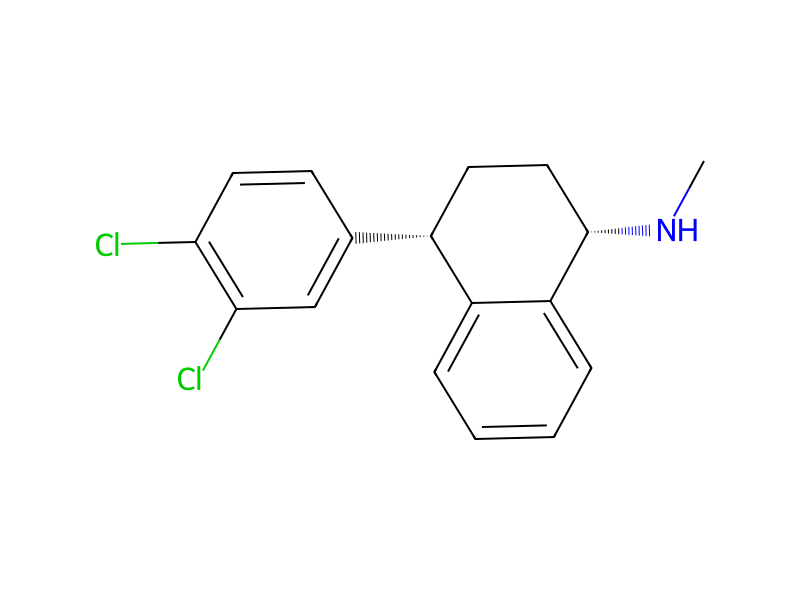
Water → Sertraline
Reaction equation

[CH3:1][NH:2][C@@H:3]1[C:8]2[CH:9]=[CH:10][CH:11]=[CH:12][C:7]=2[C@H:6]([C:13]2[CH:14]=[CH:15][C:16]([Cl:20])=[C:17]([Cl:19])[CH:18]=2)[CH2:5][CH2:4]1.Cl.O.[OH-].[Na+]>C(OCC)(=O)C>[CH3:1][NH:2][C@@H:3]1[C:8]2[CH:9]=[CH:10][CH:11]=[CH:12][C:7]=2[C@H:6]([C:13]2[CH:14]=[CH:15][C:16]([Cl:20])=[C:17]([Cl:19])[CH:18]=2)[CH2:5][CH2:4]1Participants
5
Reactant 3



Product 1
Reagents, catalysts & solvents 1

Procedure
Sertraline hydrochloride (300 g) was slurried in a 3.1 mixture of water (3 liters) and ethyl acetate (1 liter). The pH of the slurry was adjusted to 8.0 by the addition of approximately 1 liter of 1N sodium hydroxide solution. The free base of sertraline partitioned into the ethyl acetate phase. The two phases were allowed to separate completely by allowing the biphasic solution to stand overnight without agitation. The ethyl acetate layer was then separated and washed twice with 3 liters of deionized water to remove chloride ions. The final ethyl acetate layer containing sertraline base was concentrated to 300 mL under vacuum to remove residual water.
Workup
- customThe free base of sertraline partitioned into the ethyl acetate phase
- customto separate completely
- customThe ethyl acetate layer was then separated
- washwashed twice with 3 liters of deionized water
- customto remove chloride ions
- additionThe final ethyl acetate layer containing sertraline base
- concentrationwas concentrated to 300 mL under vacuum
- customto remove residual water
Sources & evidence
- ORD record
- ord-94d45a57aa8a42daaa58ee87499e0d37
- Source dataset
- uspto-grants-2003_02
- Patent number
- US06517866B1
Reaction notes
Loading…