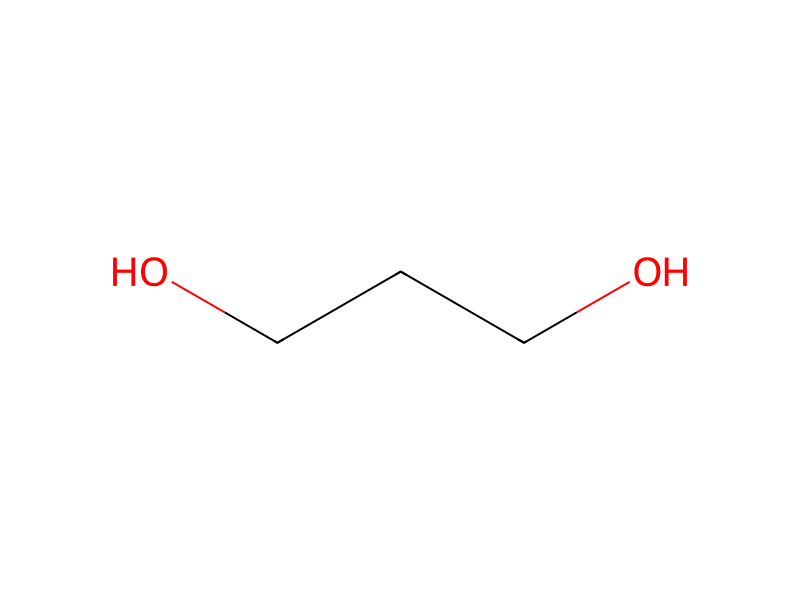
1,3-Propanediol → 2-(3-Bromopropyl)-1,3-dioxane
Reaction equation

[Br:1][CH2:2][CH2:3][CH2:4][CH:5]=[O:6].[CH2:7](O)[CH2:8][CH2:9][OH:10].O.C1(C)C=CC(S(O)(=O)=O)=CC=1>O1CCCC1.O.C(OCC)C>[Br:1][CH2:2][CH2:3][CH2:4][CH:5]1[O:10][CH2:9][CH2:8][CH2:7][O:6]1Participants
7





Procedure
To a solution of 4-bromobutanal (prepared as described in J. Org. Chem., 1979, 44, 3230-3238: 450 mg, 2.98 mmol) in tetrahydrofuran (10 mL) at room temperature was added 1,3-propane diol (1.0 mL, 13.7 mmol) and p-toluenesulfonic acid monohydrate (50 mg, 0.26 mmol). The mixture was heated at reflux for 2 hours, cooled and suspended in a mixture of water and diethyl ether (200 mL of 1:1). The two layers were separated and the organic layer was dried over magnesium sulfate, filtered, and then concentrated in vacuo to give the title compound as a clear oil.
Workup
- temperatureThe mixture was heated
- temperatureat reflux for 2 hours
- temperaturecooled
- customThe two layers were separated
- dry with materialthe organic layer was dried over magnesium sulfate
- filtrationfiltered
- concentrationconcentrated in vacuo
Sources & evidence
- ORD record
- ord-e76a2a4df3204d018586886af83cad7b
- Source dataset
- uspto-grants-2003_02
- Patent number
- US06518282B1
Reaction notes
Loading…