Chlorodiphenylmethane → HCID 18765145, compound
Reaction equation

[Cl:1][C:2]1[CH:11]=[CH:10][C:9]2[CH2:8][NH:7][CH2:6][CH2:5][C:4]=2[N:3]=1.C(N(CC)CC)C.[C:19]1([CH:25]([C:27]2[CH:32]=[CH:31][CH:30]=[CH:29][CH:28]=2)Cl)[CH:24]=[CH:23][CH:22]=[CH:21][CH:20]=1>C(Cl)Cl>[Cl:1][C:2]1[CH:11]=[CH:10][C:9]2[CH2:8][N:7]([CH:25]([C:19]3[CH:24]=[CH:23][CH:22]=[CH:21][CH:20]=3)[C:27]3[CH:32]=[CH:31][CH:30]=[CH:29][CH:28]=3)[CH2:6][CH2:5][C:4]=2[N:3]=1Participants
5
Reactant 3
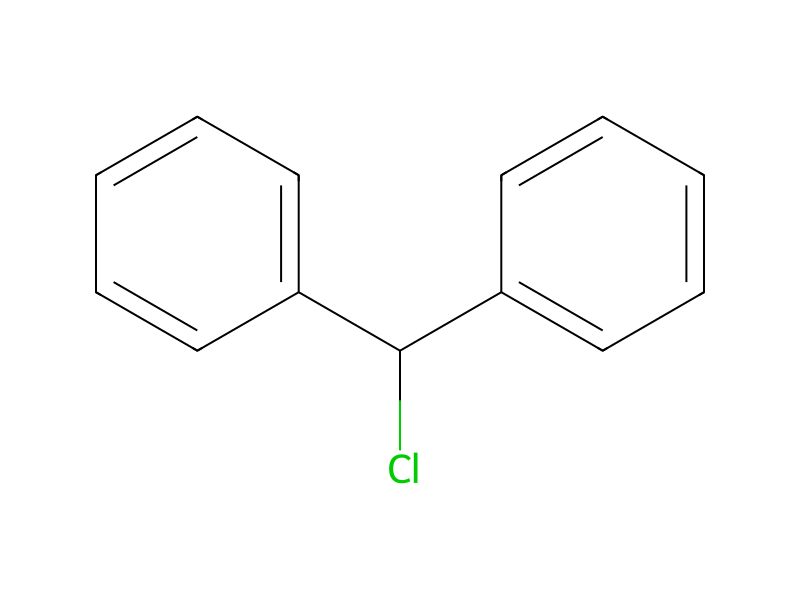


Product 1

Reagents, catalysts & solvents 1

Procedure
To a solution of the product of step (c) (1.78 g, 0.1 mol) and triethylamine (2.21 ml, 0.016 mol) in CH2Cl2 (20 ml) was added diphenylchloromethane (2.13 ml, 0.012 mol). The reaction mixture was stirred at room temperature for 20 h and evaporated under reduced pressure. The residue was dissolved in DMA (20 ml) and heated to 100° C. for 18 h and once cooled, the solution was diluted with CH2Cl2 and washed sequentially with saturated aqueous sodium bicarbonate solution, H2O and saturated brine then dried over MgSO4. Evaporation under reduced pressure afforded the subtitle compound as a solid (1.0 g, 30%), Rf 0.7 (CH2Cl2/MeOH/0.88NH3 90/10/1, v/v). MS m/z 335 (MH+).
Workup
- customevaporated under reduced pressure
- dissolutionThe residue was dissolved in DMA (20 ml)
- temperatureheated to 100° C. for 18 h
- temperatureonce cooled
- additionthe solution was diluted with CH2Cl2
- washwashed sequentially with saturated aqueous sodium bicarbonate solution, H2O and saturated brine
- dry with materialthen dried over MgSO4
- customEvaporation under reduced pressure
Sources & evidence
- ORD record
- ord-af9bfdd5ed764703b00d392742e1cdf2
- Source dataset
- uspto-grants-2003_02
- Patent number
- US06521629B2
Reaction notes
Loading…