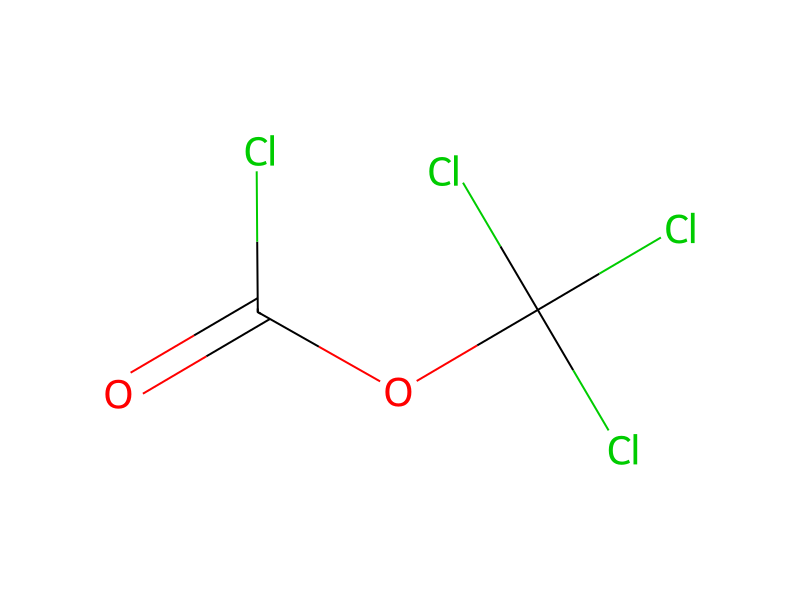
Diphosgene → HCID 22224774, compound
Reaction equation

O=C(Cl)[O:3][C:4](Cl)(Cl)Cl.[I:9][C:10]1[CH:16]=[CH:15][C:13]([NH2:14])=[C:12]([N+:17]([O-:19])=[O:18])[CH:11]=1>CCOC(C)=O>[I:9][C:10]1[CH:16]=[CH:15][C:13]([N:14]=[C:4]=[O:3])=[C:12]([N+:17]([O-:19])=[O:18])[CH:11]=1Participants
Reactant 2

Product 1

Reagents, catalysts & solvents 1

Procedure
To a solution of diphosgene (4.1 mL, 34.1 mmol) in EtOAc (40 mL) at 0° C. was added a solution of the 4-iodo-2-nitroaniline (45.5 mmol) in EtOAc (200-500 mL), and the mixture was heated to reflux for 18 h. The solvent was removed in vacuum to leave a brown solid, which was triturated with hot hexane (200 mL). The solid material was filtered off and the filtrate was concentrated under reduced pressure to leave the pure 4-iodo-2-nitrophenylisocyanate as a yellow solid. This material was refluxed in a mixture of excess tert.-BuOH in CH2Cl2 for 2.5 h. Removal of the solvent left an orange solid which was purified by silica gel column chromatography with hexane/EtOAc to give the (4-iodo-2-nitro-phenyl)-carbamic acid tert.-butyl ester as a yellow solid.
Workup
- temperaturethe mixture was heated
- temperatureto reflux for 18 h
- customThe solvent was removed in vacuum
- customto leave a brown solid, which
- customwas triturated with hot hexane (200 mL)
- filtrationThe solid material was filtered off
- concentrationthe filtrate was concentrated under reduced pressure
Sources & evidence
- ORD record
- ord-4d7c127ccd9c4325af493339232df9ca
- Source dataset
- uspto-grants-2005_11
- Patent number
- US06960578B2
Reaction notes
Loading…