Hydrogen Peroxide → Sodium percarbonate
Reaction equation

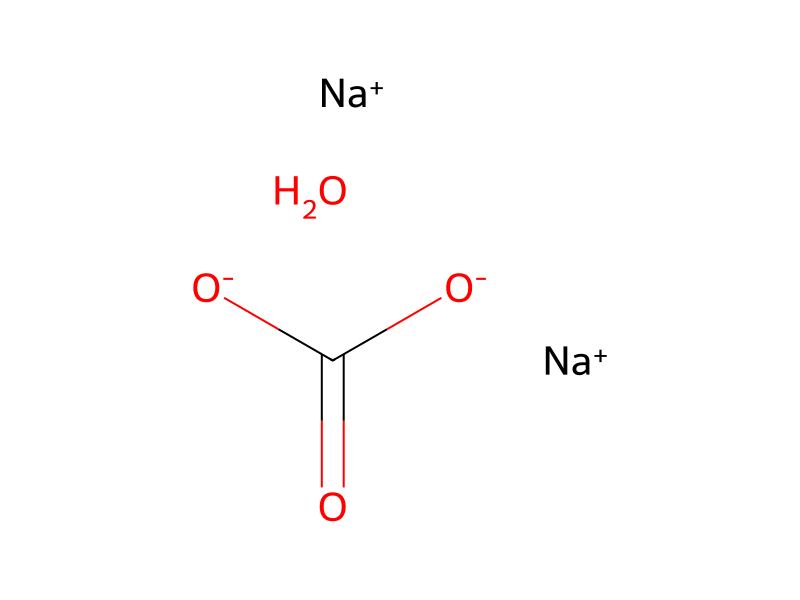
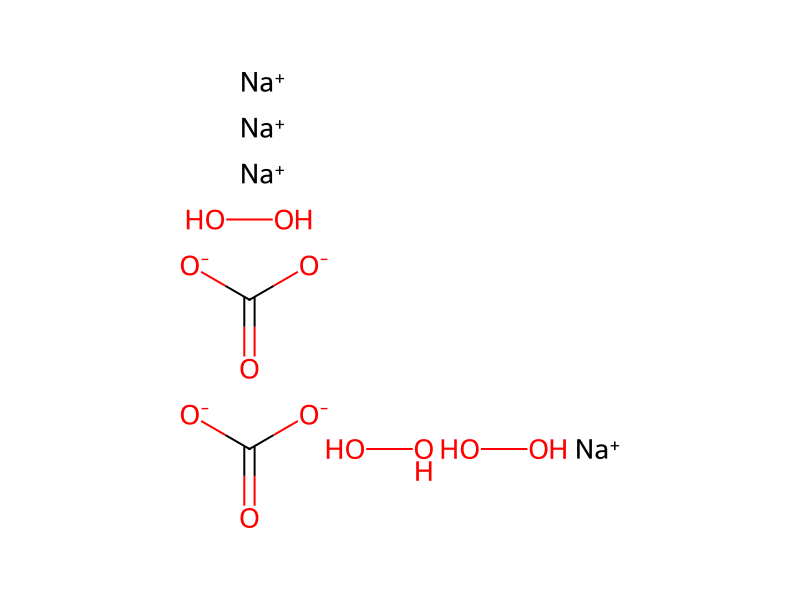
[OH2:1].[C:2](=[O:5])([O-:4])[O-:3].[Na+:6].[Na+].[OH:8]O>>[C:2]([O-:5])([O-:4])=[O:3].[C:2]([O-:5])([O-:4])=[O:3].[OH:1][OH:8].[OH:1][OH:8].[OH:1][OH:8].[Na+:6].[Na+:6].[Na+:6].[Na+:6]Participants

Procedure
The sodium carbonate monohydrate, prepared in Example 1, was subsequently reacted with hydrogen peroxide to form sodium percarbonate. For this purpose, in each case a weighed amount (about 2,000 g) of sodium carbonate monohydrate was filled into a mixer with kneader (Loedige mixer). Per mole of sodium carbonate monohydrate weighed out, 1.5 moles of aqueous hydrogen peroxide (60% by weight) were weighed out and stabilized by the addition of Turpinal SL (60% by weight) (amount: 5.75% by weight of TEL (100%) based on hydrogen peroxide (100%)). The hydrogen peroxide solution, so stabilized, was sprayed through a two-material nozzle into the Loedige mixer. The spraying time was about 13 minutes at an rpm of the mixer of approximately 120. To control the temperature during the reaction, the mixer was cooled by tap water flowing through the jacket. After the reaction, the product was removed from the mixer and dried at 80° C. in a circulating air drying oven. The drying was concluded as soon as the water content or the activated oxygen content in the end product reached the desired value (less than about 0.2%; water determined by the Sartorius method). After the sodium percarbonate product formed had cooled, its quality was checked by the usual analyses for PCS.
Sources & evidence
- ORD record
- ord-6dcabc8c891e4fedb39991bb947ee28e
- Source dataset
- uspto-grants-2001_06
- Patent number
- US06248707B1
Reaction notes
Loading…