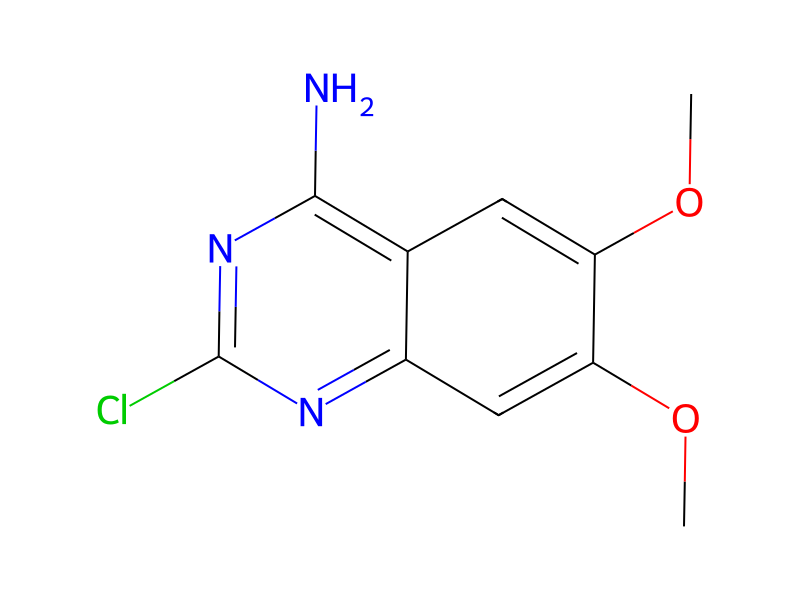
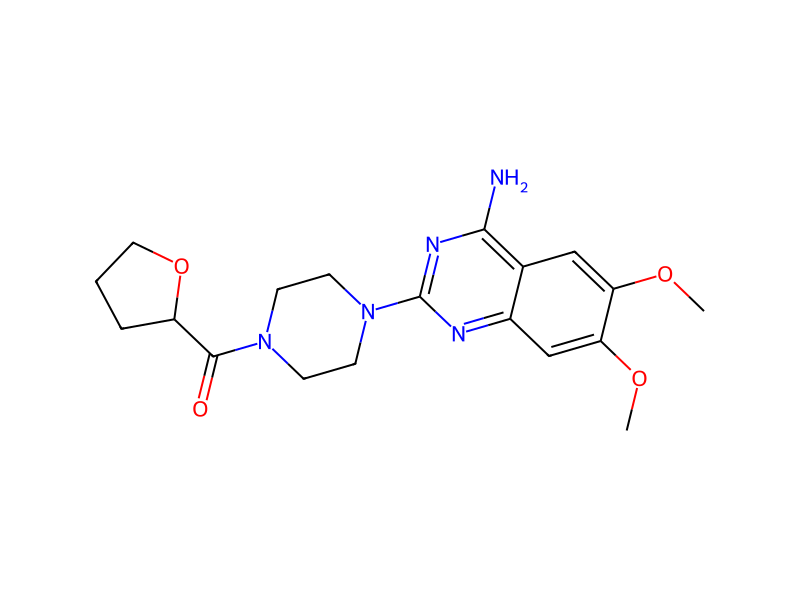
2-Chloro-6,7-dimethoxy-4-quinazolinamine → Terazosin
Reaction equation

Cl[C:2]1[N:11]=[C:10]([NH2:12])[C:9]2[C:4](=[CH:5][C:6]([O:15][CH3:16])=[C:7]([O:13][CH3:14])[CH:8]=2)[N:3]=1.[O:17]1[CH2:21][CH2:20][CH2:19][CH:18]1[C:22]([N:24]1[CH2:29][CH2:28][NH:27][CH2:26][CH2:25]1)=[O:23]>O>[CH3:14][O:13][C:7]1[CH:8]=[C:9]2[C:10]([NH2:12])=[N:11][C:2]([N:27]3[CH2:28][CH2:29][N:24]([C:22]([CH:18]4[O:17][CH2:21][CH2:20][CH2:19]4)=[O:23])[CH2:25][CH2:26]3)=[N:3][C:4]2=[CH:5][C:6]=1[O:15][CH3:16]Participants
Reactant 2

Product 1
Reagents, catalysts & solvents 1

Procedure
The process comprises adding 2-chloro-4-amino-6,7-dimethoxyquinazoline together with 1-(2-tetrahydrofuroyl)piperazine to a polar organic reaction solution comprising a polar organic solvent and water. The water is present in a minimum amount effective to obtain the desired product, Terazosin.HCl dihydrate. As can be seen from the exemplary embodiments, the minimum, effective amount of water can vary, depending on the polar organic solvent selected. In the Examples below, the percent volume of water which satisfactorily yielded the desired product ranged roughly from as little as 5% by volume to as much as 20% by volume and more. Other polar organic solvents may require a larger or smaller portion of water than the range demonstrated by the examples, but the determination thereof is well within the purview of one of ordinary skill in the art. The reaction mixture is then heated. Preferably, to ensure highest yields, the reaction mixture is maintained at reflux temperature for as much as 35-55 hours or until one or the other of the reactants is substantially consumed. The reaction mixture is thereafter allowed to cool, preferably to room temperature, and the crystalline Terazosin.HCl dihydrate is collected by filtration.
Sources & evidence
- ORD record
- ord-87e6716e2bfe4e9fba440bc370327535
- Source dataset
- uspto-grants-2001_06
- Patent number
- US06248888B1
Reaction notes
Loading…