1-Butanol → Terazosin
Reaction equation

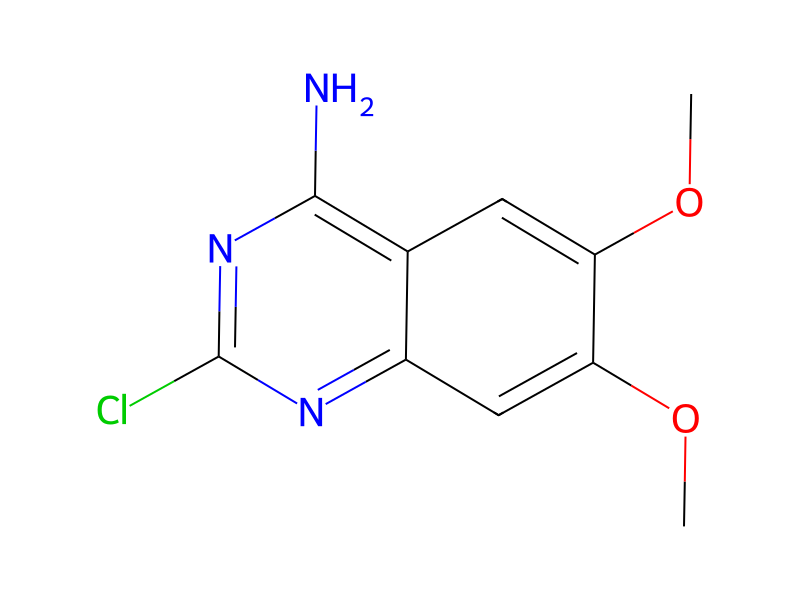
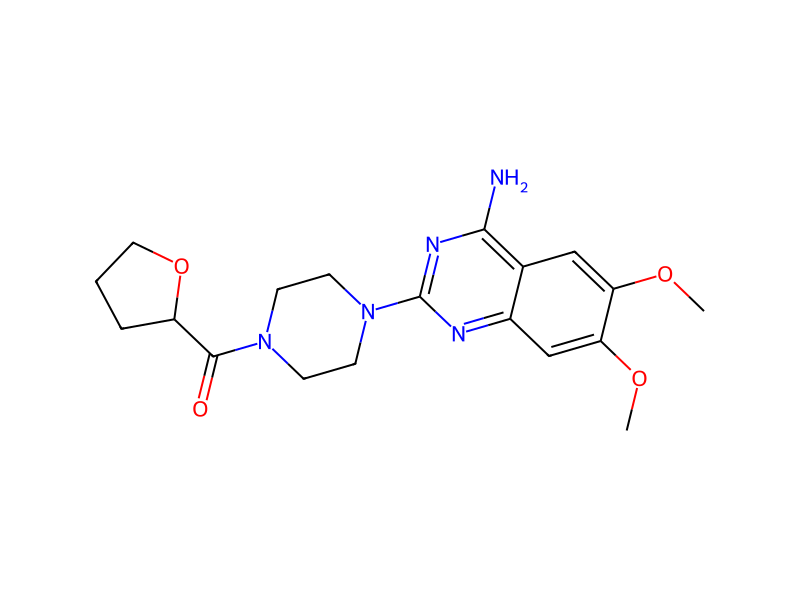
C(O)CCC.[O:6]1[CH2:10][CH2:9][CH2:8][CH:7]1[C:11]([N:13]1[CH2:18][CH2:17][NH:16][CH2:15][CH2:14]1)=[O:12].[NH2:19][C:20]1[C:29]2[C:24](=[CH:25][C:26]([O:32][CH3:33])=[C:27]([O:30][CH3:31])[CH:28]=2)[N:23]=[C:22](Cl)[N:21]=1>O>[CH3:31][O:30][C:27]1[CH:28]=[C:29]2[C:20]([NH2:19])=[N:21][C:22]([N:16]3[CH2:15][CH2:14][N:13]([C:11]([CH:7]4[O:6][CH2:10][CH2:9][CH2:8]4)=[O:12])[CH2:18][CH2:17]3)=[N:23][C:24]2=[CH:25][C:26]=1[O:32][CH3:33]Participants
Reactant 3


Product 1
Reagents, catalysts & solvents 1

Procedure
To a solution of n-butanol (316 ml), water (24 ml) and N-(2-tetrahydrofuroyl)piperazine (20 g) were added, while stirring, 4-amino-2-chloro-6,7-dimethoxyquinazoline (22.2 g). The reaction mixture was heated to reflux and the reflux was maintained for about 9 hours. Then the reaction mixture was cooled to room temperature and stirred at this temperature for about 10-12 hours. The crystals were collected by filtration, washed with n-BuOH and dried in vacuo at 40-50° C. to yield 40.1 g (94%) of Terazosin.HCl dihydrate. The product of this example was characterized by XRD and DSC melting point as shown in FIGS. 1 and 2 and in Table I as Trial H. This procedure was repeated in n-butanol using the water volumes indicated in Table I and yielding the results indicated for Trials G, I and J.
Workup
- temperatureThe reaction mixture was heated
- temperatureto reflux
- temperaturethe reflux was maintained for about 9 hours
- stirringstirred at this temperature for about 10-12 hours
- filtrationThe crystals were collected by filtration
- washwashed with n-BuOH
- customdried in vacuo at 40-50° C.
Sources & evidence
- ORD record
- ord-c3d76964717f42c3974e6bff5303eb40
- Source dataset
- uspto-grants-2001_06
- Patent number
- US06248888B1
Reaction notes
Loading…