Stannous Chloride → Ethyl 3-(3-aminophenyl)pyridine-4-carboxylate
Reaction equation
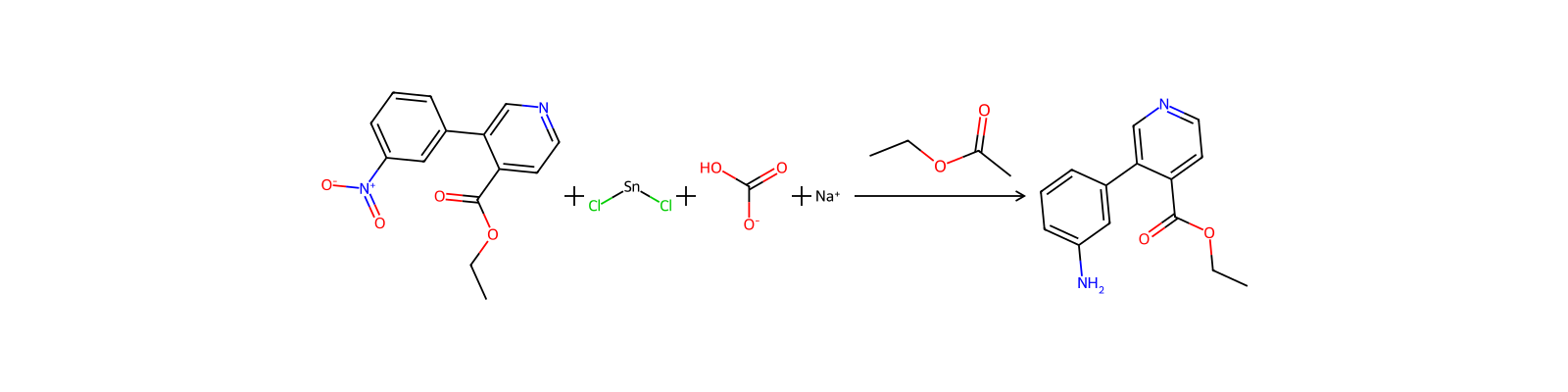
[CH2:1]([O:3][C:4]([C:6]1[C:11]([C:12]2[CH:17]=[CH:16][CH:15]=[C:14]([N+:18]([O-])=O)[CH:13]=2)=[CH:10][N:9]=[CH:8][CH:7]=1)=[O:5])[CH3:2].[Sn](Cl)Cl.C(=O)(O)[O-].[Na+]>C(OCC)(=O)C>[CH2:1]([O:3][C:4]([C:6]1[C:11]([C:12]2[CH:17]=[CH:16][CH:15]=[C:14]([NH2:18])[CH:13]=2)=[CH:10][N:9]=[CH:8][CH:7]=1)=[O:5])[CH3:2]Participants
5
Reactant 3



Product 1

Reagents, catalysts & solvents 1

Conditions
- Temperature
- 80 °C
Procedure
To a solution of 5-(3-nitrophenyl)-4-pyridinecarboxyiic acid ethyl ester in ethyl acetate (20 mL) was added tin(II) chloride (1.47 g). The mixture was heated at 80° C. for 45 min, then allowed to cool to ambient temperature. The mixture was poured into ice and saturated aqueous sodium bicarbonate was added until the mixture attained a pH of approximately 7. Celite and ethyl acetate were added, and the mixture was stirred for 10 min. The mixture was filtered and placed in a separatory funnel. The organic layer was separated, dried over sodium sulfate, filtered and concentrated to yield the crude product. Purification by silica gel chromatography (4:1 hexane: ethyl acetate) afforded the title compound as an orange oil (216 mg).
Workup
- temperatureto cool to ambient temperature
- additionwas added until the mixture
- filtrationThe mixture was filtered
- customplaced in a separatory funnel
- customThe organic layer was separated
- dry with materialdried over sodium sulfate
- filtrationfiltered
- concentrationconcentrated
- customto yield the crude product
- customPurification by silica gel chromatography (4:1 hexane: ethyl acetate)
Sources & evidence
- ORD record
- ord-541adca967804a9c982286614da418c5
- Source dataset
- uspto-grants-2001_06
- Patent number
- US06251925B1
Reaction notes
Loading…